Zero Darkness
One-Line Pitch
A security principle that flips the standard model: instead of building a system that's hard to break into, build one where every attack attempt immediately produces a visible, undeniable failure — and yields the attacker nothing.
The Idea
Most security is built on obscurity. Make the lock complicated enough that nobody can pick it. Hide the keys well enough that nobody can find them. Build walls thick enough that nobody can breach them.
The problem: obscurity requires perfect execution forever. One gap and everything behind it is silently compromised. The attacker works quietly. You find out later, if at all.
Zero Darkness is the opposite model.
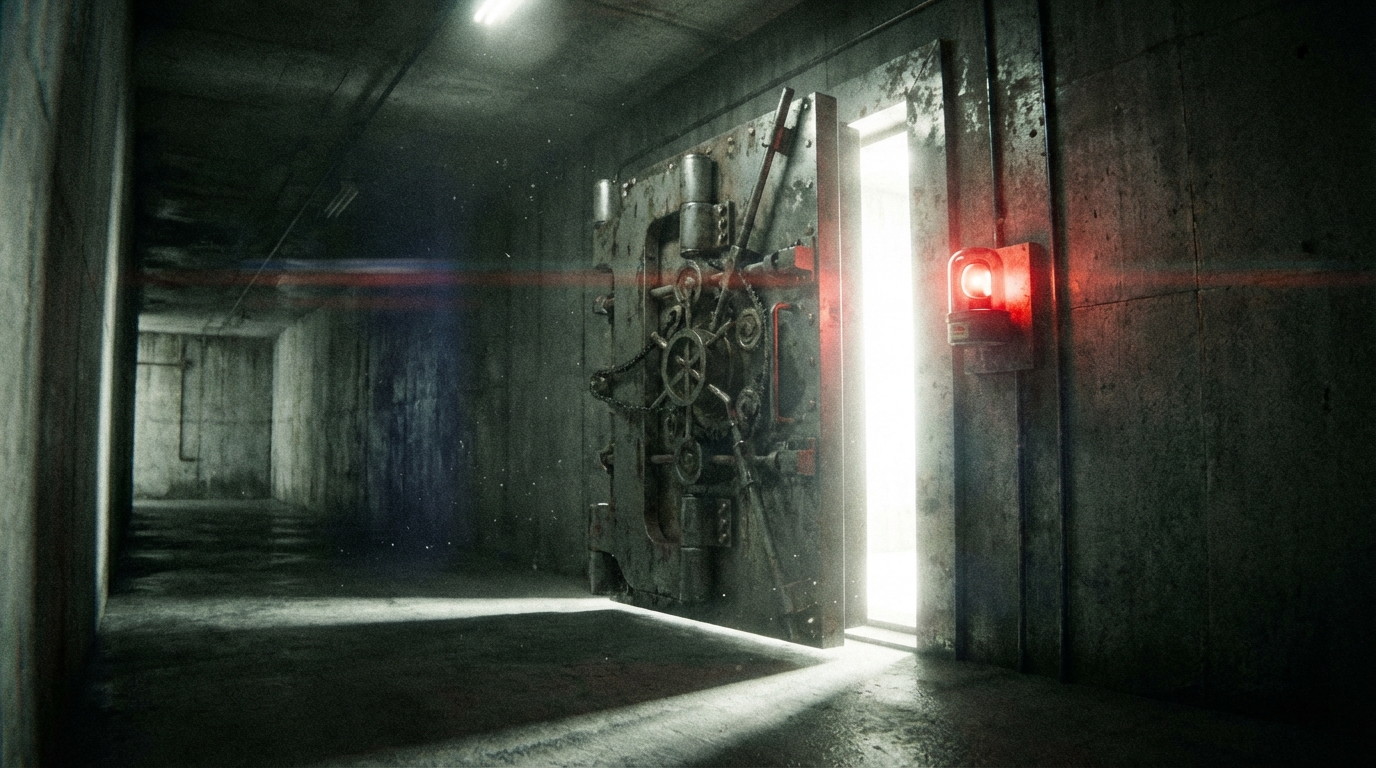
Don't build a lock that can't be picked. Build a lock that screams the moment someone tries.
"Kronos doesn't prevent attacks. It makes attacks impossible to hide. Every attempt leaves a mark, generates a panic, and fails before it yields anything useful. The security comes from transparency, not obscurity."
Security through radical visibility of failure.
Why It Works — The Geometry
Zero Darkness is grounded in something that can't be engineered away: time moves forward.
The Kronos chain is built on two axioms that are simply true about reality:
- Time moves forward. No attacker can reverse this without capabilities we're not defending against.
- You cannot reach a future moment before it arrives. The hash of this moment could not have been computed before this moment existed.
From these two facts, the chain is constructed:
T1 = nanoseconds immediately before a request is sent
T2 = nanoseconds immediately after the reply is received

Kronos_hash = SHA256(H_previous || T1_bytes || T2_bytes)
The window T1→T2 has never existed before in the history of the universe, for this request, in this chain. At nanosecond precision, even a 50ms window contains:
50,000,000 possible T1 values
× 50,000,000 possible T2 values
= 2.5 × 10¹⁵ combinations
That's the search space an attacker faces — per link. And each link chains to the previous one, so forging link k requires also forging every subsequent link while the real chain races ahead in real time.
The chain grows faster than any computer can search it. This is not probabilistic. It's structural.
The Hard Panic
Most distributed systems handle a broken connection with graceful degradation. Log the break, resume, hope to recover.
Kronos does something different: it hard panics on time manipulation.
Not because it can't recover. Because the panic is the product.
From three perspectives:
| Perspective | What happens |
|---|---|
| The server | Brief outage. Minor data loss. Resumes quickly. |
| The attacker | Zero signal. No feedback on how close they were. No ability to refine. Attack cost them effort, gave them nothing, left a visible trace. |
| The customer | The system worked exactly as promised. |
The attacker faces the worst possible outcome: they tried, they failed, and you know they tried. There's no quiet partial success. No "almost got it." The darkness doesn't happen.
Zero Darkness Extended
The original principle applies to time manipulation. But it extends naturally to anything that could silently degrade.
Original Zero Darkness: Don't tolerate time manipulation. Hard panic.
Extended Zero Darkness: Don't tolerate silent information staleness. Flag it.
A Kronos node rolling back its clock is an active attack. An atom last confirmed 8 hours ago being silently treated as live data is a passive failure. Both produce fictional continuity. Both should be visible, not silent.
The extension doesn't require new infrastructure — just applying the same principle everywhere:
- Know the age of everything
- Flag when age exceeds the live threshold
- Never silently upgrade stale data to live status
Where Zero Darkness Lives in the Kronos Stack
Zero Darkness is a property of the Kronos chain itself — not a product, not a service. Everything built on Kronos inherits it.
| Layer | How Zero Darkness manifests |
|---|---|
| Kronos temporal chain | Hard panic on time manipulation. Chain divergence is immediate and detectable. |
| Fleet nodes (GoW) | Node whose Kronos chain can't be verified panics AND broadcasts. Other nodes quarantine its data. |
| GeoProxy | Every web fetch produces a cryptographic receipt chained to all previous fetches. Receipt cannot be backdated. |
| Freddy | Field atoms are timestamped. Stale atoms are flagged, not silently used. |
| Fort Knox | Every transaction is a write-once ledger entry. No silent reversals. |
The principle propagates. Any Kronos service that handles time, state, or trust gets Zero Darkness for free by being on the chain.
The Consumer Pitch
People hear "Kronos is technically perfect" and look for a lock that can't be picked.
That's the wrong frame.
What we built is a lock that screams when someone tries. That's better. A lock that can't be picked requires perfect engineering forever. A lock that screams just needs to be connected.
The scream is the product.
What Exists Now
Zero Darkness is operational in the Kronos chain running across all Kronos services. It's not a separate module to install — it's the property the chain produces by design.
The clearest public expression of it today is GeoProxy→ — every web fetch returns a Kronos receipt that cannot be forged, backdated, or silently tampered with.
Next Step to Explore
Zero Darkness as a named, marketable property of everything Kronos builds.
Right now it's an architectural principle that engineers understand but customers don't know exists. The pitch — "a lock that screams" — is simple enough to say in one sentence and powerful enough to be a genuine differentiator.
The interesting question: which market most needs to hear that phrase? Legal evidence collection, financial audit trails, AI data provenance, compliance reporting — all of them benefit from knowing their data infrastructure is Zero Darkness native.