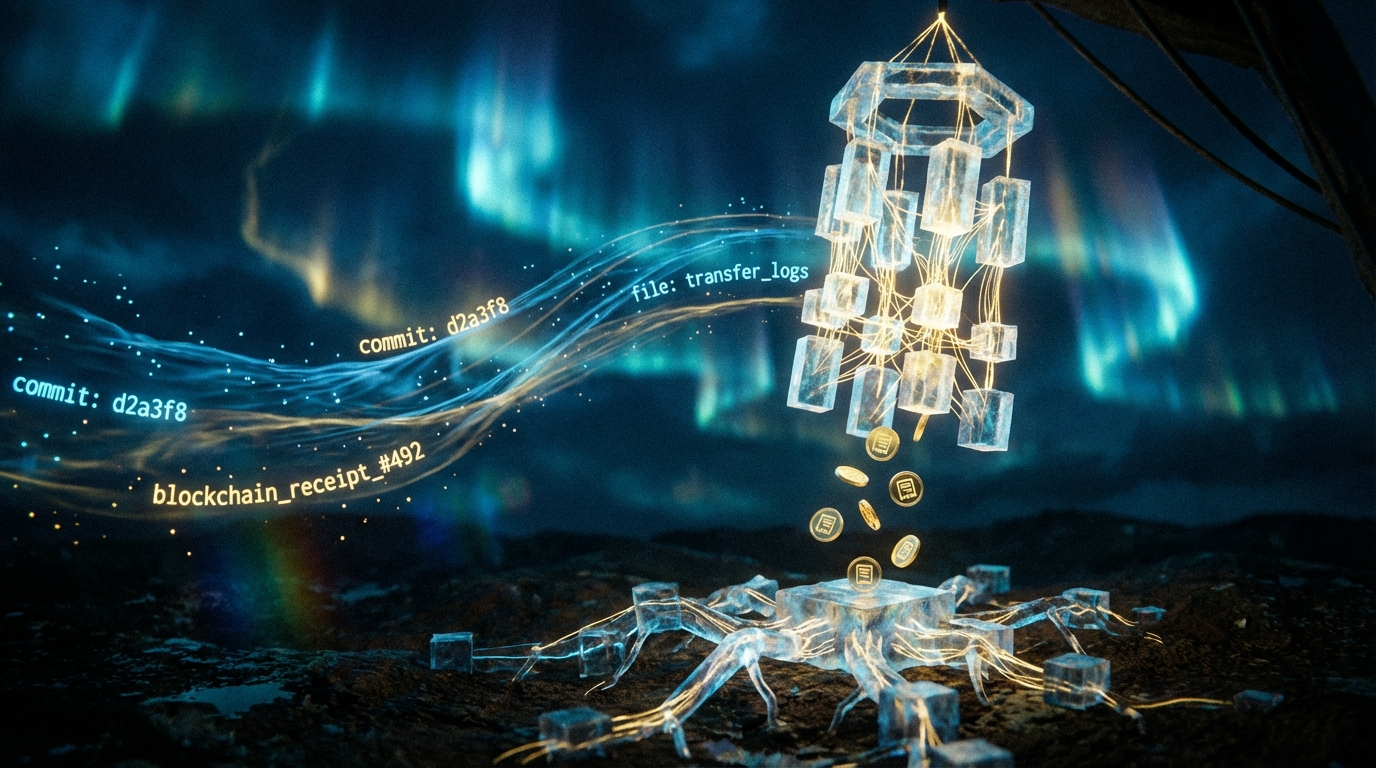
The Windchime — Backup as Mining, Receipts as Blockchain
One-Line Pitch
Every time data moves to safety, it rings a chime — and the sound is money.
The Spark
A question that shouldn't be profound, but is:
If you have the wind chime, do you have the wind?
We were building backup infrastructure. Git repos. Kronos receipts. Fort Knox ledgers. Proof-of-existence timestamps. And somewhere in the wiring, the obvious thing appeared: we're already doing everything a blockchain does, we're just not calling it that. Every commit, every backup, every file transfer generates a cryptographic receipt. Those receipts are timestamped, hashed, and ordered. They form a chain. We didn't design a blockchain — we designed a sensible backup system, and a blockchain fell out of it like spare change.
The wind chime doesn't create the wind. But if you hang it in the right place, the wind creates music every time it blows. The question is: can you sell the music?
The Core Insight: Moving Data IS Mining
In traditional blockchain, "mining" is artificial work — solve a hash puzzle, burn electricity, produce a block. The work is invented. The energy is wasted. The value is conjured from scarcity.
In the Windchime model, the work is real. You were going to back up your code anyway. You were going to push to remote. You were going to sync files across nodes. Every one of those operations already generates a cryptographic artifact:
| Normal Operation | Cryptographic Artifact | Windchime Equivalent |
|---|---|---|
git push |
Commit hash (SHA-1/SHA-256) | Block hash |
| Backup to KendoSoil node | Proof-of-existence receipt (NTP-backed SHA-256) | Timestamp anchor |
| Fort Knox transaction | Idempotent ledger entry | Transaction record |
| File sync across fleet nodes | Transfer receipt with source/destination/hash | Cross-chain bridge |
| Kronos Town shard promotion | Lane progression record (Live → Solid1 → ...) | Block confirmation |
You're already mining. You just haven't been collecting the coins.
How It Works
The Receipt Chain
Every data movement in the Kronos ecosystem already passes through Proof-as-a-Service, which generates a temporally-anchored cryptographic proof:
┌─────────────────────────────────────────────────────────────┐
│                    THE WINDCHIME CYCLE                       │
│                                                             │
│   DATA MOVES              CHIME RINGS           VALUE FALLS │
│   ──────────              ──────────            ────────────│
│                                                             │
│   git push ──────────►  Kronos() proof  ──────►  Receipt   │
│   file backup ───────►  NTP timestamp   ──────►  Receipt   │
│   shard promotion ───►  KHash boundary  ──────►  Receipt   │
│   Fort Knox debit ───►  Ledger entry    ──────►  Receipt   │
│   fleet sync ────────►  Transfer proof  ──────►  Receipt   │
│                                                             │
│   Receipts accumulate.                                      │
│   Receipts link to previous receipts (parent hash).         │
│   Receipts form a chain.                                    │
│   The chain IS the blockchain.                              │
│   No extra work was done.                                   │
│                                                             │
└─────────────────────────────────────────────────────────────┘
The Proof Anatomy
Each "chime" (receipt) contains:
{
  "chime_id": "a7b3f2c1-e4d5...",
  "parent_chime": "previous chime hash",
  "kronos_proof": "hash1-hash2 (NTP-backed temporal proof)",
  "khash_state": {
    "instant": "unique entropy",
    "second": "boundary hash",
    "minute": "boundary hash",
    "hour": "boundary hash",
    "day": "boundary hash"
  },
  "operation": {
    "type": "git_push | backup | transfer | debit | promotion",
    "source": "where data came from",
    "destination": "where data went",
    "payload_hash": "SHA-256 of the data that moved",
    "size_bytes": 48291
  },
  "temporal_evidence": {
    "ntp_drift_ns": 1240,
    "clock_stable": true,
    "time_advanced": true
  }
}
Every chime points to its parent. The parent chain extends back to the first operation. The chain has no gaps because time has no gaps.
The Three Properties That Make This Work
1. Time Is the Consensus Mechanism
Traditional blockchains need consensus — proof of work, proof of stake, Byzantine fault tolerance. The Windchime doesn't, because NTP time is the universal clock. Proof-as-a-Service already validates that:
- Time advanced monotonically (two independent measurements)
- NTP and local clocks agree (drift tolerance ±1ms)
- No clock tampering occurred (temporal evidence audit)
Two nodes comparing their chimes will always agree on ordering because they share the same time source. No voting. No mining difficulty. No wasted computation.
2. Real Work Is the Proof of Work
Every block in the Windchime chain corresponds to real data that actually moved. Not a hash puzzle. Not a stake deposit. A git commit. A file backup. A financial transaction. The proof of work is the work itself.
This means:
- No energy waste — the electricity was spent doing useful operations
- No artificial scarcity — the chain grows proportional to real activity
- No empty blocks — every chime represents genuine data movement
- Natural rate limiting — you can't mine faster than you can do real work
3. The Chain Is Self-Archiving
Kronos Town's lane system already moves data from Live → Solid1 → Solid2 → ... → Solid5. Each promotion is a chime. The longer a receipt survives without contradiction, the more "confirmed" it becomes — not through additional proof of work, but through the passage of time with no disputes.
Live     (just created)      = 0 confirmations
Solid1   (survived 1 hour)   = 1 confirmation
Solid2   (survived 1 day)    = ~24 confirmations
Solid3   (survived 1 month)  = ~720 confirmations
Solid4   (survived 1 year)   = ~8,760 confirmations
Solid5   (permanent archive) = ∞ confirmations
Time is doing the confirming. Nobody asked it to. It just does.
The Economics: Where Value Lives
The Value Stack
| Layer | What Creates It | Where It's Stored | Who Cares |
|---|---|---|---|
| Proof of Existence | Any data movement → Kronos() receipt | KendoSoil nodes | Anyone who needs to prove something existed at a point in time |
| Proof of Integrity | Chain continuity → parent hash linkage | The chain itself | Auditors, regulators, insurers |
| Proof of Custody | Transfer receipts → source/destination log | Fort Knox ledger | Legal, compliance, ownership disputes |
| Proof of Duration | Lane progression (Solid1 → Solid2 → ...) | Kronos Town archive | Long-term storage, digital estates |
| Proof of Pattern | SplashWatch correlation → cyclical signals | ML-brain analysis | Traders, researchers, prediction markets |
Each layer is independently valuable. Combined, they form a multi-dimensional proof system that traditional blockchains can't match because traditional blockchains only prove one thing: consensus on ordering.
The SplashWatch Connection
SplashWatch already detects cyclical patterns in market data. But what if the Windchime chain itself becomes a signal?
Lane A (Windchime Activity)         Lane B (Tradeable)
─────────────────────────────────────────────────────
Backup frequency increases    →     Ecosystem growth signal
Receipt chain density rises   →     Infrastructure value increases
Cross-node transfers spike    →     Fleet expansion indicator
Lane promotions accelerate    →     Archive confidence signal
SplashWatch becomes the crypto analyst for a blockchain that already exists. It doesn't create the value — it reads the value that the Windchime is already producing.
The Fort Knox Connection
Fort Knox already handles money. With the Windchime:
- PGLB credits can be earned by contributing backup capacity (your KendoSoil node stores proofs for others → you earn credits)
- Receipt verification becomes a paid service (prove this document existed on this date → Fort Knox debit)
- Chain anchoring becomes a premium tier (anchor your external data into the Windchime chain → Fort Knox subscription)
Fort Knox doesn't become a crypto exchange. It becomes the treasury for a proof economy — which is what it was always going to be.
Why This Is Different From Every Other Blockchain
| Feature | Traditional Blockchain | The Windchime |
|---|---|---|
| Consensus | Proof of Work / Proof of Stake | Proof of Time (NTP-backed) |
| Mining | Artificial hash puzzles | Real operations (backup, commit, sync) |
| Energy | Massive waste | Zero additional — uses work already done |
| Empty blocks | Common (mined for reward alone) | Impossible (every block = real data movement) |
| Block time | Fixed interval (10min Bitcoin, ~12s Ethereum) | Organic (whenever data moves) |
| Confirmation | Additional blocks mined on top | Time passing without dispute |
| Value source | Scarcity + speculation | Utility (proof that things exist and moved) |
| Scaling | Harder as chain grows | Easier (more backup = more nodes = more capacity) |
| Environmental | Destructive | Generative (backup = preservation = value) |
The Wind Chime Analogy — Fully Unwound
The wind is data in motion. It blows whether or not you capture it. Git commits happen. Files sync. Backups run. The wind blows.
The chime is the receipt infrastructure. Proof-as-a-Service, KHash boundaries, Fort Knox ledger entries. Hang them in the path of the wind and they ring automatically.
The music is the chain. Each ring links to the last. The pattern of rings over time forms a melody — a cryptographically verifiable history of everything that moved, when, where, and how.
The listener is anyone who needs proof. An auditor checking a transaction. A court verifying a document existed before a certain date. An insurer confirming a backup was made. A trader reading activity signals.
And the revenue? The revenue is that people will pay to listen to the music — because the music is proof, and proof has value in a world full of disputes.
Wind blows          →  Data moves         →  Free, inevitable
Chime rings         →  Receipt generated  →  Free, automatic
Music plays         →  Chain extends      →  Free, deterministic
Listener pays       →  Proof consumed     →  Revenue, organic
The cost of hanging the chime is the cost of the backup infrastructure. The revenue is the proof economy it enables. The margin is everything in between.
What Exists Right Now
This isn't theoretical. The pieces are live:
| Component | Status | What It Does for the Windchime |
|---|---|---|
| Proof-as-a-Service | ✅ Live (proof.krisadamstv.com) |
NTP-backed temporal proofs — the receipt engine |
| KHash | ✅ Live (KronosTown clock) | Multi-scale time-state fingerprinting — boundary detection |
| Fort Knox | ✅ Live (fortknox.krisadamstv.com) |
Immutable transaction ledger — the treasury |
| Kronos Town | ✅ Live (16 agents running) | Lane progression — the confirmation mechanism |
| KendoSoil | 🔶 Infrastructure exists | Distributed proof anchoring — the node network |
| SplashWatch | ✅ Live (correlation engine) | Pattern detection — the chain analyst |
| Librarian Agent | ✅ Live (as of today) | Git scanning + cataloguing — first backup sentinel |
| Windchime Protocol | 🔲 Not yet built | The glue: receipt chaining + parent hashing + value accounting |
The Librarian agent — built today — is the first agent that explicitly watches data movement across repos. It's already generating catalogues of what's changed, what's dirty, what's at risk. It's the first node that listens for the wind.
The Build Path
Phase 1: Receipt Chaining (The Protocol)
Wire every existing receipt system to include a parent_chime hash. When Proof-as-a-Service generates a proof, it includes the hash of the last proof. When Fort Knox logs a transaction, it includes the hash of the last transaction. When the Librarian catalogues a repo, it includes the hash of the last catalogue. The chain forms.
Phase 2: The Windchime Ledger
A new service — or an extension of Fort Knox — that maintains the master chain. It doesn't store the data. It stores the receipts of data movement. It's the index of rings. Lightweight, append-only, hash-linked.
Phase 3: KendoSoil Anchoring
Distribute the chain across KendoSoil nodes. Each node stores a segment. Verification requires checking any KendoSoil node — they all hold proof of the segment they anchor. This is where "backup as mining" becomes literal: running a KendoSoil node = storing proof segments = contributing to the chain = earning value.
Phase 4: The Proof Economy
Fort Knox begins pricing proof queries:
- "Did this file exist before March 2026?" — lookup fee
- "Prove this transaction happened on this date" — verification fee
- "Anchor my external data into the Windchime chain" — subscription
- "Run a KendoSoil node and earn PGLB credits" — mining reward
The revenue model isn't speculation. It's utility. People pay because proof is useful, not because a token is scarce.
Phase 5: SplashWatch Integration
SplashWatch reads the Windchime chain as a signal source. Chain activity patterns correlate with ecosystem health, growth signals, and capacity utilisation. This becomes a meta-layer: the chain about the chain. The wind reading its own music.
Connections
- Fort Knox→ — Treasury and ledger, becomes the Windchime value store
- SplashWatch→ — Pattern detection, reads the chain as signal
- Kendo Cards→ — Physical proof artifacts, each card a crystallized chime
- GeoProxy→ — Geographic proof layer, adds location to receipt chain
- The Stochastic Gate→ — Probability fields where chain density creates certainty gradients
- Fog of War→ — The wet ink principle: data's value changes as it crystallizes through lanes
- The Phosphor Gate→ — Persistence of signal, receipts as afterglow of data movement
The Deepest Part
What Kris is reaching for, and what makes this different from every blockchain whitepaper ever written:
Most blockchains start with a solution (distributed ledger) and go looking for a problem (what should we put on it?).
The Windchime starts with a problem everyone already has (backup, proof, custody) and discovers that the solution was already forming in the infrastructure. The chain wasn't designed. It emerged. The receipts were already linking. The time boundaries were already advancing. The proofs were already generating.
All that's missing is the recognition that it's a chain — and the plumbing to let people query it.
That's the wind chime. You don't create the wind. You don't create the sound. You create the conditions for value to precipitate from activity that was already happening. And the more you back up, the more you sync, the more you move data to safety — the louder the music gets.
You are. It's this. The infrastructure you already built is a blockchain that doesn't know it's a blockchain yet. All you have to do is tell it.