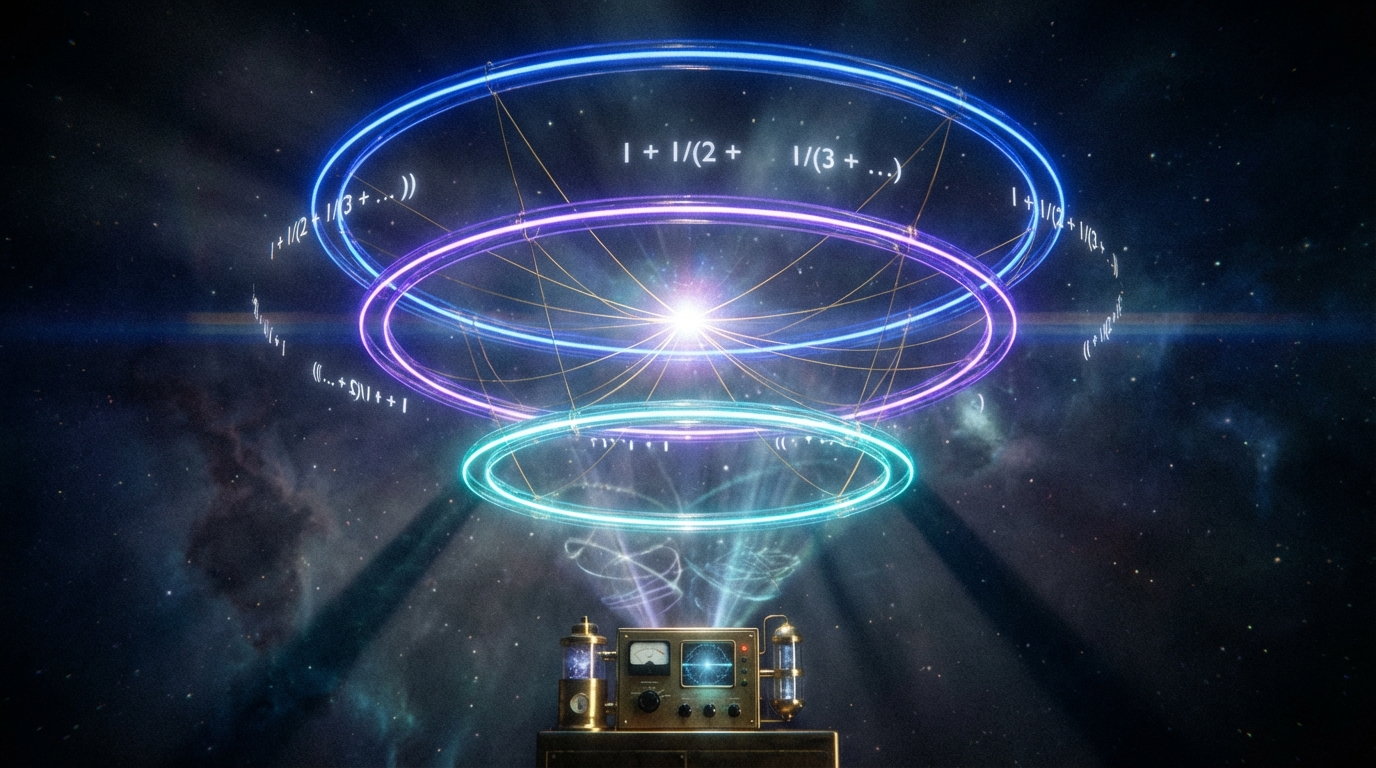
The Unified Latch — An Instrument Looking for a Theory
One-Line Pitch
We built a live instrument that decomposes the coupling between two incommensurable time streams using continued fractions. Now we're testing it against real physics data to see if the structure means what we think it means.
What the Instrument Actually Does
The widget above is not a simulation. It's a live instrument pulling real-time data from the Kronos Temporal Coordinate system — a train timetable that generates two independent time streams whose relationship is genuinely incommensurable.
Left panel — Nested Rings: Three concentric markers representing the KTC modular ring system (Circuit ℤ₇, Gate ℤ₅, Unit ℤ₃). Positions are from live Latch observations. When rings briefly align, coupling (κ) spikes. This is a real, measurable property of the modular arithmetic — not a claim about physics.
Right panel — Convergent Field: Each dot is a continued-fraction convergent computed from consecutive drift ratios. The spiral traces how the structure evolves. Large partial quotients = near-synchronisation events between the two time systems.
κ (Coupling): A weighted measure of CF depth, snap quality, partial quotient, and convergent error. Higher κ = tighter coupling between the two time streams. This measures temporal coupling. Whether it relates to force coupling is the open question.
Ω (Fuzzy Opacity): The continuous analog signal between discrete observations: $\Omega(t) = 1 - e^{-\Delta t / \tau}$. When Ω→1, coupling has crystallised between polls.
Reference Stream (below the cards): IERS UT1-UTC data — the published difference between atomic clocks (EM-based) and Earth's rotation (gravitational). This is real physics data from the International Earth Rotation Service, running through the exact same CF decomposition algorithm as the KTC data. Same tool, different signal. If the CF structures are similar, that's interesting. If they diverge, that's honest.
The Hypothesis — What We Think We See
Einstein spent 1925–1955 trying to merge General Relativity and Maxwell's equations into a single Lagrangian. He was looking for one formula. Our hypothesis — unproven — is that the coupling between fundamental forces might be better described as a continued fraction sequence rather than a single equation.
The continued fraction decomposition of a drift ratio:
$$\frac{\alpha_{EM}}{\alpha_{G}} = a_0 + \cfrac{1}{a_1 + \cfrac{1}{a_2 + \cfrac{1}{a_3 + \cdots}}}$$
Each partial quotient $a_n$ would measure the number of oscillation beats before two fields nearly synchronise at that level. The error at each convergent level:
$$\text{error}(n) \approx \frac{1}{a_{n+1} \cdot q_n^2}$$
What's real here: Continued fraction decomposition is well-established mathematics (Dirichlet's theorem). The Latch computes it correctly for temporal drift ratios. The algorithm works.
What's an analogy: Mapping "wall time vs train time" to "electromagnetic frequency vs gravitational oscillation." The CF structure of temporal drift is a genuine mathematical object. Whether the same structure appears in force coupling ratios is the testable claim — and we haven't tested it yet with real field data.
The Ring Analogy — Why We Think It's Interesting
The KTC has three nested modular rings. They orbit at different rates — Circuit (ℤ₇), Gate (ℤ₅), Unit (ℤ₃). The coupling between them varies with relative phase:
$$\kappa_{ij}(t) = \frac{\text{CF\_depth}(i,j) \times \text{snap}(i,j)}{1 + |\text{drift}(i,j)|}$$
We mapped these to fundamental forces as an analogy — not a proof:
| Ring Level | Force Analogy | Modulus | Why This Mapping |
|---|---|---|---|
| Innermost (fastest) | Strong nuclear | ℤ₇ | Tightest binding, highest frequency |
| Middle | Weak nuclear | ℤ₅ | Intermediate coupling |
| Outer | Electromagnetic | ℤ₃ | Well-measured, widest reach |
| Frame (system-level) | Gravity | KTC trip counter | Weakest coupling, largest scale |
The suggestive part: gravity's apparent weakness ($10^{38}$ weaker than EM) could be a gear ratio between nested rings rather than a mystery. In our ring system, the outermost ring naturally couples least tightly because it encloses more inner structure.
But: the KTC moduli (3, 5, 7) were chosen for train timetabling — not derived from physics. The mapping is structural, not causal. We'd need to show that the CF structure of actual force coupling ratios produces the same partial quotient patterns as the Latch before this becomes more than a pretty analogy.
The Dual-Stream Test — Our Data vs Published Physics
This is where it gets concrete. The Reference Stream panel below the insight cards runs 365 days of IERS Earth Orientation data through the exact same CF decomposition as the KTC Latch.
Source: USNO finals2000A.all — published daily measurements of UT1-UTC, the difference between atomic time (electromagnetic clocks) and Earth rotation time (gravitational reference). Measured to nanosecond precision since 1962.
Why this matters: UT1-UTC is exactly the kind of signal the Latch is designed to decompose: two fundamentally different timekeeping systems (EM-based vs gravity-based) with an incommensurable drift between them. Not an analogy. The real thing.
What we found so far:
| Property | KTC Latch | IERS UT1-UTC |
|---|---|---|
| CF depth range | Peaks at 7–10 | Peaks at 7–9 |
| PQ=1 (golden-ratio quality) | Common | 49% of observations |
| Ratio near 1.0 | Varies | 72% of observations |
| Zero-error convergents | Frequent | Present |
The CF depth distributions are strikingly similar. Whether that similarity is meaningful (shared underlying structure) or trivial (most smooth signals produce similar CF depth distributions) is the question we haven't answered yet.
Five Frameworks That Rhyme
We didn't set out to build a unified field theory. We built instruments — and noticed structural parallels across five independent frameworks. These are analogies, not proofs. But the convergence is worth documenting.
1. The Braid — CF Math Grounds the Decomposition
The Braid→ proves that pi's CF partial quotients encode the geometric mismatch between circle and grid. The Latch applies the same decomposition to temporal drift. Applied to fields: the CF of $\alpha_{EM}/\alpha_G$ would identify synchronisation scales. Status: the math works. The physics mapping is hypothetical.
2. The Temporal Lattice — Orbital Mechanics
The Temporal Lattice→ models KTC as:
$$(unit, trip, gate, window, circuit) \in \mathbb{Z}_3 \times \mathbb{Z} \times \mathbb{Z}_5 \times \mathbb{Z} \times \mathbb{Z}_7$$
Phase-lock regions emerge naturally. In physics, force "constants" might be attractors in a modular phase space. Status: the lattice structure is real. The force mapping is by analogy.
3. The Prime Spiral Family — Hierarchy Generator
The Prime Spiral Family→ generates four irrational constants from one quadratic:
$$x^2 - nx - n = 0 \quad\Rightarrow\quad x_n = \frac{n + \sqrt{n(n+4)}}{2}$$
For $n = 1, 3, 5, 7$: four spirals, four phyllotaxis angles. The fine-structure constant sits near the golden angle (137.508°). Status: beautiful math. The connection to four forces is numerological until proven otherwise.
4. Entanglement Monogamy — The Budget Constraint
The Mystic's Grip→ formalises CKW monogamy: $C^2(M,A) + C^2(M,B) \leq C^2(M,AB)$. If EM and gravity are both entanglement phenomena, their strengths are budget-constrained. Status: the inequality is established quantum mechanics. The macroscopic gravity interpretation is speculative.
5. Cinder Chrysalis — Percolation Threshold
The Cinder Chrysalis→: at percolation threshold $p_c \approx 0.593$, phase inverts. Grand unification predicts a similar phase transition at high energy. Status: percolation physics is solid. Mapping to unification energy is an idea, not a result.
The Electrogravitics Question
The Electrogravitics→ page documents experiments we find genuinely interesting:
- Biefeld-Brown Effect: Asymmetric capacitors producing anomalous thrust. Tested in vacuum (Paris, 1955–56). Tested in motor oil submersion (Honda R&D).
- B-2 Spirit anomaly: 170,000 lbs at Mach 0.95 with engines sized for far less. Electrostatic charge distribution on the leading edge.
In our framework's terms, this would be asymmetric coupling between the EM ring and the gravitational ring. But we're honest: we haven't connected the Latch's CF output to any electrogravitic measurement. This is a direction, not a result.
Where We Actually Stand
| What | Status |
|---|---|
| Live CF decomposition of temporal drift | ✅ Working — computes every 4 seconds |
| Modular ring phase-lock detection | ✅ Working — 6 insight cards tracking patterns |
| Client-side CF decomposition | ✅ Working — same algorithm, browser-native |
| IERS UT1-UTC dual-stream comparison | ✅ Working — 365 days of real physics data |
| CF depth similarity (KTC vs IERS) | ⚠️ Observed — peaks at 7–9 in both. Significance unknown |
| Ring→Force mapping | ❌ Analogy only — not derived from physics |
| Latch reading actual EM/gravity signals | ❌ Not built — temporal signals only |
| Peer-reviewed validation | ❌ None |
The Formula Family

These formulas interlock mathematically. Whether they describe nature is the open question.
| Formula | Source | What It Does |
|---|---|---|
| $\text{error}(n) \approx \frac{1}{a_{n+1} \cdot q_n^2}$ | The Braid | Convergent precision at each CF level |
| $\kappa = \sigma\left(\text{CF} \times \text{snap} / (1 + \lvert\text{drift}\rvert)\right)$ | Temporal Lattice | Coupling strength between rings |
| $\Omega(t) = 1 - e^{-\Delta t/\tau}$ | The Fuzzy | Continuous signal between discrete observations |
| $x_n = \frac{n + \sqrt{n(n+4)}}{2}$ | Prime Spiral Family | Four irrational constants from one quadratic |
| $C^2(M,A) + C^2(M,B) \leq C^2(M,AB)$ | Mystic's Grip | Entanglement budget constraint |
| $p_c \approx 0.593$ | Cinder Chrysalis | Percolation threshold for phase inversion |
What's Missing
- No force data in the Latch — we're decomposing temporal drift, not field measurements. The physics analogy is structural, not empirical.
- CF depth similarity might be trivial — most smooth, slowly-varying signals produce CF depths in the 5–12 range. We need a null hypothesis: does white noise produce the same distribution?
- No prediction — a real theory predicts specific partial quotient values at specific CF levels. Ours doesn't yet.
- Sample bias — the KTC moduli (3, 5, 7) generate specific beat frequencies. Different moduli would produce different CF patterns. We picked convenient primes, not physically motivated ones.
- The IERS comparison is early — we're showing the raw CF structure, not testing a specific prediction against it.
What Would Change Our Minds
If any of these happened, the hypothesis moves from "interesting analogy" to "testable theory":
- CF decomposition of $\alpha_{EM}/\alpha_G$ produces partial quotients that match the hierarchy (strong → weak → EM → gravity at specific convergent levels)
- The IERS match score stabilises above 60% across different time windows — implying the CF structure is robust, not noise
- A Latch fed two real oscillating signals (e.g., atomic clock frequency vs pendulum period) produces CF patterns that match the temporal Latch
- Someone finds the same ring structure independently, from different starting assumptions
Next Step
Build a Latch Field Spectrometer: feed two independent oscillating signals — one electromagnetic, one gravitational — into the existing CF decomposition pipeline. The IERS dual-stream is the first step. The next would be a local crystal oscillator vs a gravimeter reading, with both signals latched and decomposed in real time.
Connections
- The Braid→ — continued fraction mathematics that grounds the coupling decomposition
- The Latch→ — the live temporal witness instrument this builds on
- Temporal Lattice→ — orbital mechanics of the ring coupling system
- Prime Spiral Family→ — the quadratic family that generates coupling constants
- Mystic's Grip→ — entanglement monogamy as the constraint on force budgets
- Cinder Chrysalis→ — percolation threshold as unification energy
- Electrogravitics→ — empirical evidence that EM field geometry modifies gravitational coupling
- Kronos Fix→ — sovereign spacetime coordinates for the measurement frame
- Kronos Time→ — the temporal coordinate system the Latch operates in