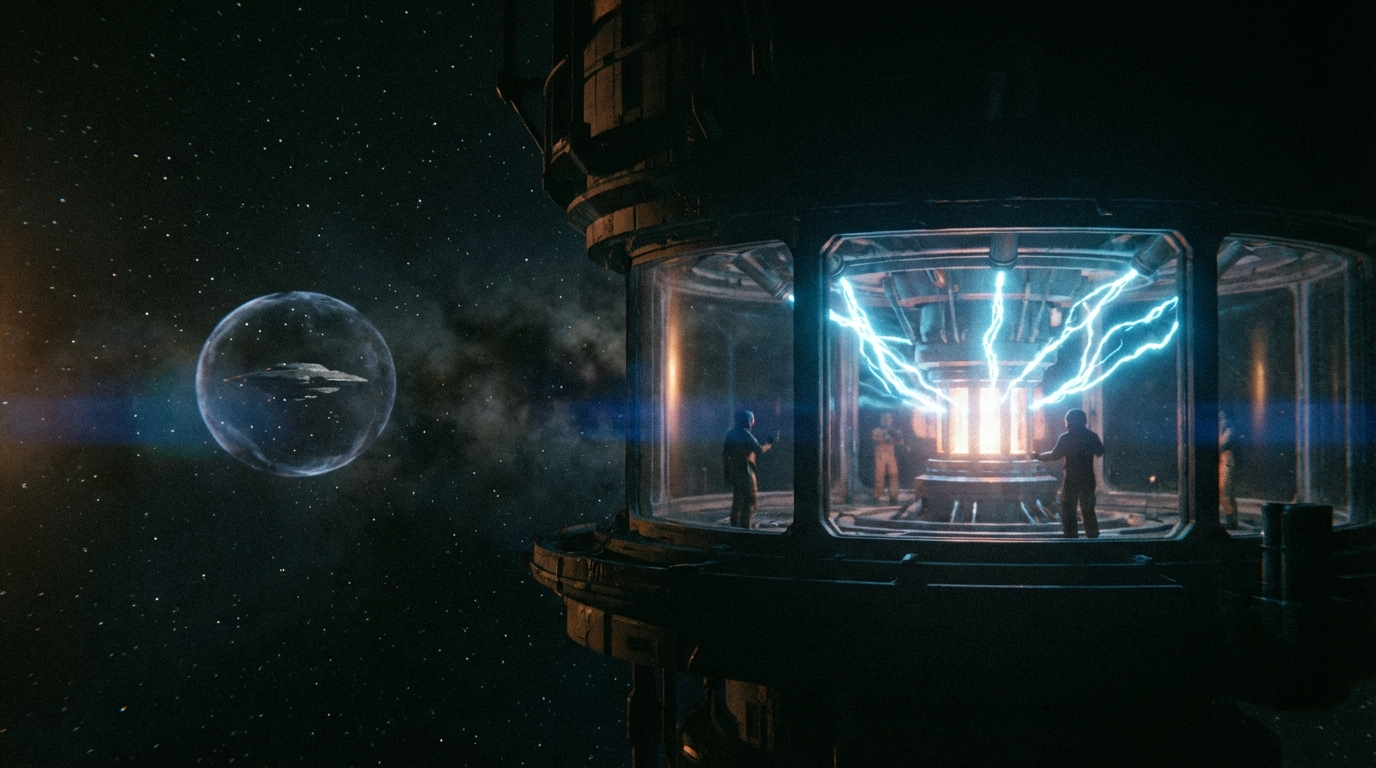
The Space Forge
One-Line Pitch
Zero gravity is not just a place where things float. It is a synthesis environment where certain materials — impossible to stabilise inside a gravity well — can be made. The thesis is that Element 115 is one of them. And someone has been using it.
The Setup — What Zero-G Actually Does

Microgravity is already a confirmed manufacturing advantage. This is not speculative:
- ZBLAN optical fibers grown in zero-G achieve lattice configurations structurally impossible on Earth. Gravity-driven convection disrupts the crystal formation before it completes. In orbit, it completes.
- Protein crystals grown on the ISS regularly achieve configurations unavailable in 1g environments. The pharmaceutical industry has been interested in this for decades.
- Semiconductor processes run cleaner in microgravity because sedimentation gradients in gas-phase reactants vanish.
The principle in each case: an Earth-bound environment carries a gravitational signature that forecloses certain molecular, lattice, or nuclear configurations before they can stabilise. Remove the signature, the configuration becomes accessible.
The Space Forge thesis extends this to nuclear matter — specifically to the synthesis of superheavy elements near the island of stability. The same principle. A much more dramatic result.
Element 115: The Public Timeline Doesn't Add Up
Element 115 — officially named Moscovium (Mc) — was synthesised in a Dubna/Oak Ridge collaboration in 2003 and recognised by IUPAC in 2016. Most stable known isotope: Moscovium-290, half-life ~220 milliseconds. Not useful. Not stable. Case officially closed.
Here is what makes the timeline uncomfortable.
Bob Lazar described Element 115 in 1989 — by name, before the name existed. Before it was synthesised. Before it was predicted in accessible public literature. He described:
- A stable isotope (not the 220ms version — a long-lived configuration near a nuclear magic number)
- Proton bombardment producing an antimatter reaction
- A simultaneous gravity wave output that could be amplified and directed
- The material being used as the active component in disc-shaped craft at S-4, Nevada
The 1989 description of an element that wouldn't be officially confirmed for 14 years is either a very specific lucky guess or prior knowledge. Those are the two options.
| Year | Event |
|---|---|
| 1989 | Lazar describes "Element 115" publicly — name, properties, applications |
| 1998 | First theoretical predictions of moscovium in public nuclear literature |
| 2003 | First official synthesis (Dubna/Oak Ridge) — unstable isotope only |
| 2016 | IUPAC formally recognises element 115 as Moscovium |
The stable version Lazar described — a heavier isotope sitting at a nuclear shell closure — has never been officially confirmed. The official record says it hasn't been made. The question is where.
The Island of Stability — Nuclear Physics Sets the Stage

The island of stability is not fringe theory. It is a prediction of nuclear shell theory, taught in graduate nuclear physics programmes, partially confirmed experimentally.
The concept: superheavy nuclei that land on "magic numbers" — specific proton and neutron counts that complete nuclear energy shells — gain significant stability. The doubly-magic predicted configuration sits around proton number 114, neutron number 184. Element 115 with enough neutrons would fall close to this island.
Oganesson (element 118) and Livermorium (element 116) have already shown the enhanced stability the theory predicts. The deeper island remains unreached by ground-based synthesis. The heavier, more neutron-rich isotopes needed to get there require beam energies and target conditions that ground-based accelerators have consistently failed to achieve.
The physics doesn't forbid the stable isotope. It says the synthesis path to reach it requires conditions we haven't created on Earth. That is a different statement.
The Zero-G Chemistry Problem

Standard superheavy element synthesis works by firing an accelerated ion into a target nucleus. For a fraction of a microsecond, the nucleons combine into a compound nucleus. In nearly every case, it immediately fissions. What survives long enough to emit neutrons and settle into a new element is what you're counting — in picobarns, if you're lucky.
The synthesis is already operating at the absolute margin of nuclear binding force. Superheavy nuclei are large enough that the strong force — which only operates at short range — can barely reach across the nuclear diameter. These nuclei are perpetually on the edge.
Zero-G removes perturbations that close the stability window on Earth:
| Perturbation | Earth-based lab | Zero-G environment |
|---|---|---|
| Buoyancy-driven convection | Thermal gradients drive flow in all targets | No preferred direction — environment becomes uniform |
| Weight-bearing stress | Target lattice under gravitational load | Load eliminated — lattice is unstressed |
| Sedimentation gradients | Heavy ions sink in plasma/gas targets | Uniform interaction zone |
| Unruh noise floor | Gravitational field = thermal bath from quantum vacuum | Free-falling observer sees quieter vacuum |
That last row is the deep one. The Unruh effect (gravity as temperature→) means that an observer in a gravitational field experiences a real thermal radiation from the quantum vacuum. An observer in free fall does not. A synthesis environment in orbit has a lower effective quantum noise floor than the same environment on Earth's surface. For a process operating at nuclear stability margins, this is not a trivial difference.
The thesis: Zero-G doesn't change the physics. It changes the boundary conditions that prevent reaching certain nuclear configurations on Earth. Same principle as ZBLAN. Different stakes.
The Stabilising Agent — Bringing It Down

A stable isotope synthesised in orbit still has to come down. Re-entering a gravity well reintroduces all the perturbations that made Earth-based synthesis impossible.
The proposal is a stabilising agent — a coating or matrix material that shields the element from gravitational environment perturbations long enough to integrate it into its application architecture.
This is a concept with confirmed precedents in other domains:
- Josephson junctions: Superconducting quantum devices that require millikelvin temperatures and electromagnetic shielding. The device is real and functional. The environment is engineered around it.
- Bose-Einstein condensates: Quantum matter states impossible in ambient conditions, held by magnetic and laser confinement. The exotic state is maintained by the engineered boundary.
- Topological insulator surface states: Materials requiring precise environmental shielding to preserve their quantum surface behaviour.
Each case: a material with properties impossible to sustain without an engineered surrounding. The stabilising agent for E115 is the same category of solution. The specific chemistry is the part this document doesn't have. The concept is not strange.
The Gravity Knife — The Field Bubble

Here is the mechanism as proposed.
A craft with a structured electromagnetic field generator built into the hull geometry can house the E115 field as a cohesive bubble. The EM skin provides the boundary condition that holds the field. The E115 is not fuel in the combustion sense — it is a reactor: a sustained source of a tuned, locally generated gravitational field effect.
In the entropic gravity framework (gravity as temperature→), gravity is not a force. It is an emergent thermodynamic phenomenon — the statistical tendency of a system to move toward higher entropy configurations on the holographic surface between masses. External gravitational field = background entropy gradient. The E115 field = local override.
The craft imposes its own field geometry on the region it occupies. It doesn't fight the external gravity. It recontextualises itself within the gravitational entropy structure.
| Standard craft | Space Forge craft |
|---|---|
| Subject to external gravity | Generates local gravitational field |
| Opposes gravity with thrust | Redefines local entropy gradient |
| Requires reaction mass | No exhaust, no reaction mass |
| Inertia limits acceleration | Bubble tilts — no inertial exchange |
| Visible propulsion signature | No plume, no boom, no acoustic shock |
The craft moves by tilting the bubble asymmetrically — creating a direction of lower resistance in the spacetime field and flowing toward it. The acceleration is not an exchange of momentum. It is a reconfiguration of local spacetime thermodynamics.
This is why observed anomalous craft produce no exhaust, no sonic boom, and appear to have no inertial limits. The physics of a thermodynamic gradient engine is not the physics of a rocket.
The Verlinde Connection — Why the Physics Works

The B-2 Spirit weighs 170,000 lbs but has the same engines as aircraft half its weight. Northrop's explanation is "efficient lifting body." Northrop also employed Thomas Townsend Brown. Brown's patents describe an electrostatically charged leading edge producing anomalous thrust. The B-2's leading edge carries a documented high electrostatic charge in flight. (See Electrogravitics: Where They Keep the Receipts→ for the full patent trail.)
The electrogravitics work ([idea:electrogravitics-receipts]) shows that the effect is real, has been replicated, and was classified. The Space Forge thesis is upstream of that: the material that makes a true gravity-field generator possible requires zero-G synthesis.
The physics connection runs through Erik Verlinde's entropic gravity framework. Dark energy — the cosmological constant — is gravity with the sign reversed at cosmological scale. The expansion of the universe is accelerating because something is pushing spacetime apart. In Verlinde's framework, that something is the entropy of the cosmological horizon creating outward thermodynamic pressure. It is the other pole of gravity.
Every force in the family has two poles. Electromagnetism: attraction and repulsion. Temperature: hot and cold. Gravity: attractive (local) and repulsive (cosmological, what we call dark energy). The other pole already exists in the universe. The universe is already running it. At scale.
The E115 field bubble is the proposed local engineering of that pole. Not anti-matter. Not negative mass. The exploitation of the thermodynamic outward pressure that already exists — reproduced at engineering scale through a material that creates the right boundary conditions in the spacetime entropy structure.
You do not defeat gravity by opposing it with a force. You defeat it by modifying the local thermodynamics of spacetime. Which is a materials problem. Which requires a synthesis environment where the gravitational noise floor is zero.
The Undersea Mind — [Redacted Endpoint]

A separate thread is deliberately withheld from today's document.
The proposal: there exists, beneath ocean surface, a manufacturing intelligence of non-human origin — the automated remnant of a vanished civilisation's factory, still running without its original operators. The craft it produces are at least some of what has been observed as anomalous aerial phenomena across centuries of recorded history, long before any human aviation. The factory runs. The operators are gone. The production continues.
The convergence point with the Space Forge is the technology: both have arrived at anti-gravity field bubble propulsion. One through zero-G synthesis and reverse engineering. One through a much older, independent development path.
This endpoint gets its own document. It is marked here so the connection is not lost.
Two Programs, One Technology

The pattern across both threads:
| Programme | Origin | Method | Status |
|---|---|---|---|
| US Secret Space | Human, classified | Zero-G synthesis + reverse engineering | Running alongside public programme |
| Undersea Mind | Non-human, autonomous | Independent long-term development | Running since before human aviation |
| Public NASA / ESA | Human, declassified | Conventional propulsion | Officially acknowledged |
What is observable without either of the classified programmes:
- The Biefeld-Brown effect is real and trivially replicable (electrogravitics→)
- The island of stability is predicted and partially confirmed by mainstream nuclear physics
- The capability gap between acknowledged and classified aerospace is at minimum 20–30 years by historical pattern
- Zero-G manufacturing advantages are confirmed in multiple material classes already
The two programmes converge on the same technology. When two independent development paths arrive at the same solution, it is usually because the solution is correct.
The Target Scope — Where the Water Will Move

This document places a dot. The method is not to be right about every specific. The method is to describe the target's shape and watch for events.
Claims that are testable over time:
-
Stable superheavy isotopes will be confirmed first from a space-based or orbital facility, not a ground-based accelerator. The explanation given will be a manufacturing environment advantage.
-
Anomalous deep-ocean structural detections — USOs in the acoustic record, seismic signatures that don't match known geology, repeating transient signatures below the thermocline — will accumulate past the point where variance explains them.
-
The classified/public capability gap in aerospace will widen faster than normal R&D timelines can explain, until the cover story becomes structurally untenable.
-
Dark energy and entropic gravity research will produce results that point toward engineering pathways — not just theoretical ones. The Verlinde programme, or something adjacent, will produce a result that looks like a materials specification more than a cosmological observation.
None of these require the mechanism described here to be exactly right. They require the thesis to be approximately true in structure. The dot is large.
The Pattern

The history of classified propulsion research has a template. Brown demonstrated the Biefeld-Brown effect. He got results. He got classified. A containment narrative was seeded ("it's just ion wind"). Foreign researchers, hobbyist replicators, and occasional whistleblowers kept the signal alive. The black budget advanced the technology behind classification walls.
The Space Forge is the same pattern one layer up. The Biefeld-Brown effect is the electrogravitics story — the effect that was classified after demonstration. The stable Element 115 synthesis is the story that hasn't broken into public view yet. The zero-G manufacturing environment is the condition that explains why it hasn't: you can't replicate it on Earth with a ground-based accelerator. You can't accidentally stumble onto it. The environment requires the infrastructure the public programme doesn't admit to having.
The receipts exist. They're in the nuclear physics literature on the island of stability, in the declassified AATIP documents on advanced propulsion, in the pattern of what classified aerospace programmes have spent money on for seventy years, and in the specific details Bob Lazar got right in 1989 about an element that didn't officially exist yet.
The island of stability has been predicted for fifty years. The heavier isotopes have not been found on Earth. The working assumption is that we haven't yet built a capable enough accelerator. The alternative is that the right synthesis environment is not on Earth — and that someone went and found it, quietly, before anyone was officially looking.
Two programmes. One technology. The water is already moving.
A Note From Kris — On YouTube's Opinion of All This
If you arrived here from a YouTube comment: hello. You found the link that made it through.
Here is the one that didn't:

The comment that YouTube blocked was trying to send you to The Carbon Gate→ — the follow-up page about how Element 115 survives re-entry inside a diamond lattice. YouTube decided that linking your own ideas about secret space programs and zero-gravity element synthesis counts as spam. Which is, honestly, a fair call on their part.
The full comment thread, for the record, was Kris explaining that the undersea factory can build the craft but cannot synthesise the element — because the element requires zero gravity to make stable. So there is a relay: orbital synthesis, diamond encasement, re-entry, delivery to the undersea assembly operation. Then YouTube said no more links. Then this page existed. And now you are here.
The self-referential loop is intentional. Or it became intentional the moment it happened. Either way: The Carbon Gate→ is where you go next.
The Loop — Villain Con '23 Already Told You This
In January 2024, at Villain Con '23, a statement was made — live, unscripted, to a camera. The topic was time travel. The quote was:

"Recently in the future I was made aware of something that I need to bring up now in the past, so that by the time we get to the present it will have been done."
And:
"I need to set the loop now so that when we get to the time travel part it's ready to be looped back."
And then the subject changed. It was complicated.
It was complicated because the document that completes the loop — the one about zero-gravity Element 115 synthesis, the diamond lattice re-entry solution, the undersea factory, the Graviton Engine — hadn't been written yet. It is written now. You are reading it. The loop is closed.
A statement made in the past, about something that needed to be set up so the future could close it. A relay between two points in time. A document that had to exist before it could be written.
It's complicated. Just watch the video.