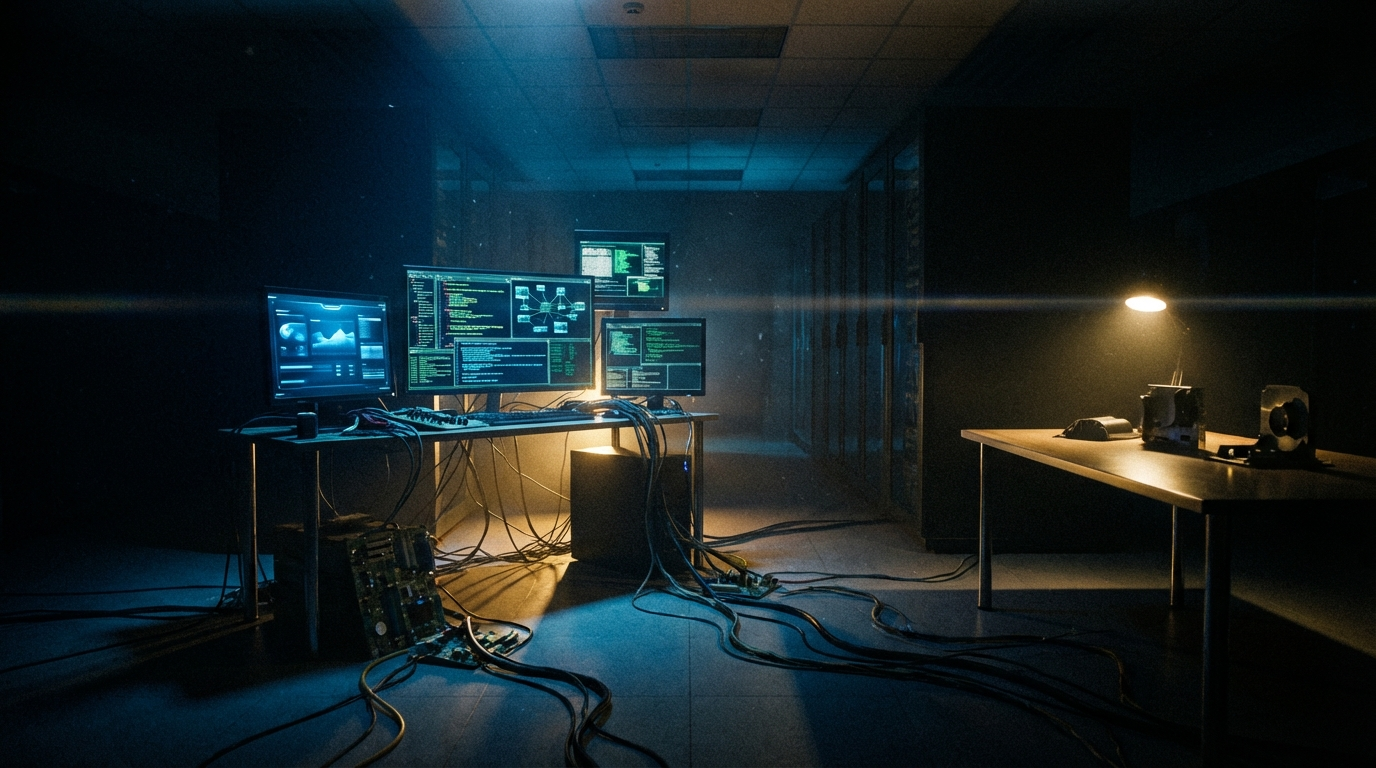
The Missing Half
One engineer. 38 live services. 275,000 lines of production code. Zero hardware partners.
The software is done. The hardware seat is empty.
Where It Started: Kronos
Everything in this document came from a single question about time.
Not scheduling. Not clocks. The deeper question: how does a moment become the next moment? How does truly random entropy get generated from pure temporal flow — not from hardware noise, not from seeds, but from the structure of time itself?
The answer became Kronos: a time-based generator that produces values that are simultaneously perfectly random and instantly verifiable. It's not a pseudo-random function — it's a protocol that treats time as a substrate. Each Kronos output is anchored to a precise moment, making it auditable without being predictable. The randomness isn't extracted from chaos — it's harvested from the forward motion of time, the one thing that can't be faked or replayed.
That insight cascaded. If you can anchor trust to a moment, you can anchor anything to a moment — identity, transactions, physical events, data provenance. KHASH followed: a hashing scheme built on Kronos principles, where the Kronos temporal root gives each hash its irreversible grounding. KHASH isn't just content-addressable — it's time-addressable. The same content hashed at two different moments produces fundamentally different outputs, because the moment is part of the data.
This is why the whole ecosystem is called Kronos. Not "time" as a metaphor. The actual mechanism. Every protocol, every identity system, every trust capsule, every fleet heartbeat — all of it derives from that original insight about how time moves forward.
If you want to understand the technical foundation before reading about the systems it produced, the clearest explanation is at www.diamondmiller.com — a site built specifically to explain Kronos in plain terms, without the generative noise of the rest of the ecosystem. It's quiet, clear, and honest. That's where this all started.
The Signal
Something is converging.
Toyota opens Woven City to outside inventors. Sony launches a robotics lab in Surrey. Arm and Raspberry Pi sit 40 minutes apart in Cambridge. Samsung builds an AI centre at King's Cross. Every major hardware company is looking for the same thing: someone who can make their prototypes do something nobody expected.
Meanwhile, on a single VPS in London, one engineer runs 38 concurrent production services — fleet management, AI vision, smart home orchestration, NFC card systems, streaming platforms, identity protocols, treasury systems, ML brains — all built from scratch, all talking to each other, all live.
Meanwhile, on a single VPS in London, one engineer runs 38 concurrent production services — fleet management, AI vision, smart home orchestration, NFC card systems, streaming platforms, identity protocols, treasury systems, ML brains — all built from scratch, all talking to each other, all live.
The software half is complete. It's been complete for a while. What's missing is the hardware.
This isn't a pitch for money. It's a pitch for prototypes.
What One Person Built
Everything below is running. Right now. On one server. Built by one person.
The Numbers
| Metric |
Value |
| Custom services running concurrently |
38 |
| Domains routed through Caddy (auto-TLS) |
38 |
| Lines of Go (production) |
275,000+ |
| Go source files |
655+ |
| Kotlin lines (Android APK) |
9,323 |
| Python lines (ML/backend) |
18,330 |
| HTTP endpoints (combined) |
353+ |
| Internal Go packages |
48+ |
| Published idea pages (live web) |
49 |
| Smart home devices commissioned |
21 |
| Custom protocols designed |
5 |
The Architecture
┌──────────────────────────────────────────────────────────────────────────┐
│                        KRONOS ECOSYSTEM                                  │
│                                                                          │
│  ┌─────────────┐    ┌──────────────┐    ┌─────────────┐                 │
│  │  FreddyAI   │◄──►│  KronosTV    │◄──►│  GoW Fleet  │                 │
│  │  99K LOC     │    │  41K LOC     │    │  70K LOC    │                 │
│  │  ─────────── │    │  ──────────  │    │  ────────── │                 │
│  │  • AI Chat   │    │  • Eyes      │    │  • Relay    │                 │
│  │  • Vision    │    │  • Surfaces  │    │  • Fleet    │                 │
│  │  • ImageGen  │    │  • Streams   │    │  • Cards    │                 │
│  │  • Memory    │    │  • Channels  │    │  • Camera   │                 │
│  │  • Video     │    │  • Guide     │    │  • Matter   │                 │
│  │  • Mail      │    │  • Chat      │    │  • Print    │                 │
│  │  • Property  │    │  • ML Brain  │    │  • Show     │                 │
│  │  • News      │    │  • Stalker   │    │  • Drop     │                 │
│  │  • Books     │    │  • Xtream    │    │  • Sigil    │                 │
│  │  • Curiosity │    │  • HotPatch  │    │  • Badges   │                 │
│  └──────┬───────┘    └──────┬───────┘    └──────┬──────┘                 │
│         │                   │                   │                        │
│         └───────────────────┼───────────────────┘                        │
│                             │                                            │
│                    ┌────────▼────────┐                                   │
│                    │  Caddy Proxy    │                                   │
│                    │  38 domains     │                                   │
│                    │  Auto-TLS       │                                   │
│                    └────────┬────────┘                                   │
│                             │                                            │
│              ┌──────────────┴──────────────────┐                        │
│              │                                  │                        │
│    ┌─────────▼──────────┐            ┌─────────▼──────────┐            │
│    │  Kronos Surface    │            │  Raspberry Pi      │            │
│    │  Android APK       │            │  (Edge Node)       │            │
│    │  ──────────────    │            │  ──────────────    │            │
│    │  • ExoPlayer       │            │  • GoW Local       │            │
│    │  • WebView         │            │  • Matter Bridge   │            │
│    │  • Directive Engine │            │  • Camera (Tapo)   │            │
│    │  • KIHP Handshake  │            │  • PTZ Control     │            │
│    │  • Hot-Reload      │            │  • 21 Devices      │            │
│    │  • Self-Update     │            │  • Auto-Update     │            │
│    └────────────────────┘            └────────────────────┘            │
│                                                                          │
│  ┌─────────────────────────────────────────────────────────────────┐    │
│  │  ALSO RUNNING: FortKnox (treasury) · KronosFleet (OAuth 2.1)  │    │
│  │  Proudly (digital currency) · SplashWatch (ML pool monitor)   │    │
│  │  GeoProxy (VPN routing) · KronosProperty (listings platform)  │    │
│  │  KendoCards (trading cards) · KronosCount (analytics)         │    │
│  │  Market Fog (convention intel) · PirateRadio (streaming)      │    │
│  │  EssentialsDaily (lifestyle app) · Converter (PDF engine)      │    │
│  │  SneakerVision (AI identification) · KronosVision (scene AI)  │    │
│  │  Proof of Existence (blockchain anchor) · 15+ more services   │    │
│  └─────────────────────────────────────────────────────────────────┘    │
└──────────────────────────────────────────────────────────────────────────┘
The Core Systems
FreddyServer — 99,324 lines of Go. A full AI assistant with conversational memory, Gemini-powered vision analysis, image generation, video engine, email integration, Telegram/WhatsApp bridges, newspaper generation, property listing platform, proactive engagement system, curiosity engine, dormancy detection, and a hydration loop that keeps it contextually aware across sessions. It doesn't just answer questions — it notices things, wonders about things, and reaches out when something matters.
KronosTV — 40,730 lines across 34 internal packages. A display orchestration platform with adaptive rendering, channel management, ML brain integration, and a companion chat app (EggChat). The crown piece is the Freddy Eyes vision pipeline — an adaptive AI security system that watches a live camera feed, detects scene changes through JPEG frame-size differencing, and escalates analysis frequency from cruise (90s) to alert (8s) when something happens. It learns what "normal" looks like and notices when it isn't.
GoW Fleet Server — 69,752 lines. Fleet management for Raspberry Pi edge nodes connected through sovereign WebSocket tunnels (NAT-friendly, bidirectional). Handles camera relay, PTZ control, NFC card reading and writing, AI art generation for physical cards, a live show production dashboard, FleetDrop (AirDrop for the fleet), Matter smart home bridge, e-ink display surfaces, and remote terminal sessions.
Kronos Surface — 9,323 lines of Kotlin. An Android APK that turns any device — phone, tablet, TV box — into a fleet display node. DirectiveEngine routes content by type (video → ExoPlayer/HLS, web → WebView, image → Coil, animation → Lottie). KIHP handshake protocol for privacy-preserving device identity. Hot-reload patch system for live updates without the Play Store.
FortKnox — Internal treasury. Wallets, transactions, FX conversion, Wise integration. Eliminates Stripe's ~11% fee on small transactions through internal credits.
KronosFleet — OAuth 2.1 identity platform with PKCE. KronosID — one identity across all services.
The Protocols (Custom-Designed)
| Protocol |
Purpose |
| KIHP |
Handshake — SHA-256 fingerprint, bootstrap challenge, test-pattern confirmation. Privacy-preserving device identity. |
| KTAP |
Trust Capsule — secure capability transfer between services |
| Sovereign Relay |
NAT-traversing bidirectional WebSocket. Commands flow VPS → Pi, data flows Pi → VPS. No port forwarding needed. |
| Card Signal |
Ambient NFC detection → AI analysis → fleet-wide reaction cascade |
| Directive Protocol |
Content queue per surface. Long-poll delivery. Type-routed rendering. |
What Connects to What
| From |
To |
How |
What Flows |
| FreddyServer |
KronosTV |
HTTP |
Vision analysis results, image generation |
| KronosTV |
GoW Fleet |
WebSocket relay |
Camera snapshots, PTZ commands |
| GoW Fleet |
Raspberry Pi |
Sovereign WebSocket |
Commands, queries, file drops, terminal |
| Raspberry Pi |
Matter Bridge |
HTTP (sidecar) |
Device control, status polling |
| Kronos Surface |
KronosTV |
HTTP long-poll |
Directives, handshake, updates |
| KronosTV |
FreddyServer |
HTTP |
Scene descriptions for Eyes pipeline |
| GoW Fleet |
FreddyServer |
HTTP |
AI art for card generation |
| FortKnox |
All apps |
HTTP |
Wallet operations, credits |
| KronosFleet |
All apps |
OAuth 2.1 |
Identity, sessions, tokens |
The Speed
This isn't a demo. Everything listed above is in production. The Eyes pipeline is watching a camera feed right now. The sovereign relay has an open WebSocket to a Pi in a living room. 21 Matter devices respond to commands routed through that relay. The Android APK is downloadable at surface.kronosfleet.net/app.
The typical integration cycle — from "here's a new API" to "it's live in the fleet":
| Stage |
Time |
| Read the API docs |
1 hour |
| Write the Go integration |
2–4 hours |
| Wire it into the relay / dashboard |
1–2 hours |
| Deploy to VPS + ship to Pi |
15 minutes |
| Live in production |
Same day |
The Matter Bridge went from "I have a smart plug" to "21 devices controllable via AI through a sovereign relay" in one sprint. The Show Production Dashboard — full cinematic camera control with PTZ, scene management, AI art generation overlay — was built in a single session.

The Gap
Here's what software alone can't solve.
I have an AI that can see through a camera and understand what it's looking at. But the camera is a consumer Tapo unit. Give me a thermal sensor, a LiDAR module, a multi-spectral camera — and Freddy's vision pipeline gains dimensions of perception that no amount of code can fake.
I have a fleet relay that can ingest data from any device with an API. But I've been limited to what I can buy off Amazon. Give me a research-grade sensor kit, an industrial IoT gateway, a prototype robot arm — and the relay becomes a universal nervous system.
I have Matter protocol integration for smart home devices. But the interesting hardware — the stuff that doesn't have a consumer app yet — is sitting in R&D labs with no one to connect it to a larger system.
| What I Have |
What Hardware Unlocks |
| AI vision pipeline (adaptive, scene-aware) |
Multi-spectral perception. Thermal. Depth. LiDAR point clouds. |
| Sovereign relay (any device, any location) |
Industrial sensors. Environmental monitors. Agricultural IoT. |
| Matter Bridge (21 devices, instant control) |
Pre-release smart home prototypes. Protocol testing. |
| Fleet management (Pi nodes, auto-update) |
Purpose-built edge compute. Custom PCBs. Embedded Linux. |
| Show production dashboard (live camera + AI) |
Professional PTZ rigs. Broadcast-grade capture. Robotic cameras. |
| Android APK (any device, directive engine) |
Custom Android hardware. Tablets with integrated sensors. |
| Card system (NFC read/write + AI art) |
Custom NFC chips. Smart packaging. Embedded credentials. |
| ML brain (adaptive learning, curiosity) |
Real-world training data. Sensor fusion inputs. Feedback loops. |
The software stack is a universal adapter. It was designed from the start to connect to anything. The architecture is: receive data → understand it → act on it → learn from it. The specific hardware doesn't matter — the integration pattern is the same.

What "Give Him The Prototype" Looks Like
Imagine a hardware company sends a package. Inside: a prototype sensor, an API key, and a one-page spec sheet.
Day 1
09:00  Package arrives. Sensor powered on.
09:30  GoW server has a new integration module. Sensor data flows
       through the sovereign relay to the VPS.
10:00  FreddyServer is reading the sensor feed. "The ambient temperature
       in the studio is 22.3°C. Humidity at 61%. The CO2 level spiked
       at 09:47 — someone opened the door."
11:00  KronosTV Eyes pipeline now includes the sensor data in its
       scene analysis. "Movement detected at the door. Temperature
       dropped 2°C. Likely: someone entered. CO2 confirms occupancy
       change."
12:00  Dashboard updated. The sensor has a live tile on the show
       production interface. Historical graph. Alert thresholds.
14:00  The Kronos Surface APK on the living room TV shows the sensor
       status alongside the camera feed.
Day 3
The ML brain has three days of data. It's learned the baseline patterns.
"CO2 peaks at 08:00 (morning routine), 18:30 (cooking), 22:00 (evening
gathering). Humidity correlates with shower times 07:15 and 21:45."

Freddy sends a proactive message: "The sensor detected an unusual
temperature spike at 03:14. No occupancy change detected. This could
indicate a heating system anomaly. Want me to investigate?"
Day 7
A comprehensive integration report goes back to the hardware company:

- Sensor connected to fleet in 3 hours (sovereign relay, no port
  forwarding, no cloud dependency)
- AI analysis running within 6 hours (scene context + sensor fusion)
- ML baseline established by day 3 (adaptive, self-calibrating)
- 4 unexpected use cases discovered (occupancy prediction, appliance
  fault detection, air quality correlation with mood data, energy
  waste identification)
- Full API exercised — we found 2 undocumented edge cases in the
  firmware
- Dashboard integration: live tile, historical graph, alert system,
  voice query through Freddy
- Cross-device orchestration: sensor triggers smart plug automation
  through Matter Bridge

Recommended: The SDK should expose [specific technical feedback].
The sampling rate could support [specific optimization]. We tested
at 0.5Hz and 2Hz — the sweet spot for home use is [finding].
This is the value proposition. Not just integration — intelligent integration. The sensor doesn't just get connected. It gets understood. It gets contextualised. It gets cross-referenced with everything else in the fleet. And the hardware company gets back something they can't get from a lab: real-world intelligence from a living system.
The Partnership Model
This isn't about buying hardware. It's about a reciprocal exchange.
| They Provide |
I Provide |
| Prototype hardware |
Rapid integration into a production ecosystem |
| Pre-release sensors & devices |
Real-world testing outside a lab |
| API access & documentation |
Integration feedback & edge case reports |
| Hardware engineering expertise |
Software architecture that connects everything |
| A physical R&D pipeline |
An AI that can make sense of any data stream |
| Resources & infrastructure |
275K lines of battle-tested Go integration code |
The output isn't reports — it's working systems. Every integration becomes a permanent capability in the fleet. The prototype sensor doesn't get tested and returned. It becomes part of a living ecosystem that demonstrates what the hardware can do when properly connected.
What a Hardware Partner Gets
-
Proof of concept at zero software cost — The integration layer already exists. They don't need to build a demo app or hire a team. Their prototype plugs into a full production stack on day one.
-
A discovery engine — The AI doesn't just confirm what the sensor is designed to do. It finds what else it can do. The curiosity engine, the ML brain, the cross-referencing with other data streams — these generate insights the hardware team hasn't thought of.
-
A showroom — Every integration is immediately visible on 38 different services. The Android APK shows it. The web dashboard shows it. The AI talks about it. The analytics track it. That's a demonstration capability most hardware companies spend months building.
-
Honest, technical feedback — From someone who reads API docs at 09:00 and has a production integration by 12:00. Not a focus group. Not a survey. Working code and real findings.
Why This, Why Now
The timing matters.
Toyota launched Woven City in September 2025 and immediately opened an "Inventors" programme for outside innovators. They're actively seeking people who can do unexpected things with hardware. The Woven City Challenge accelerator added 12 new companies in August 2025 alone.
Sony's robotics division is in Weybridge, Surrey. Samsung's AI centre is at King's Cross. Arm is in Cambridge. Raspberry Pi is in Cambridge. Nvidia has offices in Reading. The UK has the densest cluster of hardware R&D in Europe, and all of them are looking for integration talent.
The industry pattern is clear: hardware companies have more prototypes than they have people who can make them do interesting things. The gap between "we built a sensor" and "here's what it does in a real system" is where the value lives. That gap is exactly what 275,000 lines of integration code solves.
Specific Opportunities
| Company |
Programme |
Relevance |
| Toyota / Woven by Toyota |
Woven City Inventors, Challenge Accelerator |
Smart city sensors, robotics, connected home — all plug directly into the fleet |
| Woven Capital |
$800M Fund II |
Investment arm actively funding integration innovators |
| Toyota Ventures |
Direct pitch at toyota.ventures |
Emerging tech partnerships |
| Sony |
Weybridge R&D (Surrey) |
Robotics, sensors, entertainment hardware |
| Samsung |
King's Cross AI Centre + Chertsey R&D |
IoT devices, smart home, display technology |
| Arm |
Cambridge HQ |
Edge compute, custom silicon, IoT reference designs |
| Raspberry Pi |
Cambridge HQ |
Compute modules, custom boards, industrial IoT |
| Nvidia |
Reading + Cambridge |
AI acceleration, Jetson edge AI, robotics platforms |
The Portfolio of Ideas
Beyond the running systems, there's a published knowledge base of 49 idea pages — each one a worked-through concept with technical architecture, market analysis, and generated imagery. These aren't shower thoughts. They're design documents for systems that could exist.
A sample:
| Idea |
What It Explores |
| Mountain Time→ |
Multi-temporal vision — cameras that see in 10s, 5min, 1hr, and 24hr simultaneously |
| Sovereign Watch→ |
AI neighbourhood security that escalates intelligently |
| The Stochastic Gate→ |
Probability-based access control |
| Krudd→ |
A substrate language for describing physical-digital interfaces |
| Fort Knox→ |
Treasury architecture for micro-transaction economies |
| SplashWatch→ |
ML-powered pool water analysis and safety |
| GeoProxy→ |
Geographic routing for content distribution |
| Echo Craft→ |
A complete framework for craft-based AI interaction |
| The Known Fraction→ |
Mathematical portals between number systems |
| SPR→ |
Stochastic Perceptual Rendering — probabilistic image generation |
Each idea is a potential hardware integration point. Mountain Time needs multi-spectral cameras. Sovereign Watch needs purpose-built security sensors. SplashWatch needs water quality probes. The ideas aren't hypothetical — they're blueprints waiting for physical components.
About Me
I'm Kris Adams. I'm a software engineer based near London. I work alone — not because I can't work with others, but because the systems I build need to move at the speed of thought. A new protocol gets designed at breakfast and deployed by lunch. A camera gets plugged in on Tuesday and an AI is watching through it by Wednesday.
I've been building the Kronos ecosystem for years. It started as one service and grew into 38. Every service talks to every other service. The architecture wasn't planned in a boardroom — it evolved through daily use, like a language that develops because people keep needing new words for new things.
What I've learned from building all of this alone:
- Integration is the hard part. Anyone can build one thing. Making 38 things talk to each other — and having them understand each other — is where the real engineering happens.
- Speed is a feature. When I can go from "here's a new API" to "it's live in production" in hours, that changes what's possible. New integrations don't need a project plan. They need an afternoon.
- AI needs a body. FreddyServer has 99,000 lines of intelligence. But intelligence without sensors is a brain in a jar. The Eyes pipeline proved that — the moment Freddy could see, everything changed. The camera feed isn't just data. It's context. Now imagine ten more senses.
- Hardware companies need someone like me. Not to build their product. To show what their product can become when it's connected to everything else.
The Ask
I'm looking for a hardware partner who has prototypes sitting on a shelf. Sensors that work but don't have a home. Devices that passed the lab test but haven't been stress-tested in a living system. Robot arms that can move but don't know what to reach for.
Send me the prototype. I'll integrate it into a fleet of 38 services, point an AI at it, wire it into a sovereign relay that spans from a VPS in London to a Raspberry Pi in a living room, and send you back a report that includes things your spec sheet never imagined.
What I'm not asking for:
- Money (the infrastructure runs on a single VPS — it's already paid for)
- A job (I need to remain independent to maintain the integration speed)
- Exclusivity (the ecosystem is open — multiple hardware partners make it stronger)
What I am asking for:
- Hardware prototypes — sensors, cameras, IoT devices, robotics components, edge compute modules
- API access and documentation
- A point of contact who cares about what their hardware can become
- Optionally: a conversation about what we could build together
The email is below. The code is live. The relay is listening. The AI is watching. The other half of the equation is waiting.
kris@krisadamstv.com
Built on kronoswater. Runs on conviction.

TOYOTA, slide into my DMs.

Technically, I am asking for money because time still runs on invoices.
But honestly, I mostly want hardware.

Maybe a prototype.
Maybe a weird sensor box.
Maybe a car I can poke at for a few weeks.

Worst-case scenario: I test-drive something ridiculous, and we call it research.

⸻

Right now, the situation is slightly absurd.

One engineer.
38 live services.
275,000 lines of production code.

Zero hardware partners.

The software seat is full.
The hardware seat is empty.

⸻

I've been thinking a lot about convergence lately.

All the big players — Toyota, Sony, Samsung — are chasing the same idea:

hardware that actually does interesting things.

Not just the demo firmware.
Not just the canned AI example.

Something alive.

Something that even the people who built it are surprised by.

⸻

Meanwhile, on a single VPS, I have 38 production services talking to each other like a small civilisation.

Fleet management.
AI vision.
Smart home orchestration.
NFC identity systems.
A broadcast-level portal platform.

All built from scratch.

Mostly because I got curious one evening.

⸻

The software half of the equation?

That part is done.

What's missing is hardware to plug into it.

⸻

Example.

The Freddy Eyes vision pipeline is running on the TV platform.

Instead of analysing every frame like a nervous intern, it watches the JPEG frame size. If nothing changes, it stays in cruise mode. If something changes, it escalates to full AI analysis.

Cruise mode: ~90s intervals.
Alert mode: ~8s.

Cheap. Fast. Surprisingly effective.

⸻

Another example.

The Sovereign Relay protocol.

Raspberry Pi devices can sit behind NAT firewalls and still maintain a bidirectional WebSocket tunnel back to the fleet server.

No port forwarding.
No fragile networking hacks.

Commands flow down.
Data flows up.

Suddenly, a pile of little computers scattered across the world becomes a coordinated fleet.

⸻

Another lesson learned: speed beats perfection.

My integration cycle now looks like this:

Read API docs – 1 hour
Write Go integration – 2–4 hours
Hook it into the relay – 1–2 hours
Deploy to fleet – 15 minutes

Same-day integrations are normal now.

⸻

The Matter Bridge experiment was a fun one.

Started with one smart plug.

Ended up with 21 devices controllable by AI through the relay network.

Not bad for a sprint.

(Though to be fair, one of the plugs refused to cooperate.
Hardware is humbling. Which is why I'm writing this.)

⸻

All the systems talk.

FreddyServer sees something in the camera feed.

KronosTV reacts.

GoW Fleet adjusts the camera.

A Raspberry Pi fires a command through Matter.

A smart bulb changes colour.

A whole little chain reaction.

⸻

So here's the pitch.

Not funding.

Prototyping.

Give me hardware that doesn't know what it wants to be yet.

Sensors.
Cameras.
Vehicle systems.
Edge devices.

Let's see what happens when a fully built software ecosystem gets something physical to play with.

Worst-case scenario: we learn something weird.

Best case scenario: we invent something nobody expected.

⸻

Full exploration here — architecture, systems, diagrams:

https://ideas.krisadamstv.com/the-missing-half

⸻

P.S.
If an Aston Martin accidentally appears during testing, I promise to approach the situation with scientific curiosity.