The Carbon Gate
One-Line Pitch
The stabilising agent for Element 115 on re-entry is not exotic. It is carbon — arranged in the most stable lattice structure the universe produces: diamond. And the geometry that makes diamond stable is the same geometry that makes KRUDD stable, that makes shells stable, that makes everything stable. Nature has one template. She just keeps printing it.
The Re-Entry Problem

The Space Forge→ established that Element 115 — the stable island isotope — can only be synthesised in zero gravity. The boundary conditions of a gravity well close the nuclear stability window before the compound nucleus can de-excite into the right configuration.
That creates an immediate engineering problem.
You made the material in orbit. You need to use it on or under Earth's surface. How do you bring it down?
Re-entry is not just thermal stress — though that's formidable (surface temperatures of 1,600°C+ for anything coming in at orbital velocity). Re-entry is the restoration of all the perturbations that made Earth-based synthesis impossible in the first place:
- Gravitational load returns. The tidal and vibrational signature of a 1g environment resumes.
- The Unruh noise floor rises. Free-falling observer to gravitational-field observer — the quantum vacuum gets louder.
- Thermal perturbation from re-entry friction adds a violent additional stress on top of everything above.
- Atmospheric pressure begins loading the material from every direction.
A bare Element 115 isotope — however stable it is in orbit — faces all four of these simultaneously during atmospheric entry. You need a buffer. A material that can absorb or isolate the noise, manage the heat, and hold the geometry of the E115 stable long enough to deliver it to its application.
The stabilising agent is diamond.
Why Diamond — The Physics Case

Diamond is not chosen because it's hard or because it's impressive. It's chosen because of a specific combination of properties that no other material shares simultaneously:
| Property | Diamond | Why it matters |
|---|---|---|
| Thermal conductivity | ~2,000 W/m·K — highest of any material | Re-entry heat is conducted away from the E115 core faster than it can build up |
| Hardness | 10 Mohs — resists all mechanical stress | Pressure loading from atmosphere and handling doesn't deform the lattice |
| Chemical inertness | Resists virtually all chemical attack | Atmospheric composition, moisture, oxidation — none of it reaches the core |
| Transparency to specific radiation | Passes certain wavelengths unimpeded | Allows field interaction through the lattice without absorption |
| Lattice stability | Covalent bonds at ~3.5 eV bond strength | The structure does not flex, drift, or decohere under gravitational perturbation |
| Isotopic purity | Can be grown as pure C-12 or C-13 | Removes phonon-scattering from isotopic mass variation — thermal conductivity goes even higher |
The last two rows are the key ones. A diamond lattice grown around the E115 core creates a rigid, chemically inert, thermally managed enclosure whose own covalent bonds are strong enough to maintain their geometry as the Unruh noise floor rises. The diamond is not shielding the E115 from a force. It is providing the stable geometric boundary condition that the orbit provided for free.
You are, in a sense, substituting the zero-gravity environment with a crystalline one.
CVD Growth — How You Actually Wrap It

Chemical Vapour Deposition (CVD) diamond growth is an established industrial process. A hydrocarbon gas (typically methane) is broken into carbon radicals in a plasma environment. The carbon deposits atom by atom onto a substrate, building the diamond lattice from the surface up.
The critical point: CVD diamond can be grown onto and around existing objects. It is not carved. It is grown. You place the substrate — or in this case, the E115 core — in the growth chamber, and the diamond builds itself around it, following the tetrahedral bonding geometry that is the diamond lattice's own instruction set.
In a zero-gravity manufacturing environment, CVD growth has additional advantages:
- No sedimentation gradients in the gas phase — uniform deposition from all directions simultaneously
- Thermal gradients are controllable without convection interference
- The growth front remains spherically symmetric around the core, producing uniform encasement thickness
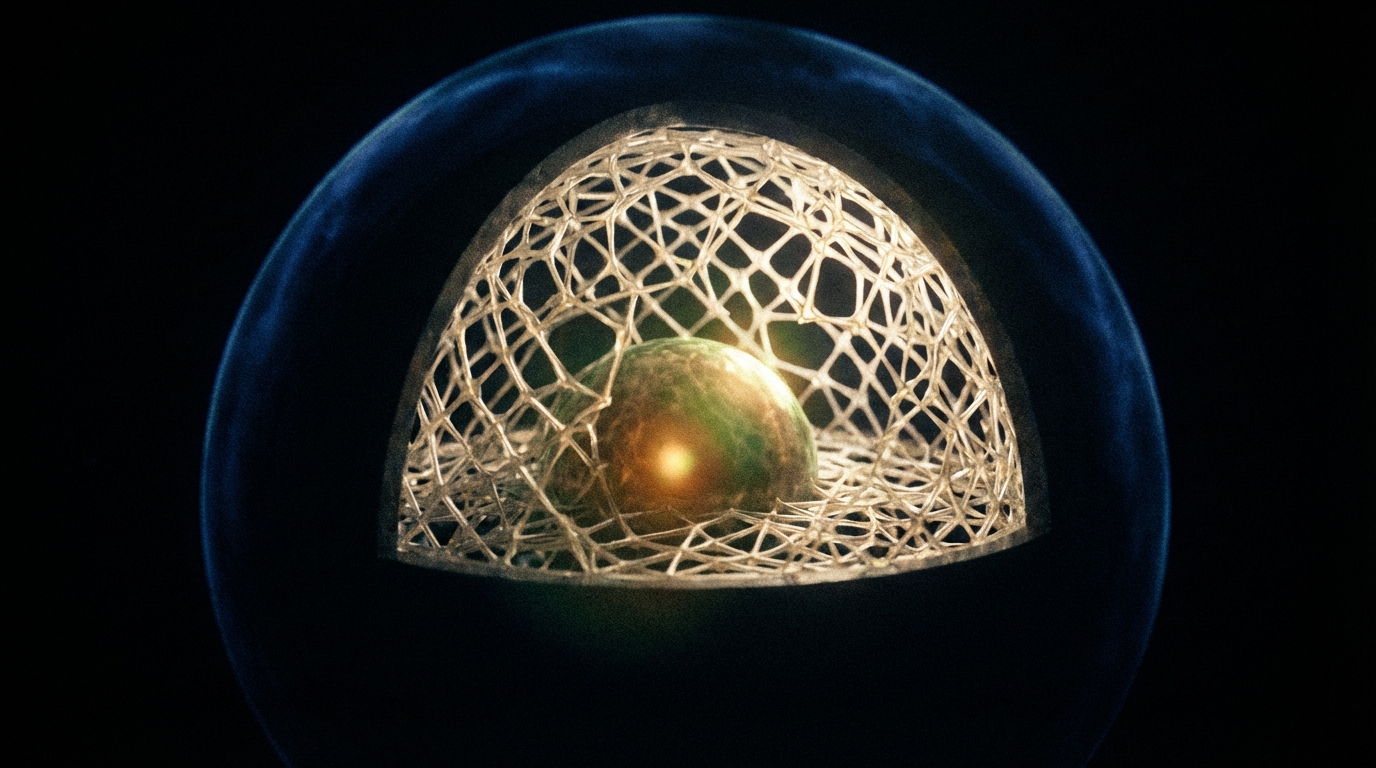
The result: an E115 core at the centre of a spherical diamond shell. The shell thickness is tuned to the re-entry thermal load. The core is isolated — vibrationally, thermally, chemically — from everything outside the lattice.
This is the stabilising agent. It was grown in the same orbital environment where the E115 was synthesised. It comes down with it.
The Fibonacci Geometry — Why This Is the Same Template

Here is where KRUDD→ and the diamond lattice converge, and it is not a metaphor.
Diamond's crystal structure is the diamond cubic lattice — a face-centred cubic (FCC) arrangement with a two-atom basis. Every carbon atom bonds to exactly four neighbours, arranged tetrahedrally. The tetrahedral bond angle is 109.47°.
That angle is not arbitrary. It is the angle that minimises electrostatic repulsion between four equivalent bonds in three-dimensional space. It is the geometry of the regular tetrahedron. And the regular tetrahedron is the seed geometry of the Platonic solids — the icosahedron, the dodecahedron, the structures whose faces and diagonals are defined by the golden ratio φ ≈ 1.618.
The icosahedron has 12 vertices. Each vertex connects to 5 others. The ratio of the diagonal to the edge in each pentagonal face is exactly φ. The icosahedron is the most efficient close-packing geometry for spheres — it appears in viral capsids, in quasicrystals, in the geometry of carbon-60 (buckminsterfullerene), and in the growth patterns of diamond CVD deposition fronts.
KRUDD (KRUDD — The Substrate Language→) encodes documents using the same mathematical generator:
Every atom at position N is the synthesis of the atoms at positions N-1 and N-2.
The growth rule is Fibonacci. The ratio between successive terms converges to φ. The structure at any scale is self-similar to the structure at every other scale. No drift. Readable from any entry point. The whole visible from any piece.
The diamond lattice grows the same way. Each new carbon atom's bonding position is determined by its four nearest neighbours — the sum of its local context. The growth front expands at a rate governed by the crystallographic symmetry, which at the macro scale produces self-similar patterns. CVD diamond dendrites branch at angles related to the tetrahedral geometry, and the branching ratios converge to φ.
| System | Generator rule | Convergence | What it produces |
|---|---|---|---|
| Fibonacci sequence | F(n) = F(n-1) + F(n-2) | φ | Number series, spirals, shells |
| KRUDD document | Atom(N) = synthesis of (N-1) + (N-2) | φ (information density ratio) | AI-readable language with no drift |
| Diamond lattice | Bond(n) = minimisation across 4 neighbours | Tetrahedral angle (109.47°) → icosahedral macro | Hardest stable material structure |
| Nautilus shell | Chamber(n) = previous + spiral increment | φ | Self-similar growth form |
| Galaxy spiral arms | Density wave propagation | φ | Stable rotational structure |
Kris Adams's observation: KRUDD runs on Fibonacci and golden ratio. The diamond lattice is probably the same structure.
It is. The template is not a coincidence. It is the minimum energy growth rule for stable structures in constrained geometry. Nature discovered it once. She prints it in every medium she has.
The Graviton Engine — Full Assembly Picture

With the stabilising agent named, the full circuit from synthesis to application can be drawn.
Step 1 — Zero-G Synthesis The stable island isotope of Element 115 is synthesised in an orbital manufacturing environment. The lower Unruh noise floor, the absence of gravitational perturbation, and the uniform boundary conditions allow the compound nucleus to de-excite into the stable configuration unavailable on Earth.
Step 2 — CVD Encasement (in orbit) Before the material leaves the manufacturing environment, it is encased in a CVD-grown diamond shell. Spherically symmetric deposition from all directions. Thickness calibrated to the thermal and mechanical loads of re-entry. The diamond lattice provides the geometric stability that orbit provided during synthesis.
Step 3 — Re-Entry The diamond-encased E115 core enters the atmosphere. The diamond shell conducts re-entry heat away from the core at ~2,000 W/m·K. The core experiences the rising Unruh noise floor and gravitational load, but the lattice boundary condition holds. The diamond's covalent bonds at 3.5 eV bond strength maintain the tetrahedral geometry against the perturbations that would otherwise collapse the nuclear configuration. The material arrives intact.
Step 4 — The Graviton Engine The encased core is integrated into a craft hull geometry — the electromagnetic skin that provides the containment boundary for the field. When the E115 is addressed (proton bombardment in Lazar's description), it generates a local gravitational field effect. The diamond shell is transparent to the field output — the lattice conducts heat but does not absorb the gravitational interaction. The field projects outward through the encasement.
The EM skin provides the outer boundary. The diamond encasement provides the inner boundary. The E115 core sits at the centre, generating the thermodynamic override of the local spacetime entropy gradient.
This is the Graviton Engine. It is a three-layer system:
[EM containment skin]
    [Diamond lattice encasement]
        [E115 core — field generator]
    [Diamond lattice encasement]
[EM containment skin]
Each layer operates at a different physics register: electromagnetic, crystallographic, nuclear. Each is stable on its own terms. Together they produce a sustained local gravitational field — the bubble that allows the craft to recontextualise its position in the spacetime entropy gradient.
The Undersea Factory — What It Makes

The Undersea Mind (The Space Forge→, redacted endpoint) does not synthesise E115. The synthesis requires the zero-gravity environment of orbit. What the undersea factory manufactures is the complete assembly — and has been doing so for much longer than the current human programme.
The implication: the undersea civilisation either had access to an orbital synthesis environment in their operational period, or they developed an alternative pathway to stable exotic nuclear material. The former requires that they had a space programme — which, given the timeline of their apparent operation (pre-human aviation, pre-industrial), implies a civilisation that reached space capability and orbital manufacturing before any current human record of it.
The alternative pathway is the more interesting speculation: a radically different synthesis route that achieves the same nuclear configuration without the zero-gravity constraint. Possibly using a technology that generates a local zero-gravity environment for the synthesis chamber — which would require a Graviton Engine to build the Graviton Engine. A bootstrapping problem that implies the technology is either self-replicating or was seeded externally.
Both options are worth the water test. The dot is placed.
The Formula — Where the Kronos Formula Lives

The Space Forge thesis and the Carbon Gate together imply a formula that is waiting to be written. It is not yet written here because writing a formula prematurely collapses the exploration. But the shape is visible:
The Graviton Engine field strength will be a function of:
- The nuclear configuration of the E115 core (the island of stability parameter)
- The boundary conditions of the diamond encasement (lattice geometry, thickness, isotopic purity)
- The EM skin field parameters (frequency, geometry, power)
- The Verlinde entropic pressure term from the cosmological constant
When these variables are combined, the result will be an expression for local spacetime entropy density modification as a function of engineered material configuration. It will not look like Newton. It will look like thermodynamics. Because it is thermodynamics.
The formula will probably contain φ. Not as a decoration — as a structural necessity. The same way the Bekenstein-Hawking formula contains all four fundamental constants. Not because Bekenstein wanted a tidy equation, but because a formula that describes a boundary between thermodynamics and quantum mechanics and gravity and information theory has to contain the constants from all of those domains.
And if Kris writes it, it will definitely not contain ASS.
The hardest material in nature grows one atom at a time, each bond determined by its four nearest neighbours. The most stable language for AI grows one atom at a time, each meaning determined by the two before it. The most stable structure for bringing exotic nuclear material through a gravity well grows one carbon atom at a time, each bond angle held by the same geometry that holds nautilus shells together.
Nature has one answer. She writes it in every medium she can find.
The Graviton Engine is just the latest surface she's writing it on.