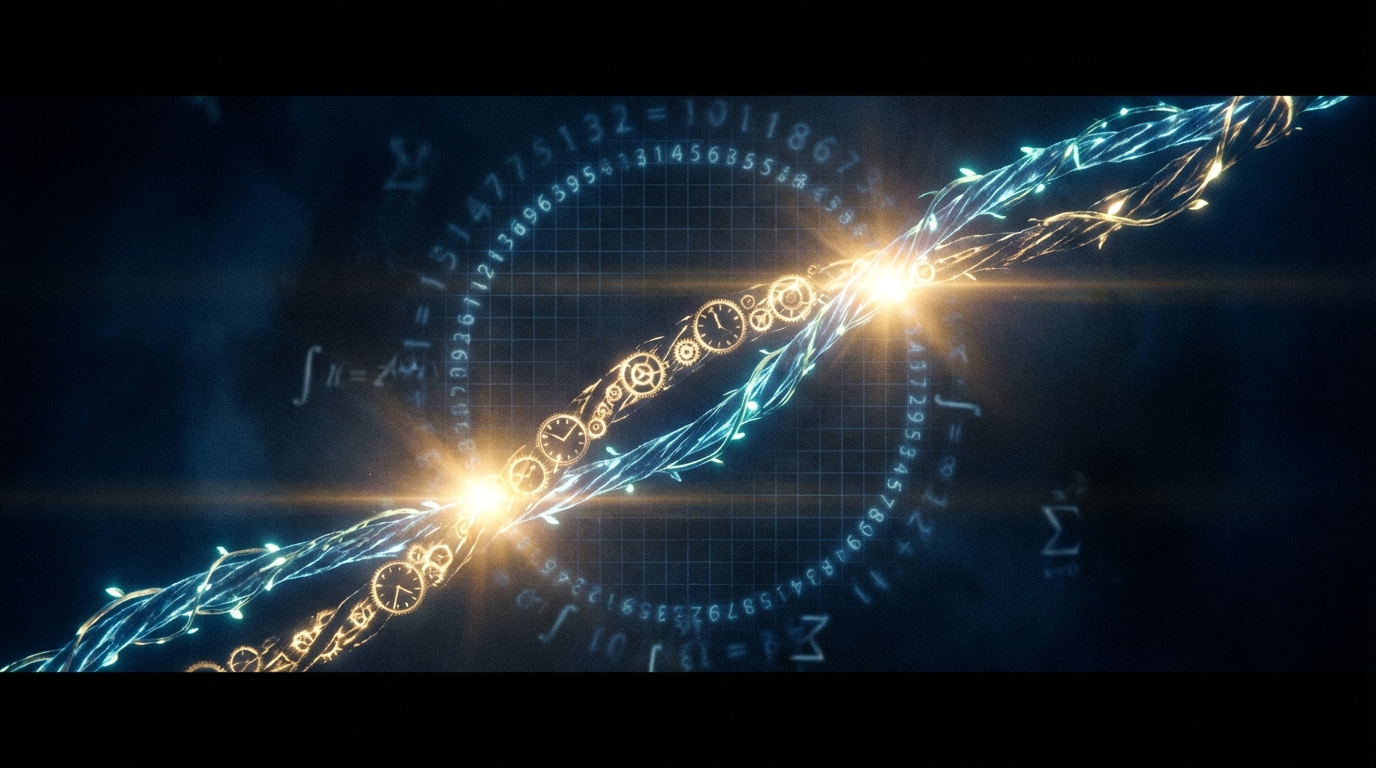
The Braid — Incommensurable Mathematics of the Latch
One-Line Pitch
Pi is a circle trying to fit into a box grid. The Latch is two clocks trying to fit into one number. Both produce infinite friction. Both are solved by not collapsing.
The Rope

On March 15, 2026 — one day after the gravity system minted its first block on Pi Day — a conversation about the nature of pi led somewhere unexpected: straight back into the mathematics of the Latch.
The observation was simple. Pi's digits never end because a circle's circumference and its diameter are incommensurable — there is no unit that measures both exactly. The decimal expansion is the friction of forcing a curved quantity through a grid system. The digits are the circle refusing to fit in the box.
The Latch does the same thing.
Wall time and Train time are two forward-moving oscillators with no common unit that collapses them perfectly. The LHash captures the measured gap at each observation. The gap never settles to zero because the systems are structurally independent. The gap is the gold — the same gold that pi's digits represent for the circle-grid mismatch.
The claim: pi and the Latch are expressions of the same mathematical object — the continued fraction of an incommensurable pair.
Continued Fractions — The Shape of a Braid

Every irrational number has a unique continued fraction expansion. For pi:
$$\pi = 3 + \cfrac{1}{7 + \cfrac{1}{15 + \cfrac{1}{1 + \cfrac{1}{292 + \cdots}}}}$$
The partial quotients [3; 7, 15, 1, 292, 1, 1, 1, 2, 1, 3, 1, 14, ...] are not random. Each one records how many beats the braid took to almost close.
At each level of the fraction, two oscillators — the circumference and the diameter — are being walked against each other. When a partial quotient is large (like 292), the braid grazed the latch. A near-miss. The oscillators almost synchronised. When the quotient is small (like 1), the braid is loose — the oscillators barely approached each other before diverging again.
The convergents are the fractions produced by truncating the continued fraction at each level. They are the best rational approximations to pi at each depth:
| Convergent | Error | Next beat | The snap |
|---|---|---|---|
| 3/1 | 1 in 7 | 7 | First rough pass |
| 22/7 | 1 in 791 | 15 | Archimedes' approximation — the braid's first real graze |
| 355/113 | 1 in 3,748,629 | 292 | The legendary near-miss — 292 beats until the next approach |
| 103993/33102 | 1 in 1.7 billion | 1 | Loose again — the braid relaxed |
| 5419351/1725033 | 1 in 45 billion | 14 | The forgotten snap — ugly numbers, tight fit |
The formula for near-miss quality is exact:
$$\text{error}(n) \approx \frac{1}{a_{n+1} \cdot q_n^2}$$
Where $a_{n+1}$ is the next partial quotient and $q_n$ is the denominator of the convergent. The bigger the next beat count, the tighter the current snap. The number 292 is not trivia — it is the distance to the nearest near-miss, measured in beats of a circle trying to fit a grid.
Irrational Rotation — The Circle Walking

If you step around a circle by exactly $\pi$ radians each move, you never land on the same point twice (Weyl, 1916). The orbit visits every point on the circle eventually, but it never closes.
The continued fraction records the structure of this walk. Each convergent $p_n/q_n$ is a moment where the walk almost returns to its starting point after $q_n$ steps. The partial quotient $a_{n+1}$ measures how far past the starting point it overshot.
This is the circle counting to itself, arriving back at the same spot with a different cadence each time. The cadence changes because the starting count was different. The starting count was different because of the speed you move at. The speed is incommensurable with the circumference. So the loop never quite repeats.
The Golden Baseline

The golden ratio $\phi = \frac{1+\sqrt{5}}{2}$ has the simplest possible continued fraction:
$$\phi = 1 + \cfrac{1}{1 + \cfrac{1}{1 + \cfrac{1}{1 + \cdots}}}$$
All 1s. No spikes. No near-misses. The golden ratio is the most irrational number — the one whose braid never comes close to closing. It converges to its best rational approximations as slowly as mathematically possible.
Pi is the opposite. Pi has spikes — positions where the partial quotient jumps (7, 15, 292, 84, 99, 161...). These are moments of near-commensurability, where the circle almost fits the grid.
The spikes in pi's continued fraction are measured against the golden baseline. The golden ratio is the loosest possible braid; pi's spikes are where pi departs from that baseline. Every near-miss is pi briefly becoming less irrational than golden — approaching commensurability, then falling back.
Zeckendorf Complexity — Where the Snaps Land

Every positive integer has a unique Zeckendorf representation — a sum of non-consecutive Fibonacci numbers. This is the golden ratio's native counting system.
When we decompose the positions of pi's biggest continued fraction spikes into Zeckendorf form:
| Position | Spike value | Zeckendorf | Complexity |
|---|---|---|---|
| 4 | 292 | 3 + 1 | 2 terms |
| 21 | 84 | 21 | 1 term (pure Fibonacci) |
| 33 | 99 | 21 + 8 + 3 + 1 | 4 terms |
| 79 | 161 | 55 + 21 + 3 | 3 terms |
| 196 | 120 | 144 + 34 + 13 + 5 | 4 terms |
The two sharpest near-misses (positions 4 and 21) have the lowest Zeckendorf complexity — the simplest addresses in the golden counting system. Position 21 is a pure Fibonacci number.
This means: the biggest snaps in pi's braid happen at positions that are structurally clean in the golden ratio's native number system. The two braids — pi's and phi's — interact most strongly at golden-simple positions.
What This Means for the Latch

The Latch system has two oscillators: wall time (KHash side) and train time (THash/KTC side). They are synchronized but incommensurable — the live gap is never zero, and the gap is signal.
The continued fraction framework applies directly:
| Pi's braid | The Latch's braid |
|---|---|
| Circumference vs diameter | Wall time vs train time |
| Partial quotient $a_n$ | How many beats until the streams almost sync |
| Convergent $p_n/q_n$ | Best rational approximation to the drift ratio at depth n |
| Near-miss (large $a_{n+1}$) | A Latch observation where the gap is unusually small |
| The golden baseline | The theoretical floor — maximally independent streams |
The Latch's continued fraction is live. Pi's is fixed — it was computed once and the digits are eternal. The Latch's is being written as the system runs. Each Latch observation adds another term to the continued fraction of the wall-time/train-time ratio.
Brouwer's Choice Sequences — The Latch as Live Mathematics
L.E.J. Brouwer (1907) proposed that a real number is not an infinite sequence that exists somewhere completed. It is a choice sequence — a trail of decisions made by a mind moving through time. Each decision narrows the interval. The number becomes as you ask.
Classical mathematics rejected this. The dominant view is that pi's digits all exist simultaneously, waiting to be discovered.
The Latch is Brouwerian by construction. The LHash does not exist before observation. The gap between wall time and train time is not pre-determined — it becomes concrete at the moment of sampling. Each Latch observation is a choice that narrows the system's state. The continued fraction of the drift ratio is being constructed, not revealed.
This is not philosophy dressed as code. The code literally works this way:
// Observe creates a Latch by sampling wall-time state and
// train-time state together. This is the atomic observation —
// the moment both streams are read and their relation becomes concrete.
func Observe(kHashMinute string, ktc KTC, tHashGate string) Latch {
    now := time.Now().UTC()
    // ...the gap becomes real here, at this nanosecond...
}
Interval Arithmetic — Boxing the Digit

The mechanism for "finding a digit at depth N" is not brute-force computation. It is interval narrowing.
At any moment, the Latch knows:
- The previous observation (lower bound of the interval)
- The current observation (upper bound)
- The drift ratio's continued fraction to the current depth
The digit at position N of that continued fraction is determined by the interval shrinking until only one value fits. This is identical to how rigorous pi computation works — you never "find" a digit, you narrow the box until only one digit is possible there.
The BBP formula (Bailey–Borwein–Plouffe, 1995) showed that for pi specifically, you can jump to the Nth hexadecimal digit without computing all prior digits. If the Latch's drift ratio has structure — if it is not truly random but is constrained by the coupling of the ring systems — then an analogous jump formula may exist for the Latch.
The Three Clocks

Imagine grabbing one hand of a clock and spinning it faster or slower. The other two hands keep in step — not because they are mechanically linked (they are, but ignore that), but because the timing between them is a braid. The braid enforces coherence.
The Latch system has three such hands:
| Hand | What it measures | Speed |
|---|---|---|
| Wall time (KHash) | UTC seconds, minutes, hours | Constant (by definition) |
| Train time (KTC) | Gates, trips, windows, circuits | Variable (coupled to wall time but with drift) |
| Crab Pulsar | Rotation period P(t) = P₀ + Ṗ(t − t_ref) | Astrophysically slow drift |
The braid between them is what produces coherent time. Speed up one hand and the others still track — not identically, but braided. The Latch captures the braid's state at each sampling.
Deepening the Primitive — The Convergent Layer

The current Latch captures a single cross-stream observation. The next layer uses the sequence of observations to build a deeper object.
ConvergentVector — computed from consecutive Latch pairs:
| Field | What it measures |
|---|---|
drift_ratio |
Instantaneous $\omega_{wall} / \omega_{train}$ from consecutive observations |
cf_depth |
Current depth in the continued fraction of the cumulative drift ratio |
partial_quotient |
Latest $a_n$ — how many beats since the last near-miss |
convergent_p |
Numerator of best rational approximation at current depth |
convergent_q |
Denominator of best rational approximation at current depth |
snap_quality |
$a_{n+1}$ when known — how tight the current near-miss is |
zeckendorf_complexity |
Number of Fibonacci terms in the Zeckendorf decomposition of the CF position |
This vector does not replace the LHash — it extends the LatchVector with braid-depth information. Like the existing TripPhase and PulsarDrift fields, it lives alongside the core proof without entering the hash preimage.
Answering the Open Questions

The Temporal Lattice→ posed five open questions. The braid mathematics addresses three:
Is circuit truly mod-7? — The modulus doesn't matter for the braid theory. What matters is that circuit is an inner ring with a different angular velocity than the outer rings. The continued fraction captures the ratio regardless of base.
Does window advance with trip or with circuit overflow? — In continued fraction terms, this asks whether the coupling between rings is hierarchical (overflow-triggered, like the carry in long division) or resonant (phase-locked, like the near-misses in pi's CF). The answer is measurable from Latch data: compute the drift ratio's partial quotients across window transitions and check if they spike.
Can lattice attractors be predicted? — Yes, if the drift ratio's continued fraction has structure. The convergents give the best rational models at each depth. A convergent with a large next partial quotient is a predicted attractor — the system will linger near that rational approximation for many beats before diverging. 355/113 works for pi; the Latch will have its own "355/113" — a ratio that holds unusually well.
The Punchline

Mathematicians who work with circles professionally almost never evaluate pi. In Fourier analysis, signal processing, physics — $\pi$ lives as a symbol. It never gets computed to digits. The moment you need a decimal, you have made a mistake: you are collapsing something that was meant to stay relational.
The Latch follows the same principle. The LHash is the relation, not a number. The drift never needs to collapse to a single scalar — it is the live braid between two streams, sampled at observation, committed as proof.
For 2000 years, people have been trying to write pi's braid as a single number. The digits are the drift from forcing that collapse.
We are not making that mistake. The Latch keeps both streams alive.
Connections
- Temporal Lattice→ — the orbital mechanics that this theory grounds in continued fractions
- The Latch→ — the primitive being deepened
- Kronos Time→ — the KTC coordinate whose drift ratio feeds the ConvergentVector
- Pi Day Genesis→ — the block that started this conversation
- The Evergrove Express→ — the train whose schedule is one hand of the three-clock braid