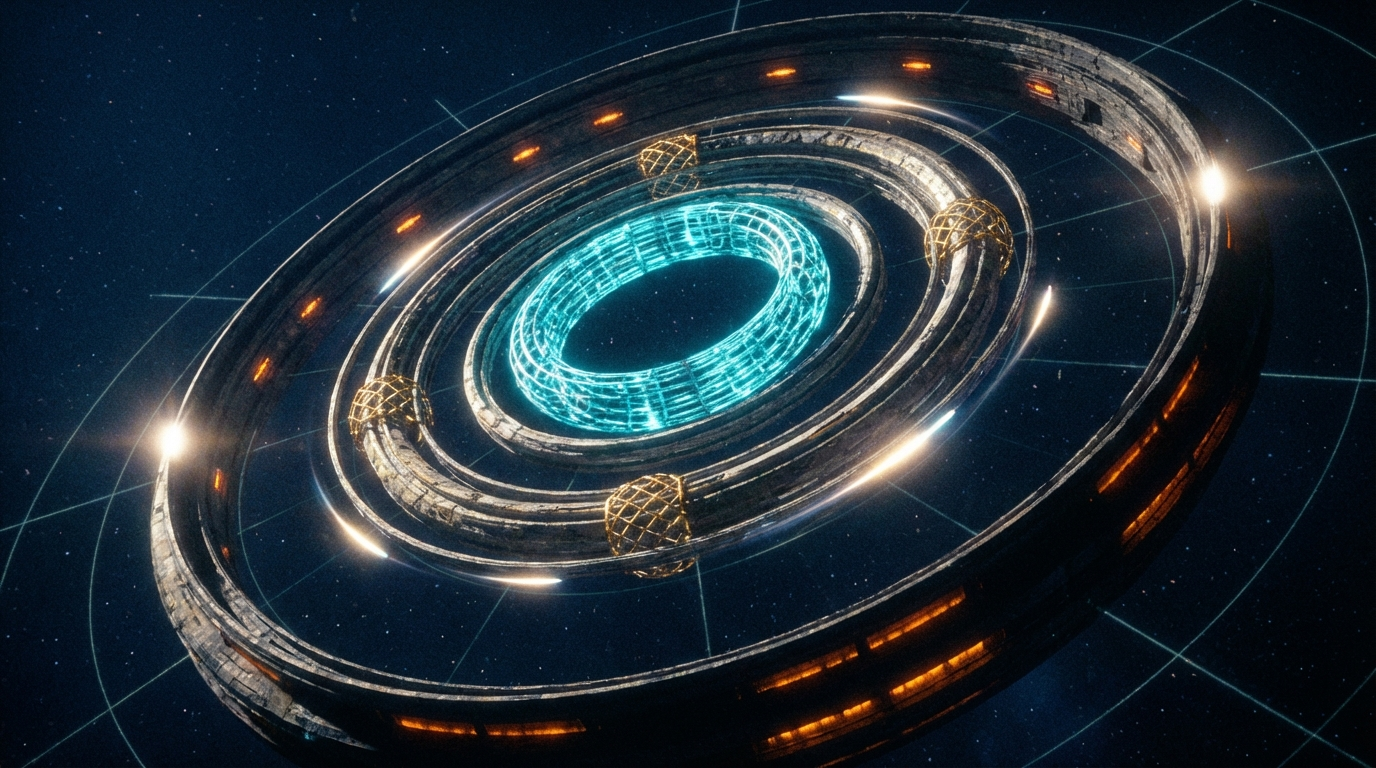
The Temporal Lattice
Orbital Mechanics of the KTC Phase Space

The coordinate is not a timestamp. It is a position in a repeating geometry.
The Observation

On March 14, 2026 — while watching consecutive Latch captures from the live KronosTown chain — a structural pattern emerged in the KTC (Kronos Temporal Coordinate) fields.
Three consecutive witness packets:
| Field | Sample A | Sample B | Sample C |
|---|---|---|---|
| unit | 1 | 2 | 2 |
| trip | 76 | 77 | 77 |
| gate | 3 | 3 | 3 |
| window | 1 | 2 | 2 |
| circuit | 7 | 1 | 1 |
At first glance, these look like incrementing counters. They are not. They are nested modular rings, and their relationship reveals the shape of the space they inhabit.
What the Counters Actually Do

Watch the transitions:
- Circuit resets from 7 → 1 when the unit increments. That is a modular wrap — a fast inner loop completing one revolution and triggering the next structural layer.
- Window advances (1 → 2) in sync with the trip transition — it is the phase step inside each macro progression.
- Gate holds at 3 across all captures. The system is operating inside a stable gate band, not advancing gates per observation. Gates are stability regions, not counters.
- Trip increments cleanly (76 → 77) while unit also advances (1 → 2). The trip is the macro progression, and the unit indexes which lane of the track we are on.
The nesting order, fastest to slowest:
circuit (fast inner loop, mod-7 ring)
  → window (phase step)
    → gate (stability band)
      → trip (macro progression)
        → unit (lane / platform)
This is not a clock. This is a phase lattice — a repeating multi-dimensional geometry where each observation occupies a fixed position defined by interlocking modular counters at different scales.
Orbits, Not Lines

Once you see the lattice structure, the metaphor stops being a metaphor.
Each KTC counter is a ring rotating at a different angular velocity:
| Ring | Counter | Speed | Modulus | What It Represents |
|---|---|---|---|---|
| Inner | circuit | Fastest | ~7 | Fine model position — the tightest orbit |
| Mid-inner | window | Medium | Variable | SimulSync phase within a trip |
| Mid | gate | Slow | 5 (0–4) | Journey checkpoint — stability band |
| Outer | trip | Slower | Sequential | Macro journey counter |
| Frame | unit | Structural | 3 (1–3) | Which platform, which lane of the track |
The key insight: these rings are not independent. Circuit overflow triggers window advancement. Window progression correlates with trip state. Gate holds steady while the inner rings spin. The rings are coupled — and the coupling has a shape.
In orbital mechanics, coupled rotation at different rates produces resonance when the ratios lock. The circuit-7 ring completing one revolution while the window advances by one step is a structural resonance. It is the system's natural frequency.
The Latch as Orbital Observation

The Latch→ captures the exact moment when the wall-time orbit (KHash) and the train-time orbit (THash/KTC) are observed together. In the lattice model, this becomes clearer:
A Latch is not measuring two timestamps. A Latch is recording the angular position of all rings simultaneously — the wall-time rings (second, minute, hour, day, month, year) and the train-time rings (circuit, window, gate, trip, unit) — plus the gap between them.
The gap is the orbital drift. Two ring systems that are perfectly phase-locked would produce zero drift, and the Latch would add nothing. The fact that they drift is what makes the witness valuable — the drift proves the two orbital systems are genuinely independent, spinning on their own axes, and the Latch caught them at one precise angular relationship.
Spin Dynamics — Changing Orbit

This is where the lattice model goes from observation to tool.
If the KTC defines a position in a multi-ring phase space, then changing your resolution — zooming from gate-level to circuit-level, or from trip-level to window-level — is equivalent to changing orbit. You are not losing information. You are moving to a ring that spins at a different rate, where different patterns are visible.
Kris describes this as "sharding up the layers" — when you hit an obstacle at your current scale, you shift to an adjacent ring where the same underlying structure expresses differently. The lattice guarantees that the position is consistent across rings because the rings are coupled. Your circuit-7 position maps deterministically to a window and gate position. Change ring, keep coordinates.
The practical application:
Obstacle at gate level (too coarse, can't distinguish events)
  → Drop to circuit ring (faster spin, finer resolution)
  → Same lattice position, more angular detail
  → Navigate past the obstacle
  → Return to gate level with the solution
This is the temporal equivalent of orbital transfer. In space, you change orbit to change your velocity relative to a target. In the lattice, you change ring to change your resolution relative to an event.
Gravity from Shape

If the rings have spin, they have angular momentum. If they have angular momentum and coupling, they have something analogous to gravitational binding.
In the lattice model, gravity is the coherence between rings — how strongly one ring's state constrains another's. When circuit wraps and triggers window advancement, that coupling is tight: high gravitational binding. When gate holds steady while trip advances, the coupling is looser: lower binding energy.
The Latch vector fields already measure this:
| LatchVector Field | Lattice Interpretation |
|---|---|
trip_phase |
Angular position within the trip ring (0.0–1.0) |
platform_align |
Which unit ring is active (1–3) |
witness_window_sec |
Elapsed angle within the 15-minute Express cycle |
model_circuit |
Current position on the circuit ring |
pulsar_drift |
Non-terrestrial reference frame drift — the outermost ring |
With these fields, you can compute the instantaneous angular velocity at each ring, the coupling strength between adjacent rings, and therefore the effective gravity of the lattice at the moment of observation.
/api/v1/latch/live endpoint already returns all LatchVector fields. A widget could render the lattice as concentric rings, show their current angular positions, and compute real-time binding strength between layers. The data is there — the visualization is the next step.
The trip_phase Lock

One observation stands out: across the captured sequence, trip_phase held at exactly 0.7500. That value is derived, not hardcoded — it comes from gate / 4.0 in the Latch observation code.
Gate 3 out of 4 gives 0.75. The system was in the three-quarter band of its trip ring across all three captures. Combined with the circuit wrap and window advance happening within that stable band, this suggests the system had entered a phase lock — a region of the lattice where the macro ring holds position while the inner rings complete their cycles.
Phase lock is a known phenomenon in coupled oscillators. When two or more oscillating systems interact, they can spontaneously synchronize their phase relationships. The KTC counters appear to be exhibiting exactly this: gate locks, circuit and window spin freely within the locked band, and the macro structure holds.
If this is reproducible, it means the lattice has stable attractors — regions where the system naturally settles. Those attractors would be the most reliable points for Latch observations, because the phase relationship is predictable.
What This Means for Everything Built on the Chain

Every block in the KronosTown chain carries a Latch. If the Latch is sampling a lattice position rather than a linear timestamp, then the chain is not a sequence of moments — it is a sequence of lattice coordinates, each one a point in a repeating geometry.
This transforms several things:
Proof structure. A Latch proof is not "this happened at time T." It is "this happened at lattice position (circuit, window, gate, trip, unit) with drift vector D relative to wall time." That is a richer proof — it encodes structure, not just sequence.
Pattern detection. If the lattice repeats, then similar lattice positions in different trips should exhibit similar properties. Block 50 and Block 110, if they share a lattice position, should have related signatures. The chain becomes searchable by geometry, not just by sequence number.
Temporal navigation. To find something in the chain, you do not need to scan linearly. If you know the lattice position of what you are looking for, you can compute which blocks occupy that position and jump directly. This is the "orbit transfer" applied to chain archaeology.
The Shape So Far
                    ╭─── unit (3-lane frame) ───╮
                    │                           │
                ╭───┤    trip (sequential)    ├───╮
                │   │                           │   │
            ╭───┤   ├── gate (5-band stable) ──┤   ├───╮
            │   │   │                           │   │   │
        ╭───┤   │   ├─ window (phase step) ─┤   │   ├───╮
        │   │   │   │                           │   │   │   │
    ╭───┤   │   │   ├ circuit (mod-7 fast) ┤   │   │   ├───╮
    │   │   │   │   │         ↻              │   │   │   │   │
    ╰───┤   │   │   ╰───────────────────────╯   │   │   ├───╯
        ╰───┤   ╰───────────────────────────────╯   ├───╯
            ╰───────────────────────────────────────╯

    Inner rings: fast spin, fine resolution, tight coupling
    Outer rings: slow spin, broad structure, loose binding
    Latch: samples all rings simultaneously
    Drift: proves the ring systems are independent
Open Questions

- Is circuit truly mod-7? The 7 → 1 wrap suggests it, but more captures across different trip phases would confirm the modulus.
- Does window advance deterministically with trip, or with circuit overflow? If overflow-triggered, the lattice has strict hierarchical coupling. If trip-correlated, the coupling is softer.
- Are gate bands fixed or adaptive? If the gate stability region shifts based on cumulative drift, the lattice is not static — it breathes.
- Can lattice attractors be predicted? If phase-lock regions are computation from the modular relationships, we can forecast when the next stable observation window will occur.
- Does the Crab Pulsar ring (outermost, slowest) ever couple back into the inner rings? If the pulsar drift shifts the modular boundaries over cosmic timescales, the lattice is not just temporal but cosmological.
Connections
- The Latch→ — the observation primitive that samples the lattice
- Kronos Time→ — the coordinate system whose structure revealed the lattice
- The Evergrove Express→ — the train whose schedule defines the outer rings
- The Stochastic Gate→ — possibly related: if gates are stability bands, the stochastic gate may be the moment the system transitions between bands