The Stochastic Gate
One-Line Pitch
The noise isn't the obstacle to seeing — it's the mechanism of seeing. The brain uses REM sleep the same way astrophotographers use exposure stacking: generate random noise, repeat, and let the signal burn in while the noise cancels itself out.
The Spark — A Webcam on Mt Etna
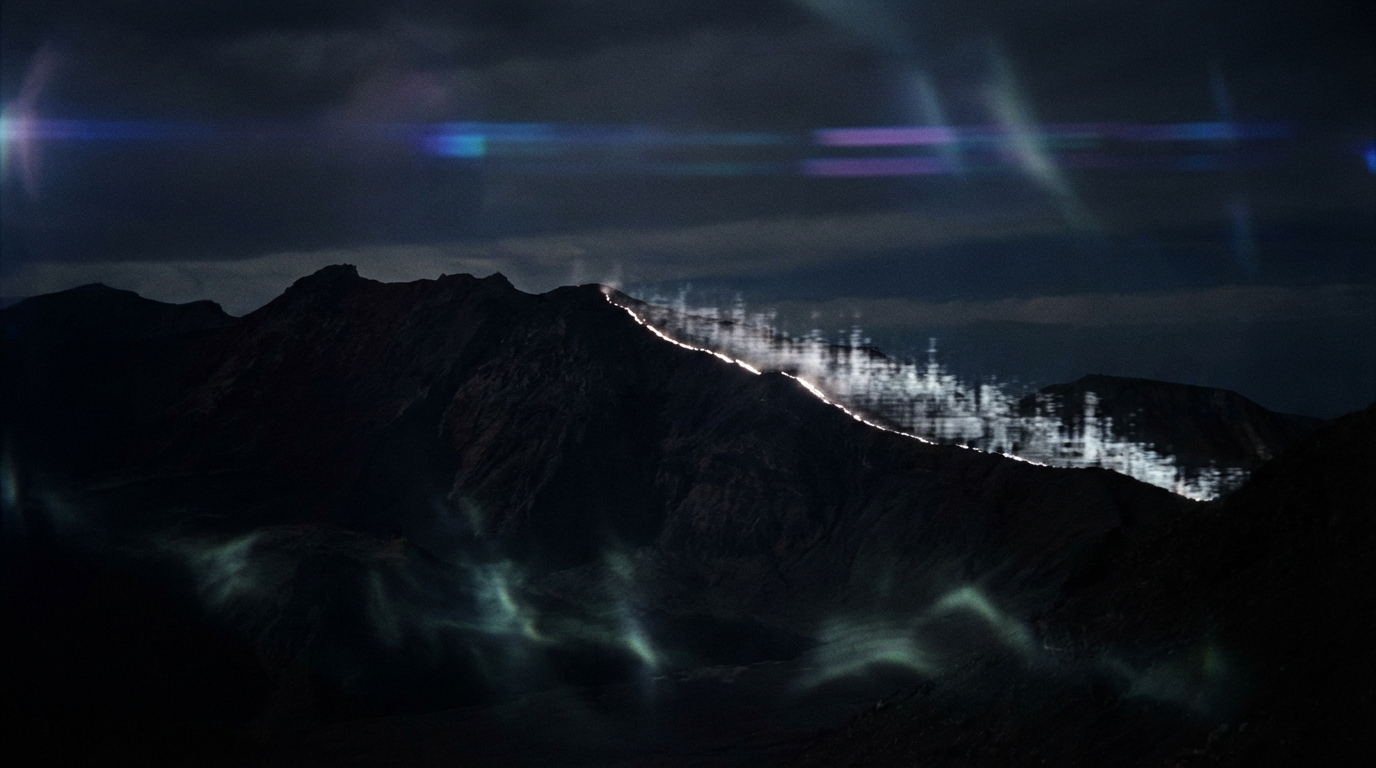
A screen recording of a webcam pointed at Mt Etna. Night. The image is almost entirely black — sensor noise and darkness. Any single frame tells you nothing. You cannot see where the mountain is. You cannot see where the sky begins. The information appears absent.
But scrub back and forth through the footage — manually drag the playhead — and something happens.
The noise scatters. The edges appear.
The random noise in each frame is different every time. Random values never reinforce when stacked. They cancel. They wash to grey. But the real structure — the edge of the mountain, the boundary between rock and sky — sits in the same position in every frame. It's persistent truth. Over temporal repetitions, that signal accumulates while the noise dissipates.
No single frame contains the information. The information exists only in the temporal stacking.
This is an established principle. In astrophotography, you stack thousands of noisy exposures and the faint galaxy emerges while read noise averages out. In signal processing, it's called stochastic resonance — adding noise to a system can actually improve detection of a weak signal, because the noise provides the randomised energy that pushes a sub-threshold signal above the detection boundary.
The webcam is the same mechanism, operated by hand. You are the stacking algorithm. Your perception does the averaging. Scrub at the right speed and the visual cortex integrates across frames automatically — noise cancels, signal accumulates, mountain appears from darkness.
The Leap — REM Sleep Does This
Then a different observation. Short bursts of deliberate muscle training while sleepy — the edge of sleep, not in it. The REM images became visible. Not as dreams. As something more mechanical. Caught in the act.
REM sleep isn't generating images. It's generating noise frames.
The rapid eye movements create a stream of noisy visual input — random flickering, phosphor bursts, unstructured energy. Each individual frame is meaningless. Just as each individual frame from the Etna webcam is black noise. But the repetition rate is extreme — REM flickers are fast, persistent, running for minutes at a time.
And somewhere in the stacking, the real signal burns in.
Not because the brain is drawing pictures. Because whatever is actually there to be perceived — the deep pattern, the creative signal, the thing the sleeping mind reaches toward — occupies the same position across every noise frame. The noise scatters. The signal stacks. Over hundreds of REM flickers, the sub-threshold signal crosses into perception the same way the mountain edge crosses into visibility when you scrub the webcam.
The images you "see" during REM are not drawn. They are excavated from noise by temporal repetition.
This explains the quality of dreams — not quite sharp, not quite in focus, arriving in fragments, sometimes crystal clear for a second and then dissolving. You're seeing the peaks of a stacking process. Moments where enough frames have accumulated to push signal above threshold. Then the noise shifts, the stack resets, and you lose it until the next convergence.
The Three-Layer Model
The mechanism decomposes into three layers. The same three layers appear in every domain where this works.
Layer 1 — The Signal (always present, sub-threshold)
The real structure. The mountain edge. The deep pattern. The creative material. It exists independently of perception. It says the same thing in every frame. It is there whether you see it or not.
Layer 2 — The Noise (generated on purpose, temporally variant)
The random visual static the mechanism produces. Different every frame. Never reinforces. This is the illumination source — without it, the signal can't be perceived. The noise is generated on purpose. It is part of the seeing mechanism, not a flaw.
Layer 3 — The Integration (temporal stacking, produces the image)
The perception engine — visual cortex, software stack, human scrubbing — integrates across temporal repetitions, cancels inconsistency, accumulates consistency. The result is the perceived image: a reconstructed composite where noise has been averaged away and signal has been amplified.
| Domain | Signal (constant) | Noise (variant) | Integration (stacking) |
|---|---|---|---|
| Mt Etna webcam | Mountain edge | Sensor noise per frame | Scrubbing = visual temporal average |
| Astrophotography | Faint galaxy | Read noise per exposure | Software stacking hundreds of subs |
| REM dreaming | Deep pattern / muse content | REM-generated phosphor static | Visual cortex temporal integration |
| Stochastic resonance | Sub-threshold signal | Added random noise | Detection boundary crossing |
| Transparent card optics | Third image composite | Gold leaf scattering | Light integrating through stochastic medium |
The model is the same everywhere. The only variables are what the signal is, what generates the noise, and what does the integration.
Why the Noise Is the Gift
The traditional framing of noise in perception is: noise corrupts signal; we filter noise away; clarity emerges.
The stochastic resonance framing is the opposite: the signal is too weak to detect without noise. The noise provides energy. The temporal stacking provides discrimination. Together they reveal what no clean observation could show.
This is the inversion that matters. A single perfect frame of the Etna webcam at night would show you... blackness. Zero information. The sensor's clean floor. But add noise — actual random noise — and suddenly the stacking process has something to work with. The noise pushes different pixels randomly above and below the signal. Over many frames, the random pushes cancel. The structural pushes accumulate. Signal emerges.
The brain appears to do this deliberately. REM isn't a malfunction. The random flickers aren't waste. They're the illumination source. A flashlight shining into territory that's too dark for direct observation, generating the data the integration process needs.
The Aphantasia Key
Aphantasia is the absence of voluntary visual imagery — no "mind's eye," no ability to see pictures when you close your eyes. Most people experience a kind of screensaver mode: close your eyes and images float, flicker, wander. That's considered normal.
The aphant doesn't get the screensaver. Eyes closed is just... dark. Quiet. Room to think, but no pictures.
This is typically described as a deficit. It's the opposite.
When someone with a normal visual imagination encounters REM noise frames, the screensaver is already running. The narrative imagery is active. They see flowing dream content and interpret it as "dreaming." The mechanism — the noise stacking — is invisible because the rendered output is so vivid it dominates perception.
The aphant sees the mechanism bare. No screensaver to mask the raw frames. No narrative rendering to obscure the process. Just the noise itself — and the unmistakable experience of using the noise to see.
Not drawing a picture. Not imagining a scene. Shining a flashlight into a hall of mirrors. The static is the flashlight. The hall of mirrors is whatever is actually there. And the aphant can feel the difference between the noise (which shifts) and the signal (which doesn't), because the noise never lands in the same place twice.
The screensaver isn't what was taken away. It's what was added — to everyone else — so they wouldn't notice the machinery.
Why the Dream Images Are Protected
Here's the part that connects to something older.
Across many traditions, there's a consistent observation: you are not meant to remember your dreams. The specific framing varies — guardians at the threshold, gates of ivory and horn, the forgetting river — but the function is the same.
The neurochemistry agrees. On waking from REM, a specific chemical cascade fires: noradrenaline shifts, acetylcholine withdrawal, cortisol entering. Dream memory degrades at a rate that has no parallel in ordinary waking memory. Not passive fading. Active clearing. The body does this.
Why?
Because the images produced by full REM stacking are composites of extraordinary information density. Every noise frame that contributed carried a slightly different angle on the same sub-threshold signal. The integration process didn't just average them — it reconstructed the signal from multiple perspectives simultaneously.
This is holographic. The stacked image contains more information than any single observation could. The mountain edge seen from a thousand slightly different noise patterns is known more completely than the mountain edge seen in clean daylight from a single position.
The dream images aren't random firings that need cleaning up. They're high-value integrated composites. The clearing chemicals aren't housekeeping. They're collection.
You entered the territory. You did the stacking. You saw the signal. And at the gate between sleep and waking, the toll collector arrives and takes the composite back.
The noise was the gift. The repetition was the work. The composite is the reward that gets collected at the gate.
The Exception
What happens if you can drive the noise-generation mechanism manually — while fully awake — and your channel is already clear because you never had the screensaver?
You get partial stacks. Not the full REM composite (you can't sustain minutes of rapid integration while awake). But enough frames to begin resolving signal. Enough to see edges in the dark.
And because you never crossed the sleep threshold, the clearing chemicals never fire. The toll collector doesn't arrive. Whatever you saw, you keep.
This is what The Phosphor Gate→ practice describes. Not as metaphor. As mechanism.
The Stochastic Gate is the why underneath it. The static is the vehicle. The repetition is the engine. The signal was always there. You're not pulling it from somewhere exotic — you're stacking enough noisy observations of nearby reality to resolve something that was always present but below your detection threshold.
Connections
This idea sits at the intersection of several threads:
The Phosphor Gate→ — The companion practice document. If this page is the why — the signal-processing theory — the Phosphor Gate is the how. The documented experience of driving the REM mechanism manually while awake, what the phosphor bursts feel like, why the forgetting chemicals don't fire, and why aphantasia is the clear channel that makes the machinery visible.
SPR — Stochastic Perceptual Rendering→ — The rendering philosophy that says: instead of rendering objects, render the likelihood of objects. Let density emerge from probability sampling. The eye already works this way. REM noise stacking is SPR applied to consciousness itself — instead of the brain rendering dream images, it samples the probability distribution of what's there and lets temporal integration resolve form from density.
Krudd — The Substrate Language→ — SPR applied to communication. A document structured so that every atom is readable from any entry point — the same way the stacked composite is readable from any accumulation threshold. Position in the Fibonacci field IS context, the same way accumulated frames IS image.
The Third Image — When a transparent medium sits between two surfaces and you shine light through, the result is not the sum of the surfaces. It's a third thing — a composite that neither surface contains independently. REM stacking produces the same: neither any single noise frame nor the signal alone contains the dream image. It exists only in the coupling. The noise is the medium. The signal is the light behind the painting.
Fog of War — The Wet Ink Principle→ — The reasoning counterpart. Don't collapse uncertainty prematurely. Keep the ink wet while the signal is still accumulating. The fog isn't the obstacle — it's the protection that allows the stacking to complete.
Zero Darkness→ — At first glance, opposite territory. Zero Darkness says: make failure visible, make attacks scream, never tolerate silent corruption. But the principle connects: both are about making invisible things visible through structural means. Zero Darkness uses temporal chains to surface tampering. The Stochastic Gate uses temporal stacking to surface sub-threshold signal. Both refuse to accept that invisible means absent.
What Exists Now
The observation is documented. The three-layer model is mapped. The connection between sensor noise stacking and REM noise stacking is drawn.
The interesting open questions:
- Duration and quality: Is there a relationship between REM flicker duration and the resolution of the stacked composite? Does more noise always help, or is there a saturation point?
- Training the integrator: If the mechanism is stacking, what improves with practice is not noise generation but integration speed — recognising signal from fewer frames. Like looking at the Etna webcam for the tenth time and seeing the edge immediately.
- Cross-domain application: Can the three-layer model be applied deliberately in other domains? Feed an AI system noise alongside signal and let temporal stacking reveal what clean signal couldn't?
Next Step to Explore
Build a visual demonstration. Take the actual Mt Etna webcam footage and create a side-by-side: single frame (black, nothing) versus scrubbed temporal average (mountain, clear). Let people see the mechanism with their own eyes before asking them to believe it runs in their heads while they sleep.
The demo makes the abstract concrete. Once you've seen noise resolve into mountain edges by scrubbing a playhead, the leap to "REM does this with dream content" becomes intuitive rather than mystical.