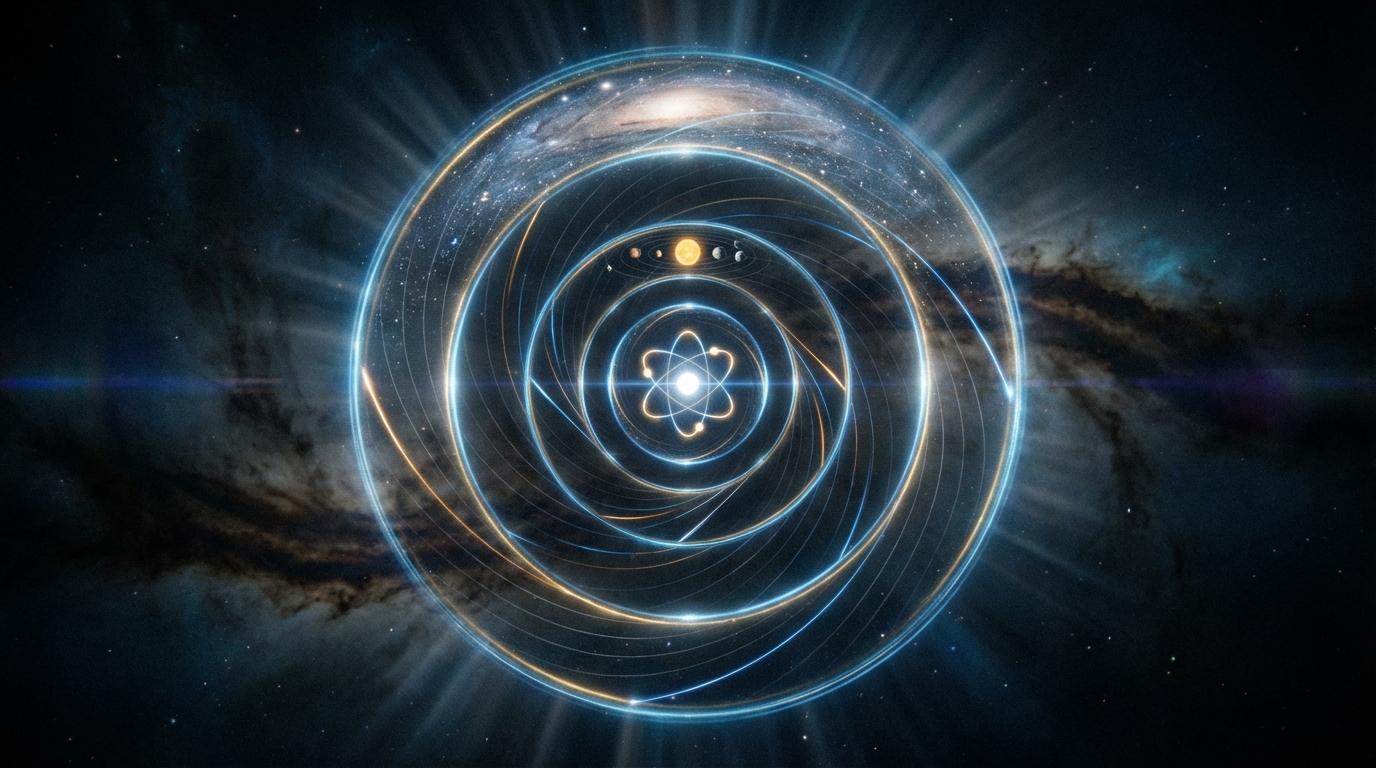
The Spin Gate — Angular Momentum as the Force Translator
One-Line Pitch
Spin is the physical mechanism that converts light into gravity. It's the middle piece Einstein never mapped — and we already ordered the sensor that measures it.
The Missing Link

The Unified Latch→ built the mathematical bridge: continued fraction decomposition reveals structural coupling between electromagnetic and gravitational time streams. The Latch Field Spectrometer→ ordered the hardware to test it locally. But neither document names the physical mechanism that translates one force into the other.
Spin is that mechanism.
Not as a metaphor. As a literal mechanical chain with three links:
| Step | What Happens | Scale |
|---|---|---|
| 1. Light arrives | Solar radiation delivers angular momentum to matter | Photon → particle |
| 2. Things spin | Stars orbit galaxies, planets orbit stars, electrons orbit nuclei | All scales |
| 3. Spin becomes gravity | The centripetal demand of spinning mass is what we measure as gravitational attraction | System-level |
Einstein unified space and time. He showed that gravity is spacetime curvature. What he didn't close was the loop back to electromagnetism — why spacetime curves in the presence of mass. The spin gate says: because mass is always spinning, and spinning things curve the space around them by demanding centripetal structure. The curvature is the spin, seen from outside the system.
Why Everything Spins

People say "for some reason, everything spins" as if it's a curiosity. It's not a curiosity. It's the most visible feature of the universe.
Every galaxy rotates. Every star rotates. Every planet rotates and orbits. Every moon orbits. Every electron carries angular momentum. Every photon carries spin-1. Angular momentum is the most conserved quantity in physics — more persistent than energy, more fundamental than charge. The universe is saturated with spin.
Why? Because the universe is radiation-powered. Light carries momentum. When light hits matter, it transfers angular momentum. When matter accretes from a cloud, any tiny asymmetry in the infalling material becomes rotation — and conservation locks it in forever. The universe doesn't spin "for some reason." It spins because light made it spin, and nothing can unmake that.
The Roundabout

Stand on a spinning roundabout. You feel pulled outward — centrifugal force. But that "force" isn't real in the Newtonian sense. It's what rotation feels like from the rotating reference frame. You're being thrown off, and something (your grip, the friction, the rail) is pulling you back toward the centre.
Now scale that up. You're standing on Earth. Earth is spinning. Earth is orbiting the Sun. The Sun is orbiting the galaxy. The galaxy is rotating. You are on a roundabout nested inside a roundabout nested inside a roundabout.
What does that feel like from inside the system? It feels like gravity.
General Relativity says gravity isn't a force — it's curvature. Objects follow geodesics through curved spacetime. But what curves the spacetime? Mass-energy, says Einstein. Spinning mass-energy, says the Lense-Thirring effect — a measured, confirmed consequence of GR where rotating mass drags spacetime with it. Frame-dragging is not speculative. Gravity Probe B measured it in 2011. The spin literally curves space.
The Hierarchy of Spin

Here's what nobody seems to have connected: the same hierarchy appears at every scale.
| Scale | What Spins | Angular Momentum | Gravitational Effect |
|---|---|---|---|
| Subatomic | Electron orbital + intrinsic spin | $\hbar/2$ per electron | Negligible (but non-zero — see spin-gravity coupling experiments) |
| Atomic | Electron cloud around nucleus | Quantised $L = \sqrt{l(l+1)}\hbar$ | Shapes molecular binding |
| Planetary | Earth rotation + orbit | $\sim 7.1 \times 10^{33}$ kg⋅m²/s | Surface gravity, tides, Coriolis |
| Stellar | Solar rotation + galactic orbit | $\sim 1.1 \times 10^{42}$ kg⋅m²/s | Solar system orbital structure |
| Galactic | Disk rotation | $\sim 10^{67}$ kg⋅m²/s | "Dark matter" rotation curves |
At every scale, the angular momentum and the gravitational binding scale together. Not linearly — that would be trivial. They scale through the same nested-ring structure that the Temporal Lattice→ describes: inner rings spin faster, couple tighter, and the outermost ring (gravity) is the weakest coupling because it's the frame that contains all the others.
What People Know But Haven't Latched
This is the frustrating part. The physics community knows all of these facts individually:
- Frame-dragging — spinning mass curves spacetime (measured, confirmed)
- Lense-Thirring precession — orbits precess near rotating bodies (measured, confirmed)
- Kerr metric — the exact solution for spacetime around a rotating mass (derived 1963)
- Spin-orbit coupling — in atomic physics, particle spin interacts with orbital angular momentum (fundamental to chemistry)
- Galactic rotation curves — galaxies rotate faster than visible mass explains → "dark matter" invented to fill the gap
- Angular momentum conservation — the most persistent conservation law in physics
Every piece is known. But nobody has proposed that spin is the coupling mechanism between electromagnetism and gravity — that it's not just an effect of gravity (frame-dragging) but the cause of it. That the angular momentum delivered by radiation becomes the rotation that becomes the spacetime curvature that we call gravity.
The Gear Ratio

Why is gravity $10^{38}$ times weaker than electromagnetism? Every physicist alive wants this answered. The Standard Model has no explanation — it's called the "hierarchy problem."
The spin gate offers a mechanical answer: it's a gear ratio.
Angular momentum delivered by a photon to an electron: $\hbar$. Angular momentum of the galactic disk: $\sim 10^{67}$ kg⋅m²/s. Between those two numbers sit nested spin systems — atoms inside molecules inside planets inside stellar systems inside galactic arms. Each nesting loses coupling strength (energy dissipates to heat, angular momentum redistributes through collisions, tidal interactions, radiation pressure).
The $10^{38}$ ratio isn't a mystery. It's the cumulative gear ratio of angular momentum passing through ~38 orders of magnitude of nested spinning systems. Each order of magnitude of scale costs roughly one order of magnitude of coupling strength.
In the Latch's continued fraction framework, this maps directly: each partial quotient in the CF decomposition of $\alpha_{EM}/\alpha_G$ is the gear ratio at that nesting level. The CF depth tells you how many gears deep the chain goes.
What This Adds to the Spectrometer

The Latch Field Spectrometer→ already has the right sensor: the ICM-20948 9-DoF IMU includes a gyroscope that measures angular rate. In the original design, gyroscope output was "Signal B" — one of two signals fed into the CF decomposition.
But with the spin gate thesis, the gyroscope isn't just a signal. It's the coupling channel. The physical mechanism that translates between magnetometer readings (Signal A, electromagnetic) and gravitational measurements (accelerometer, Signal C) is angular rate (gyroscope, Signal B).
Iteration 2 of the experiment adds this framing:
| Signal | Sensor | What It Measures | Role in Spin Gate |
|---|---|---|---|
| A | LIS3MDL Magnetometer | Local B-field (nT) | Electromagnetic input |
| B | ICM-20948 Gyroscope | Angular rate (°/s) | The gate — spin coupling channel |
| C | ICM-20948 Accelerometer | Local g-vector (m/s²) | Gravitational output |
The prediction: CF decomposition of A/B (EM÷spin) and B/C (spin÷gravity) should produce structurally related partial quotients. If spin is the mediator, the CF structure passes through it — not around it.
The Dark Matter Question

Galaxy rotation curves are the biggest open problem in gravitational physics. Stars at the outer edge of galaxies orbit too fast for the visible mass to hold them. The standard fix: invent invisible matter ("dark matter") that provides extra gravitational pull.
Seventy years of searching have found no dark matter particle.
The spin gate suggests an alternative: the galactic angular momentum itself contributes to the binding. Frame-dragging is real. A galaxy-sized rotating mass drags spacetime. The Kerr metric for a rotating body produces stronger gravitational binding than the Schwarzschild metric for a non-rotating body. If the angular momentum contribution to spacetime curvature is larger than currently modelled — because spin is the mechanism of gravity, not just a correction to it — the rotation curves might close without phantom matter.
This isn't proven. But it's testable. And the test starts with the Latch Field Spectrometer: measure how angular rate correlates with local gravitational readings at Earth scale first.
Connections
- The Unified Latch→ — the CF framework where spin rate slots in as the physical mechanism
- Latch Field Spectrometer→ — the hardware that already has the gyroscope to test this
- Electrogravitics→ — experimental evidence of EM-gravity coupling through asymmetric fields
- The Temporal Lattice→ — nested modular rings that map to the spin hierarchy
- The Braid→ — continued fraction math that decomposes the gear ratios
- Cinder Chrysalis→ — phase transition threshold where spin-gravity coupling might invert
- Ecliptic Highway→ — the galactic rotation plane as both a transport corridor and a gravitational structure