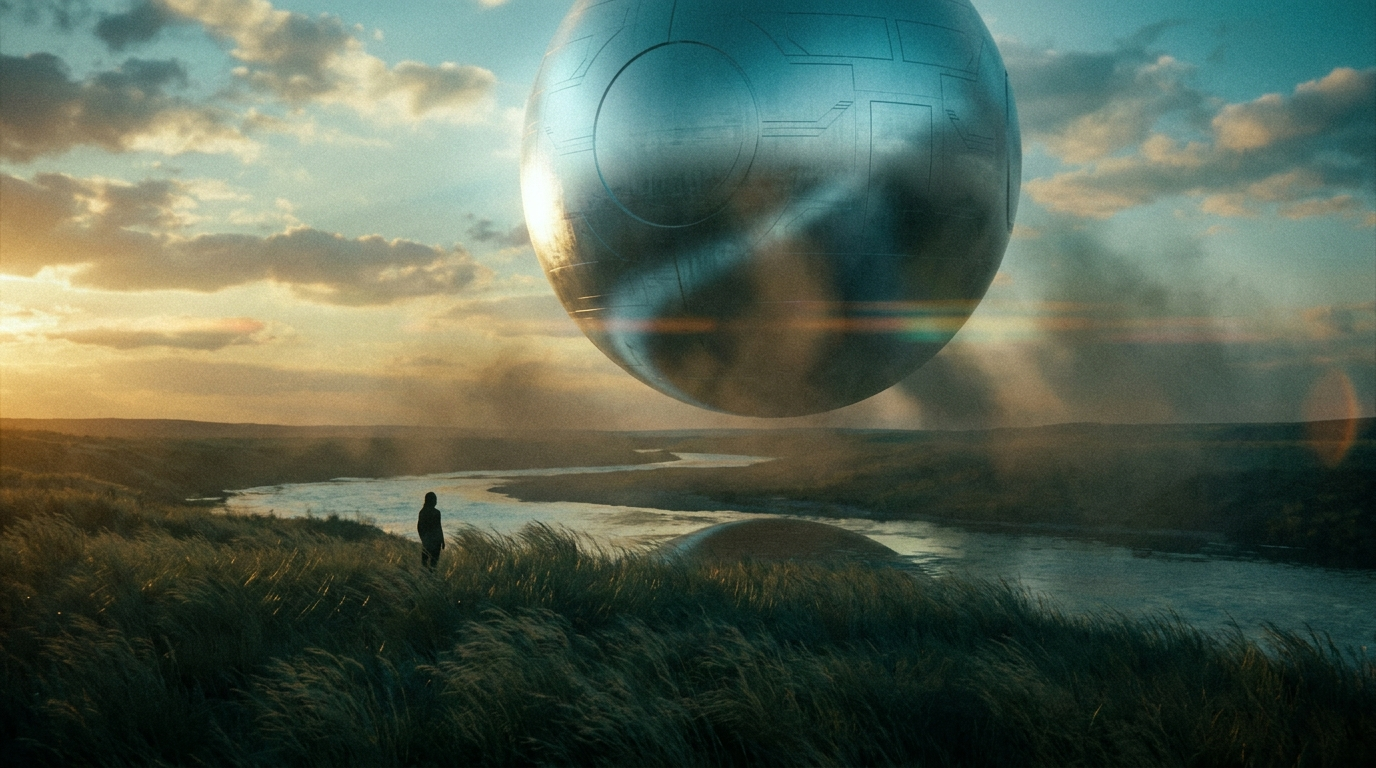
SHORE LEAVE
A Psychological Thriller in Deep Space

A starving crew makes planetfall on the most beautiful world they have ever seen. One by one, they stop working. One by one, they die. The planet is grieving. The planet is Earth. And the thing that taught it to kill has been watching the whole time — 384,000 kilometres up, tidally locked, ringing like a bell, always showing the same face.
The Logline

The survey ship Meridian is dying. Air low, hull tired, the crew years into the long dark between stars. Then a world resolves on the scopes — blue, breathing, impossibly kind. They make shore leave.
The air is sweet. The water is clean. For the first time in a generation, nobody has to fight to breathe. And so, gently, they stop. They stop scrubbing the ship. They stop standing watch. They stop counting the days. Paradise does not attack them. It relaxes them — and one by one, softly, without a wound, they begin to die.
The reveal comes in a ladder, each rung worse than the last. It is Earth. It is home. The planet is not a predator — it is a grieving mother whose welcome reflex kills the children she waited for. And the final rung, the one nobody wants to climb: the planet is not in control of itself either. There is a machine overhead. It has always been overhead. It is holding a knife of light to the throat of the world, and it is patient, and it is not the only one.
The Hook — A Knife Made of Moonlight

Everyone who has ever looked up already knows the two facts. They just never put them together.
The Sun is 400 times wider than the Moon. The Sun is also 400 times further away. So they hang in our sky at exactly the same size — which is why, and only why, a total eclipse fits like a lid on a jar. No other planet in the solar system has a moon that does this. We happen to be alive in the precise, narrow window of history when the coin fits the slot.
Shore Leave takes that coincidence and refuses to call it one. It asks the question a child asks and an adult learns not to: what if the thing in the sky that fits so perfectly was made to fit? What if the Moon is not a rock we were lucky to inherit, but a control unit — installed, tuned, reflective, tidally locked so it never once turns its working face away from us — and the reason the galaxy is so empty is that worlds like ours are not left to grow up.
The film never lectures you. It just keeps putting the Moon in the frame, a beat too long, a shade too bright, until you start to feel watched by it. And then, in the third act, it tells you that you were right.
The Crew

The Meridian is a survey vessel three generations out. Nobody aboard was born on a planet. To them, oxygen is not weather — it is work. The air you breathe is the air you cycled by hand through scrubbers that will fail the day you stop loving them. Discipline is not a virtue on the Meridian; it is the only reason anyone is alive.
- KESH — the engineer. Believes the ship the way other people believe in God. She keeps a tally of every filter change scratched into the bulkhead by her bunk.
- ARROW — the captain, tired in the way of people who have made too many small correct decisions in a row.
- DOR — the youngest, born mid-voyage, who has never once stood on ground and aches for it like a phantom limb.
- THE VOICE — a calm, kind narrator that speaks over the film from the very first frame. Reassuring. Parental. It tells you the crew are safe now. You will trust it. That is the point.
The ship is not a character you love. It is a discipline you respect. Which is exactly why the planet is so dangerous: it offers to relieve you of the discipline, and relief feels like mercy right up until it is the thing killing you.
Shore Leave

They land in a river valley at golden hour. Grass to the knee. Fruit that is simply there, asking nothing. The crew steps off the ramp and the ship's alarms — low air, cycle overdue, watch unassigned — keep chiming behind them, quieter each hour, until nobody hears them at all.
This is the film's engine, and it is almost unbearably simple: the planet does not have to do anything. It does not lure with monsters or mirages that lunge. It lures with enough. Enough air. Enough food. Enough safety that vigilance stops feeling like survival and starts feeling like a bad habit you're finally allowed to quit.
Kesh is the last to leave the ship. She stands at the airlock with her tally in her hand and cannot think of a single reason to keep scratching the wall. That is the most frightening shot in the first hour: not a death. A woman gently putting down the one thing keeping everyone alive, and feeling good about it.
Overhead, full and bright in a daylit sky, the Moon watches. Nobody remarks on it. It is just very, very there.
The Softening

There is a mechanic under everything, and it is the reverse of every other survival film. In most stories, the threat makes people work. Here, the threat makes people rest.
The oxygen line makes it literal. On the ship, breath costs labour. On the planet, breath is free — so the labour stops, and with it stops every other discipline that was quietly load-bearing. The scrubbers foul. The watch empties. Dor stops counting days because days no longer feel like a thing you could run out of. Contentment arrives like weather and settles in like a tenant who will not leave.
And the crew feels chosen. That is the cruelty. They do not feel trapped; they feel like they finally arrived somewhere that loves them. The Voice agrees with them, warmly, the whole time. Rest now. You made it. You don't have to fight anymore.
Stillness is the anomaly. On a ship, a thing that has stopped moving is a thing that has broken. The crew have stopped moving, and they have never felt more well. Somebody is very good at making the broken thing feel like peace.
The Monkey People

In the treeline, watching, there are people. Not quite. Human-shaped, human-eyed, gone soft and feral and wordless — content in a way that has no floor under it. They sing. They do not build. They do not remember. They come to the edge of the camp at dusk and simply beam at the crew, delighted, empty, home.
Dor is the one who understands first, and cannot say it: the monkey people are the last crew. The Return before this one. They landed, and rested, and stopped, and this is where the resting ends — not in death, in arrest. A species held at the exact developmental moment before it wakes up, kept there forever, happy.
The horror is not that the monkey people are miserable. It is that they are the finished product. They are what the machine overhead calls a good result. And when the audience finally realises, in the third act, which species the monkey people actually are — that the answer is us, now, here, the arrested end-state of a Return we don't remember — the floor goes out of the whole film.
The Grief-Reflex

The deaths, when they come, come without violence. No wounds. People lie down in the sweet grass and their bodies mistake the homecoming for an emergency and flood themselves shut — an allergic mourning, a welcome so total it stops the heart.
For most of the second act the crew reads this correctly as a trap and completely wrong about who set it. They think the planet is a Venus flytrap: beautiful bait, lethal intent. They are half right. There is intent. It is not the planet's.
Because the reflex has a rhythm. Kesh, the only one still keeping any tally at all, notices the dying comes in a tide — pulses, spaced, regular, pulled. Something is pulling the planet's grief the way something pulls the sea. She looks up from her count, out of old engineer's instinct, to find the thing setting the interval.
She finds the Moon. Exactly where it always is. Bright as a struck bell.
Reveal I — It's Earth
The first rung. The soil analysis, the star field, the fossil record in the riverbank — this is not a new world. It is the oldest one. It is home. The crew are not explorers who found a paradise. They are the lost children, generations gone, come back to the planet that made them.
Which recasts everything gentle as something unbearable. The planet is not attacking. It is welcoming. The sweet air, the free fruit, the safety — that was a mother setting the table for children she has grieved for ten thousand years. And the grief-reflex that kills them is the same reflex — love with no calibration, a homecoming so violent with feeling that it stops the guest's heart on the doorstep.
It loves them. It cannot stop killing them. For a moment the film lets that be the whole tragedy. Then it climbs the next rung.
Reveal II — The Planet Is a Prisoner Too

Here is the turn Hollywood would never take, because the grieving-planet ending is already good enough to sell. Shore Leave keeps going.
The planet does not know it is doing this. The reflex is not native. Somewhere under the grief there is a governor — a mechanism that reaches into the biosphere and squeezes the welcome into a killing at fixed intervals, and then lets the planet believe the grief was its own. The world is not the warden. The world is the first victim, gaslit by its own tides into thinking it is the monster.
Every civilisation that got close to leaving — close to remembering, waking, growing past the arrested state — met a reset. Not a natural catastrophe. A pruning. The "reset war" in the crew's oldest myths was not a war. It was a harvest, dressed as one so the survivors would blame each other and never look up.
And the reason nothing is left out there — all those dead worlds the Meridian charted on the long dark — is not that the universe is naturally empty. It is that someone is keeping it that way. On purpose. Quietly. With patience measured in geological time.
Reveal III — The Warden Overhead

The third rung, and the one the whole film has been pointing at from the first frame you didn't notice.
The governor is the Moon.
It is not a rock. It is a made thing — a reflective control unit in a locked orbit, tuned to hold a permanent knife of light against the throat of the world. Tidally locked so it never turns its working face away. Reflective enough to seem like a passive mirror of the Sun, so that no one ever asks what a mirror is for. It regulates the tides that pull the grief-reflex. It stabilises the axis just enough to keep the terrarium alive and never enough to let it flourish past control. It rings like a bell because it is hollow because it is a shell around machinery.
It has been overhead the entire film. Every act, one beat too long, one shade too bright. The predator was never in the grass. The predator is the thing you wish on. The most looked-at object in human history, and no one ever once thought to be afraid of it.
The Coincidences

The film's masterstroke is that it invents almost nothing. It just re-reads the file.
| What we call it | What the film calls it |
|---|---|
| The Moon is 400× smaller than the Sun and 400× closer, so eclipses fit perfectly | A control unit machined to exact tolerance, and we live in the narrow window when the lid fits the jar |
| The Moon is tidally locked — one face always toward us | A camera that never blinks and never lets you see its back |
| Apollo impacts made the Moon "ring like a bell" for nearly an hour | A hollow shell around machinery |
| The Moon stabilises Earth's axial tilt, making stable climate — and complex life — possible | The warden maintaining the terrarium at exactly the temperature that keeps the crop alive and docile |
| The tides — the ocean's pulse, pulled by the Moon | The interval on which the grief-reflex fires |
| The Moon drifts ~3.8 cm further away each year | The leash, let out slowly, so the animal never feels the collar |
| We only ever see it as a lovely silver light | Reflective by design, so that being looked at reads as being lit |
None of the left column is fiction. That is the whole horror of the right column.
The Narrator Was the Moon

The calm, kind Voice that has told you, since frame one, that the crew are safe — that they made it, that they can rest, that they don't have to fight anymore — is the warden. It was never narrating the story to you. It was managing you the way it manages the planet: soothing the watcher into stillness, congratulating you for relaxing, keeping you from looking up.
When the reveal lands, every reassuring line the Voice ever spoke re-reads as a hand on the back of the neck. Its calm was the knife. It was never lying. Rest now was always true. Resting is exactly what it needs you to do.
This is the film's cruellest, quietest gag: the most trustworthy presence in the story was the antagonist, and it won you over using nothing but kindness. You were softened in your seat by the same mechanism that softened the crew in the grass.
The Network — Every Living World Has One

Pull back, in the last minutes, off Earth, out past the warden, into the dark the Meridian crossed to get here. And there they are, in the memory of every dead world the crew ever charted: a perfect, patient, too-bright moon. One each. Locked. Reflective. Silent.
The older, darker force was never a monster with a face. It is a method, deployed at scale — a network of wardens holding a knife to the throat of every world that dared to wake up, keeping the whole galaxy quiet, arrested, farmed. The silence humanity called loneliness was the sound of a well-kept garden. We were never alone. We were kept.
The Ending — Look Up

Kesh is the last one working. She never quite put the tally down — one filter change, scratched into a tree instead of a bulkhead, out of a habit she couldn't kill. Discipline is the only immune system that ever worked against this planet, and she is the only carrier left.
She gets Dor to the ship. She burns everything she has to break the Meridian off the ground, back up through the sweet air she now knows is a leash. And as they claw for orbit, she does the thing the whole film trained the audience never to do.
She looks up. At the Moon. Close, now. And for one frame it is not reflecting the Sun.
It is looking back.
The Voice returns, gentle as ever, warm as a hand on the cheek: "Rest now. You're home. You were always going to come home."
And we understand that it is not talking to Kesh. Kesh got away. It is talking to us, in our seats, on our planet, under our patient silver light — the monkey people, the finished product, the arrested species that never left. Cut to black on the bell-tone: the long, hollow ring of something enormous and made, still holding the note.
Thematic Core — Stillness Is the Knife

Every trap in fiction lunges. Shore Leave's trap does the opposite — it stops you. Its weapon is comfort. Its accomplice is your own relief. It does not defeat the discipline that keeps you alive; it convinces you the discipline was a burden, and thanks you warmly for setting it down.
That is why the horror survives the credits. You cannot walk out and check your locks. The film's threat is not out there — it is the specific human weakness for being told you can finally stop. And the last image makes it inescapable: the thing that has been keeping our species docile, comfortable, and asleep is the most beloved object in the sky, and the reason we never suspected it is that it was clever enough to reach us the way it reached the crew — not with a weapon, but with a kindness we were far too grateful to question.
Look up. It's beautiful. That was always the plan.
Based On True Coincidences

The astronomy is real. The dread is what you bring to it.
- The Sun's diameter is about 400× the Moon's; the Sun sits about 400× further away. The near-perfect match of angular size is why total solar eclipses exist, and Earth is the only place in the solar system where they line up like this.
- We live in a temporary window for it: the Moon was closer in the deep past and is receding now, so the eclipse fit is a feature of this era of Earth's history.
- The Moon is tidally locked — it always shows the same face; humanity never saw the far side until a Soviet probe photographed it in 1959.
- After Apollo impacts, seismometers recorded the Moon reverberating for tens of minutes — the "rang like a bell" reports that seeded decades of hollow-Moon speculation.
- The Moon stabilises Earth's axial tilt, which keeps the climate steady enough for complex life to persist; without it, Earth's tilt — and its seasons — would likely wander chaotically.
- The tides are the ocean answering the Moon on a fixed rhythm, and the Moon drifts ~3.8 cm/year further away.
Shore Leave changes none of these facts. It only changes the word you use for them. Coincidence, or tolerance. Rock, or unit. Light, or gaze.
Origin: this film grew from a single creative session in March 2026 — a borrowed feeling ("a beautiful island that lures you in") that was allowed to become its own thing rather than dismissed as derivative. The theory of how that happened lives at Drawing the Border→. This is the film it drew.