The Rose Garden
One-Line Pitch
Your own private green world — lock the door, name your plants, tend what lives, and let something grow.
This Idea Started With Moose
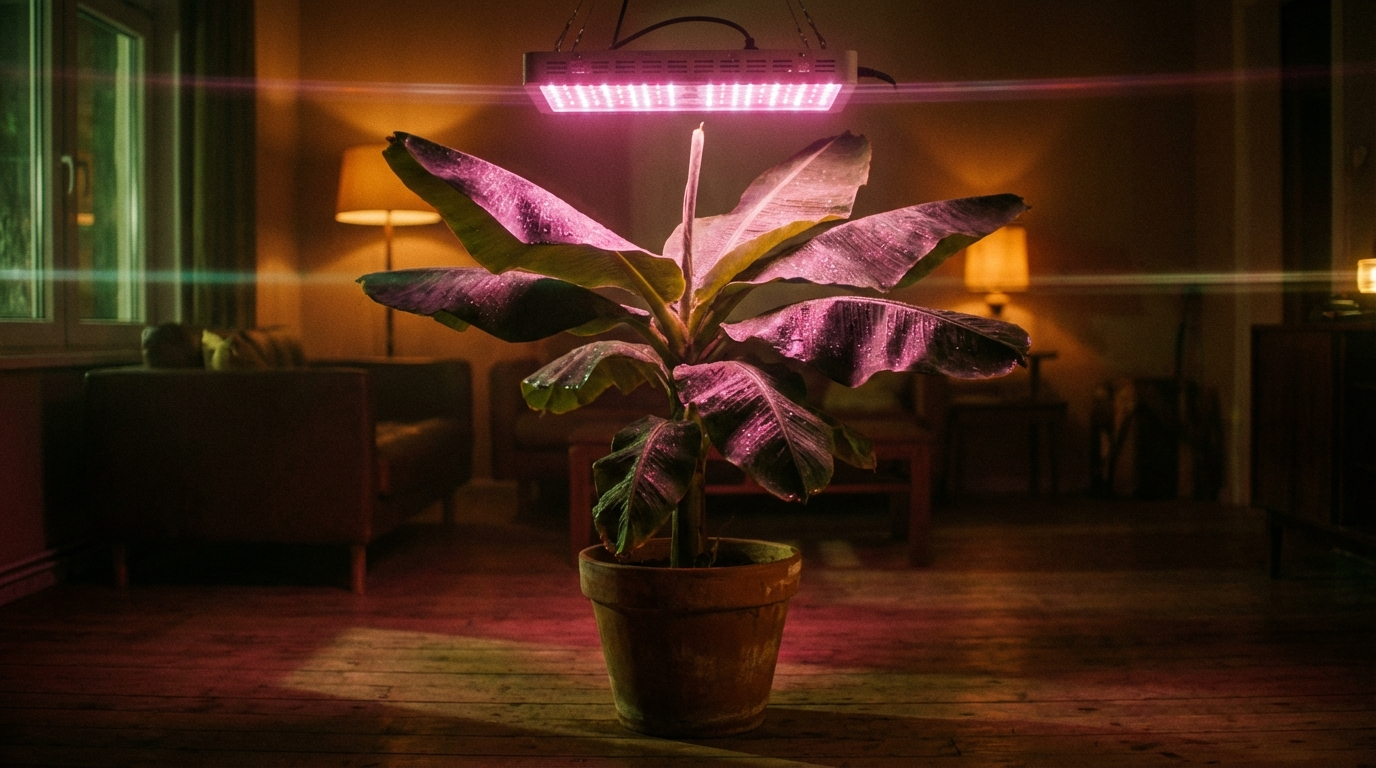
There's a banana plant in my flat.
Its name is Moose. Its full name — if you're being proper about it — is Musa acuminata 'Dwarf Cavendish'. A rhizomatic tropical plant from Southeast Asia, now living in a pot in a British flat under a grow light on a timer.
It nearly died. Twice. Both times were my fault. Too much water. You'd think a tropical plant would like excess, but no — banana plants drown. The roots go anaerobic, the whole thing collapses. I watched the leaves go yellow, then brown, then I watched myself do it again a few months later.
But Moose made it. Because it's rhizomatic — it stores its life underground, in a dense network of rhizomes that can survive conditions that would kill the visible plant above them. If the leaves die, sometimes the rhizome doesn't. Sometimes you get another chance.
Now Moose has a dedicated grow light directly overhead, with an on/off schedule built into the timer. It gets the right amount of water — no more, no less. And it is — slowly, constantly, quietly — growing.
That's the Rose Garden.
What the Rose Garden Actually Is
The Rose Garden is not a gardening method. It's not a productivity system. It's not something you need a south-facing window or a specialist subscription for.
It's a philosophy about having something alive in your space — and taking actual responsibility for it.
Plants cannot walk to water. They cannot call you when they're thirsty. They cannot look at you reproachfully when the soil has been bone dry for two weeks. They just wait, quietly, drooping slightly, sending the only signal they have. And you either notice, or you don't.
Moose — A Field Guide
Moose is a Dwarf Cavendish banana. Here's what that means in the real world:
Rhizomatic
Moose doesn't grow from a seed or a single root. It grows from a dense underground rhizome — a network of root-like stems that store energy. This is why it survives when the top dies back. The life is underground.
Light Hungry
Banana plants want 6–8 hours of bright light daily. In a British flat, natural light isn't enough in winter. Hence the grow light — a full-spectrum LED on a timer. This isn't optional. It's the deal.
Watering Is The Skill
The most common way to kill a banana plant indoors is too much water. The soil should dry out partially between waterings. In practice: lift the pot, feel the weight, learn its language. When it's light, it's thirsty.
Tropical at Heart
15–30°C is the comfort zone. Below 10°C and Moose starts to suffer. Dry air from central heating is the silent enemy. Occasional misting helps. So does keeping it away from cold windows in winter.
It Will Pup
Mature banana plants produce offshoots — called pups — from the base rhizome. These can be separated and propagated. In other words: if you tend it well, Moose will eventually give you a second Moose.
Dwarf ≠ Tiny
Dwarf Cavendish can reach 2–3 metres indoors with proper care. It won't stay small. It's "dwarf" relative to its 6-metre wild cousins. Plan for growth. Moose has ambitions.
The Interesting Part (Genuine Plant Facts Worth Knowing)
A banana plant is not a tree. Technically, it is the world's largest herbaceous plant. That trunk — the bit that looks like wood — is actually a pseudostem, made entirely of tightly packed leaf bases. It's almost entirely water.
Bananas are parthenocarpic — they fruit without pollination. The bananas you eat evolved to have no seeds because humans selected for that trait over thousands of years of cultivation. Every banana you've ever eaten was produced by a plant that never needed to be fertilised.
The Cavendish banana (Moose's variety) is a monoculture catastrophe waiting to happen. Almost all commercial bananas worldwide are genetically identical Cavendish clones, which means a single pathogen can theoretically wipe out the entire supply. This is currently happening — Panama disease (a fungal pathogen) is slowly spreading through Cavendish plantations globally.
Banana leaves are used as food platters across South Asia, Southeast Asia, and parts of Africa. The leaves are naturally antibacterial. They're large — sometimes 3 metres long — and waterproof. They evolved to shed tropical rainfall without becoming saturated, which is also why they're beautiful: that waxy surface is engineering.
The Rose Garden Rules
These are rules Kris made for himself. Adapt them.
One Plant, One Name
Start with a single plant. Give it a name. This is not affectation — it's commitment. A named plant is harder to neglect. You're responsible for Moose, not "the banana plant in the corner."
Learn Its Language
Every species communicates through its appearance. Study yours. Yellow leaves usually mean overwatering or nutrient deficiency. Brown leaf tips usually mean underwatering or low humidity. The plant is always talking. The Rose Garden teaches you to listen.
Build the System
A grow light timer is not overthinking — it's care made reliable. A watering schedule is not rigid — it's attention made consistent. The Rose Garden is a system. Build the system and then relax.
Watch, Don't Hover
Plants don't respond to attention. They respond to conditions. You don't need to check daily. You need to check regularly. The difference is anxiety vs. care. The Rose Garden is care.
Earn the Next Plant
The rule for expansion: your current plant must be visibly thriving before you add another. No plant cemetery. No good intentions. Proof, then growth.
Why This Matters More Than It Should
Here is the honest version of why the Rose Garden idea exists:
screens don't grow. notifications don't unfurl new leaves. emails don't tilt toward light because that's where the good photons are. your phone doesn't care whether you watered it.
Moose does. In the quietest possible way.
There's something useful in having something alive in your space whose entire existence is biological and has nothing to do with the internet. Something that operates on seasons, on light cycles, on root systems, on chemistry. Something the ancient parts of your brain recognise as life in a room full of glass rectangles.
The Rose Garden isn't about becoming a plant person. It's about having a small, sovereign corner of the world that is green, alive, and yours.
That's worth something.
How to Start Your Own Rose Garden
Start somewhere. A plant that costs less than dinner. Coming up with a way to make sure it gets light and water regularly. Giving it a name. Then just showing up.
You might:
- Get a pothos (basically unkillable, trails beautifully, thrives in low light)
- Get a ZZ plant (handles neglect better than almost anything alive)
- Get a Dwarf Cavendish banana (our personal recommendation. bold choice. dramatic leaves. Moose-level presence)
- Get anything that interests you (interest keeps you paying attention)
The species matters less than the commitment. Build the system. Learn the language. Get the timer on the grow light. Show up.
The Rose Garden grows from there.
Connections
- Verdant Craftsman — the practitioner archetype who fuses field discipline with living systems (in progress)
- Root Link — Verdant Intelligence→ — The EchoCraft subskill that explains exactly what Moose is doing
- EchoCraft — The Field Manual→ — The full system: four prime powers, 15+ subskills, and the Root Link protocol that explains exactly what Moose is doing