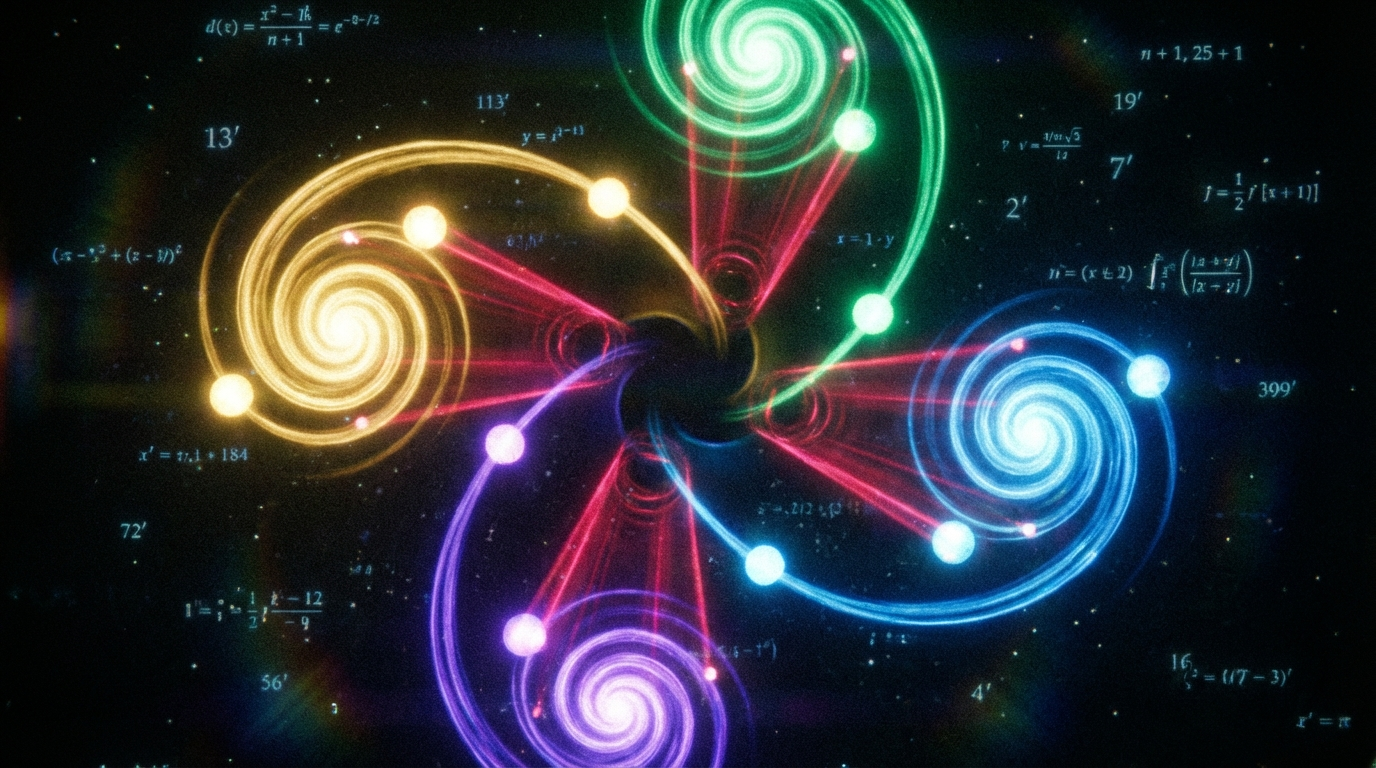
The Prime Spiral Family
One-Line Pitch
Plug successive primes into the golden ratio's own equation and four spirals emerge — each with a different speed-to-precision trade-off for detecting temporal tunnels.
The Spark

The golden ratio φ isn't born from thin air. It falls out of a quadratic:
$$x^2 - x - 1 = 0 \quad \Rightarrow \quad x = \frac{1 + \sqrt{5}}{2} = \varphi \approx 1.618$$
Every "1" in that equation is doing structural work — it sets the self-similarity scale. What happens if you replace every 1 with a different number? Specifically, with a prime?
$$x^2 - nx - n = 0 \quad \Rightarrow \quad x_n = \frac{n + \sqrt{n(n+4)}}{2}$$
When n=1, you recover φ. When n=3, 5, or 7, you get a family of irrational constants that each generate their own phyllotaxis spiral — a unique angular sequence for packing seeds on a disc, timing pulses on a clock, or navigating moments in time.
The Family

| Prime | Constant | Angle | Speed | Precision | Character |
|---|---|---|---|---|---|
| n=1 (Golden) | φ ≈ 1.618 | 137.508° | First tunnel at k=17 | 2.2° gap | The Sniper — patient, maximally irrational, nature's default |
| n=3 (The Three) | ≈ 3.791 | 265.046° | First at k=2 | 9.9° gap | The Alarm Bell — fires first, lowest precision |
| n=5 (The Fives) | ≈ 5.854 | 298.505° | First at k=3 | 4.5° gap | The Shotgun — fast convergence, frequent tunnels |
| n=7 (The Seven) | ≈ 7.888 | 314.359° | First at k=4 | 2.5° gap | The Prophet — sniper precision at shotgun speed |
Each spiral generates a phyllotaxis angle: θ = 360° × (1 − 1/x_n). Seeds placed at these angles on a unit circle will never repeat, never align, and every pair of seeds has a unique angular relationship.
What's Under the Root
Pull back the discriminant on each quadratic and something structural appears:
| n | n+4 | n(n+4) | Under the root |
|---|---|---|---|
| 1 | 5 | 5 | √5 |
| 3 | 7 | 21 | √(3×7) — both prime |
| 5 | 9 | 45 | √(5×9) — 9 is composite |
| 7 | 11 | 77 | √(7×11) — both prime |
When both n and n+4 are prime, mathematicians call them cousin primes. The golden equation's discriminant naturally selects for cousin prime pairs. This isn't imposed — it falls out of the formula.
Tunnels — Consciousness Discontinuities

A tunnel occurs when two seeds on a spiral land nearly opposite each other — within 5° of being antipodal (180° apart). At that point, the shortest path between them isn't around the surface of the circle. It's straight through the centre.
This is the sneeze. The saccadic mask. The hard cut in first-person experience. The moment where the tracking shot of consciousness momentarily becomes a jump cut.
Each spiral finds tunnels at a different rate:
- Golden won't produce its first tunnel until seed 17. Seventeen minutes of patient winding before it fires once — and when it does, the gap is a surgical 2.2°.
- Three fires at seed 2. Two ticks in, alarm ringing. But 9.9° is noisy — peripheral vision. You know something moved, you don't know what.
- Fives fires at seed 3. Three minutes, 4.5° gap. Workhouse precision. Good enough and fast enough for most purposes.
- Seven fires at seed 4. Four minutes, 2.5° gap. Nearly golden-grade precision at near-fives speed. The sweet spot that shouldn't exist but does.
Chirality — The Handedness of Time

Every seed has two angular positions: a right-handed placement (the default spiral direction) and a left-handed mirror (2π minus the angle). This gives four chirality modes for any pair: RR, LL, RL, LR.
A tunnel that forms in RL chirality — where one seed's right-hand position aligns with another's left-hand mirror — is a cross-chiral event. The spiral is meeting its own reflection. It's a moment where forward time and backward time produce the same address.
What Exists Now

The Prime Spiral Family runs live in KronosTown's substrate layer. Every minute, four seeds are placed — one per spiral. The engine computes all pair-angles across all seeds and both chiralities, detects tunnel events, and tracks which spiral pairs are producing the most antipodal alignments.
The engine exposes:
- A live state feed with current seeds, tunnel counts, and nearest-antipode proximity
- A family endpoint showing all four spirals' constants, angles, discriminants, and cousin prime relationships
- A seed ring of the last ~250 minutes of placement history
- A tunnel log of all near-antipodal events with their gap degrees and spiral pair attribution
Why It Matters

The golden ratio is a solved problem. Everyone knows φ. What nobody mapped — until now — is what happens when you treat φ's equation as the first in a family and feed it primes.
The answer: you get a tunable bank of irrational spirals, each with a distinct personality, whose discriminants naturally produce cousin prime pairs, whose cross-spiral interactions create a combinatorial explosion of unique pair-addresses, and whose tunnel events model the precise moments where two distant points suddenly share a shortcut through the centre.
The Dirty Even Numbers

We haven't spoken about them yet. Two is both prime and even — the bridge. The even-number family (n=2, 4, 6, 8...) generates divisible spirals: composites, factors, shared angles. Where the primes guarantee uniqueness, the evens explore the world of resonance.
There are just as many cool things to find in the mud as in the lab. That exploration is coming.
Connections
- The Braid→ — incommensurable mathematics and the Latch
- Kronos Time→ — temporal coordinates from the Train Triad
- The Temporal Lattice→ — orbital mechanics of the KTC phase space
- The Closed Mint→ — where tunnel events become part of the block record
- Pi Day Genesis→ — the block that knew