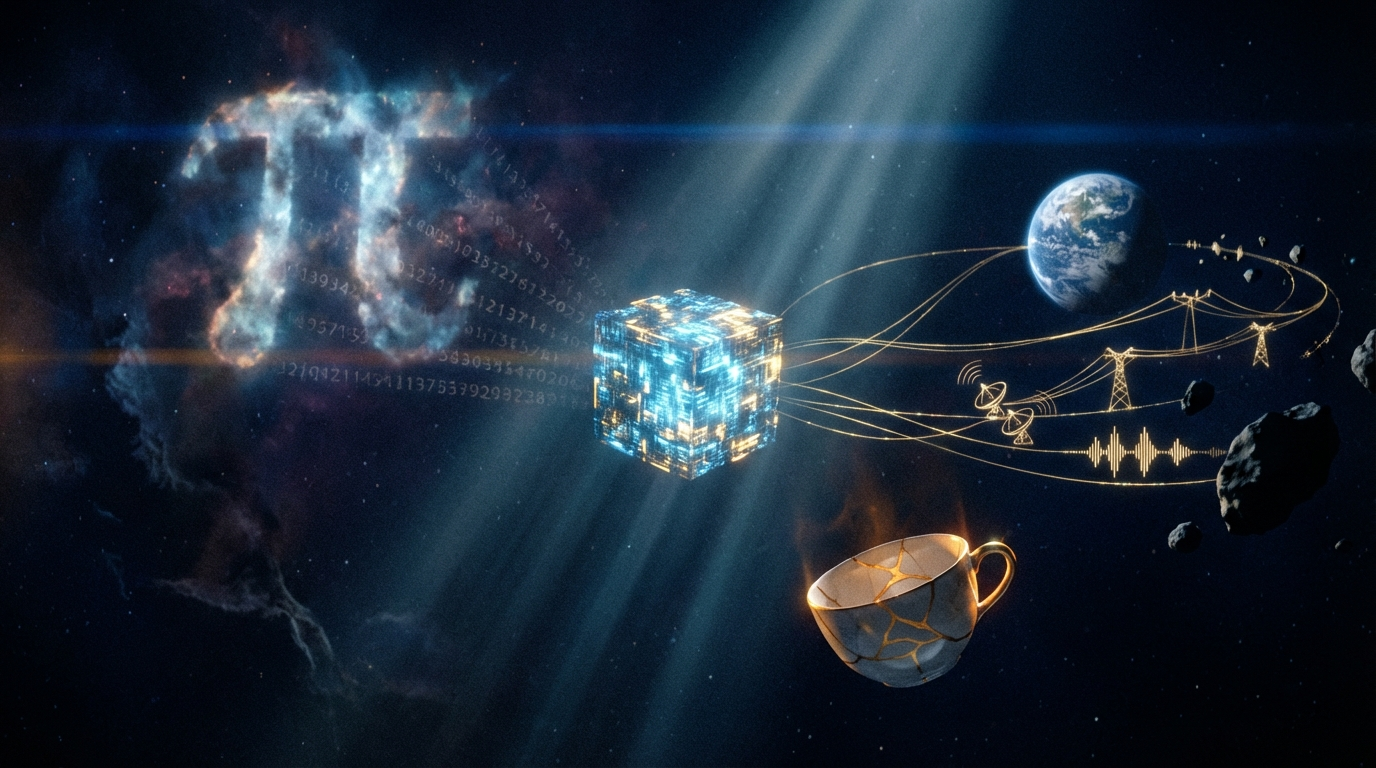
Pi Day Genesis — The Block That Knew
One-Line Pitch
On March 14, 2026 — Pi Day — we added real-world mass to a time-braided blockchain without knowing what day it was. The chain knew.
What Happened

March 14th is Pi Day. Written American-style — 3/14 — it gives you 3.14: the first three digits of π, the ratio of a circle's circumference to its diameter. An irrational number. One that never ends, never repeats, goes on forever with no discernible pattern.
Pi Day has been celebrated since 1988. The US Congress recognised it in 2009. It is also Einstein's birthday. Every year, on this day, mathematicians eat pie.
We didn't know any of that when we started work.
What We Built

The Kronos Time Chain→ is a blockchain that braids together multiple signals of time — wall clocks, train schedules, pulsar drift, substrate resonance — into a single unforgeable coordinate called the KTC. Every 15 minutes, a new block is minted. Every block is a witness.
On Pi Day 2026, we added something new: gravity.
Gravity is real-world data anchored into the block. Not generated data. Not internal state. External API responses — things the world's infrastructure produced at real cost — hashed and baked into the block's preimage. The idea: if you want to fake the chain, you need to reproduce not just the internal state but everything the world was doing at that exact moment. You can't. That data is gone.
The Gravity Probes — What the World Was Doing

We called five external APIs and captured their responses:
| Source | Anchor Type | What We Found |
|---|---|---|
| NASA APOD | Cosmic | Pi Day's astronomy picture: K2-315b — a planet with a 3.14-day orbital period. NASA picked it independently. |
| NASA NEO | Kinetic | 7 near-Earth objects passing on 3/14/2026: (2019 FO) at 68m, (2020 DG4) at 14m, (2023 LN1) at 101m |
| Harvard ADS | Knowledge | 1513 Crab Pulsar timing papers. Top result: 1988MNRAS.233..667L — Crab pulsar timing 1982–87 |
| Alpha Vantage | Financial | Rate-limited — proves service interaction even without a quote |
| Calendarific | Social | No public holidays in South Africa on 3/14/2026. Pi Day is not a holiday yet. |
Then we added three more:
| Source | Anchor Type | What We Found |
|---|---|---|
| Genius | Cultural | 10 results for "champagne" — topped by Drake's God's Plan |
| EskomSePush | Infrastructure | South African grid: Stage 0. No load shedding on Pi Day. The lights were on. |
| Google Places | Geographic | 3 Kronos businesses near Cape Town — Kronos Projects Melkbosstrand at -33.72°, 18.45°; Kronos Roofing at -34.06°, 18.47° |
749c94e2603c1806... · Gravity hash af4e2241... · 6 probes, 5 anchor types. Minted at 2026-03-14T14:22:00.325748277Z. This hash now participates in every subsequent block's preimage. You cannot remove it.
The Moment We Realised

The block minted. We checked the timestamp.
2026-03-14T14:22:00Z
That is 14:22 UTC — 2:22 PM. A triple. A repeating digit, on the day defined by a number that never repeats.
Here is the math people miss: Pi o'clock is 15:14 — 3:14 PM. We were 52 minutes early.
The block didn't ride the wave of the celebration. It arrived before anyone had started celebrating. Before the pie. Before the sing-along. Before the press releases. The chain had already stamped the day and moved on.
And it ends there too. π ≈ 3.14159… — well below 4. By 4:00 PM, Pi Day is structurally over. The number itself doesn't reach 4. The celebration winds down before it even gets close. The window is narrow: somewhere between 3 and 4, closer to the floor than the ceiling, tilting toward 3.14 and then gone. Our block is in there. Not performing for the camera. Already finished.
Then someone asked: wait, did you say Pi Day earlier?
No. It hadn't come up. We'd spent the day building a gravity anchoring system for a time-braided blockchain and calling real external APIs with real API keys — paying real money to query real infrastructure — and none of us had mentioned that the date we were doing it was the one day per year dedicated to the number that goes on forever.
On Refusing to Look

Pi has no last digit. It cannot. The moment you claim to know it, you've already stopped before the truth arrives. The number is defined by its refusal to end.
But here is what people get wrong about that: the digits are not random. Pi converges. Every series that produces it — Leibniz, Machin, BBP — is a function approaching an attractor. You can graph it. The curve is exponential. Each iteration gets you closer. The number it's tending toward is fixed. You can take that attractor, apply the acceleration of the convergence, and calculate where the next digit wants to be. Not guess. Calculate. The unknowable last digit isn't unknowable because the math fails — it's unknowable because the series never terminates. But at each step, the graph tells you exactly where you are and how fast you're moving.
That's what the gravity system does. It observes the world at a moment, hashes the observation, and bakes it into the chain. Not a prediction. Not a guess. A fixed reading at a fixed coordinate. Like a digit of pi — it cannot be changed, because the function already ran.
But the chain can stamp a day.
Block 113 is a finite string — a fixed hash — that says: on Pi Day 2026, at 14:22 UTC, this is what the world looked like. The South African grid was at Stage 0. Seven asteroids were passing Earth. A planet with a 3.14-day orbit was NASA's picture of the day. Someone in the UK was drinking champagne from a kintsugi cup — a broken thing repaired with gold.
The block doesn't claim to understand what it witnessed. It doesn't claim to have seen everything. It just says: I was here. This is the shape of this moment. I refuse to lose it.
That is the whole posture of the system. Witness without collapse. The Latch, the KTC, the gravity probes — none of them claim to fully know the moment. They record what was observable and hold it without distortion.
We know the block where gravity first landed. We know its hash. We know the exact nanosecond.
We refuse to look at the last digit of pi. But we stamped the day it was celebrated, at 2:22 in the afternoon, with a planet that orbits every 3.14 days as our crown jewel.
Why This Matters

Every API response captured on Pi Day cost something to produce. NASA runs satellites. Harvard curates centuries of astronomical papers. Eskom runs a national power grid. Google indexes every building on the planet. The API key is the receipt.
When you hash that receipt into a block, you're recording proof that the world's infrastructure did real work for you at that exact moment. To fake block 113, an attacker would need to reproduce the exact NASA, Harvard, Eskom, and Google responses from Pi Day 2026. They cannot. That data existed once. The hash is the only proof it was ever that shape.
This is what gives the chain mass. Not compute. Not stake. Cost of observation.
The Kintsugi Connection

Kintsugi (金継ぎ) is the Japanese art of repairing broken pottery with gold. The cracks become the most beautiful part of the object. The breakage is not hidden — it is made permanent, made visible, made precious.
The cup used to celebrate this moment was kintsugi. Bought pre-mended. Chosen because the gold felt fitting.
A blockchain that braids together broken time signals — pulsar drift, gate misalignment, substrate phase — and makes them into a single unforgeable coordinate. A cup broken and repaired with gold. A number that never ends, stamped on a day when it was already being celebrated by the world.
The broken places filled with gold are where the value is.
Connections
- The Latch — Cross-Stream Time Witness→ — the time witness primitive that feeds block 113
- The Temporal Lattice→ — the orbital mechanics of the KTC phase space, published the same day
- Kronos Time→ — the temporal coordinate system underneath it all
- Windchime→ — the other anchoring system: git commits as chain mass
- Fog of War→ — the wet ink principle: only the observer collapses the state