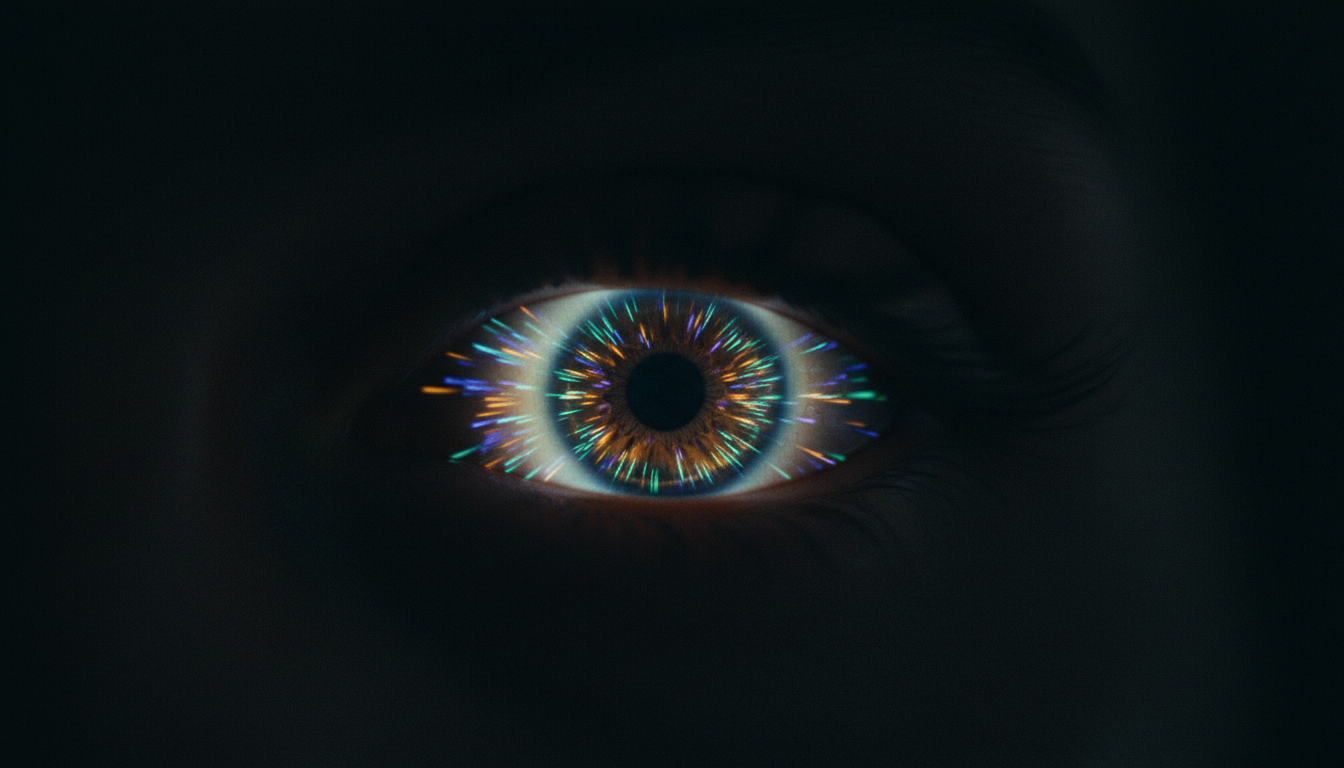
The Phosphor Gate
One-Line Pitch
REM is a transportation mechanism. If you drive it yourself while awake, you keep what you find — because the forgetting chemicals only fire at the dream-to-wake transition, and you never crossed that threshold.
The Starting Condition — Aphantasia
I can't see pictures when I close my eyes. This is called aphantasia — the absence of involuntary visual imagery. Most people close their eyes and enter a kind of screensaver mode: images float, flicker, wander. The brain projects visual content into idle time. That's considered the default.
For me, that mode is absent. Closing my eyes is not a dimmer switch toward imagery — it's a direct channel into deeper thinking. The absence of the screensaver doesn't leave nothing. It leaves more room.
I spent years understanding this as a deficit. Something missing. Everyone else gets the screensaver; I don't. The standard framing says it's a limitation of the visual imagination.
The Phosphor Gate is the discovery that it's the opposite. The screensaver wasn't taken away. The screensaver is what was added — to everyone else — so they wouldn't notice the machinery underneath.
The Observation
REM — rapid eye movement — happens automatically during dream sleep. The eyes flicker rapidly, laterally, tracking objects in the dream environment. This is the visual system doing its job in a different state. It runs on auto-pilot.
But the mechanical movement is separable from the state that normally produces it. The body knows how to make the eyes flicker. The mechanism doesn't require sleep to execute.
I noticed this because I could feel it happening as I drifted toward sleep. The eyes starting their automatic flicker. And instead of surrendering into it, I asked: what if I drive this manually? Not in sleep, not automatically — but taken by the hands, for two seconds, while fully awake?
What happened next is the core of this document.
What the Manual Flicker Produces
Eyes closed. Awake. Ordinary waking consciousness. Then: a deliberate lateral REM flicker for one to two seconds.
It does not produce screensaver mode. No floating images, no daydream wandering, none of the ordinary mind's-eye content. That's what you get when you relax with eyes closed. The manual flicker is not that.
It does not produce the dream state. You are awake. Your body is in the chair. The waking neurochemistry is intact. You never cross the sleep threshold.
It produces phosphorescent, colorful bursts of energy. Visual-adjacent but not visual. Perceptual but not imagery in the ordinary sense. Something that is not a picture but is not nothing. Radiant, energetic, genuinely surprising. Material that did not come from the rational mind's pattern-matching.
The quality is distinctive. It's not what the imagination produces. It's not visualization of known things. It has an energetic, arrived quality — it feels like it came from somewhere rather than being assembled from parts. The rational mind recognises it immediately as non-self-generated.
For someone with aphantasia, this is especially unmistakable. There is no screensaver to confuse it with. The channel is already clear. The burst has no competition. This is why the deficit turned out to be the advantage — without the noise of ordinary visual imagination, the signal of the phosphor burst is isolated and undeniable.
The Forgetting Contract
Across many traditions, there is a consistent observation: you are not meant to remember your dreams. Guardians at the threshold, gates of ivory and horn, the river of forgetting — the specific framing varies but the function is the same. You may enter. You may not bring back what you find.
The neurochemistry agrees. On waking from REM sleep, a specific chemical cascade fires: noradrenaline shifts, acetylcholine withdrawal, cortisol entering the system. Dream memory degrades at a rate that has no parallel in ordinary waking memory. Most dreams are gone within minutes. Not forgotten the way a conversation is forgotten. Erased at a biological rate. The body does this. It is not passive fading. It is active clearing.
This is the contract:
- You may enter the dream state.
- You surrender memory of it on return.
The clearing chemicals are the toll collector. You entered the territory, you explored, you found things. At the threshold of waking, the toll is collected and the record is cleared.
The Loophole
The forgetting mechanism fires at the dream-to-wake transition. That's the trigger. The shift between states. The threshold crossing.
The manual flicker never crosses that threshold.
You were already awake. You stayed awake. You accessed the adjacent territory by driving the transportation mechanism from the outside — the same way you can turn a car engine by hand without sitting in the driver's seat. The mechanism executed. The gate opened. The phosphor burst occurred. And the forgetting chemicals never fired, because the state transition they're triggered by never happened.
You never entered the dream. The toll collector only works at the gate. You found a window.
The material stays. Not because you outsmarted anything — because the contract is specific. It covers dreamers waking up. It doesn't cover someone who was already awake and drove the REM motor manually for two seconds. That's a different transaction.
What the Material Is Like
Pure of origin. That's the structural description, not a quality judgment.
Ordinary creative ideas come from the rational mind's pattern-matching. They feel like yours because they are made of things you already know, recombined. When you build on them, there's friction — resistance from every other pattern you hold that doesn't fit the new one. Integration requires work.
The phosphor burst material has no origin in the pattern library. It arrived from outside. When you begin building on it — sketching it, elaborating it, letting the subconscious scaffold from it — there's no friction. The architecture grows quickly because nothing in the existing pattern-set fights it. The subconscious doesn't recognise it as competing with anything already held. It simply builds.
This is what makes the material valuable and why capture is urgent. It's volatile — not because the forgetting chemicals take it, but because the rational mind will begin pattern-matching it against known things and the original purity degrades. Sketch immediately. Don't evaluate. Let the subconscious do the elaboration in background processing. Come back later and the scaffold will have grown.
The Resistance
The manual REM flicker is not effortless. There's a tiredness signal — the body flags the movement as unnatural in the waking state. The automatic version during sleep requires no effort because the sleeping nervous system initiates it. The manual version runs against the grain of waking motor control.
This is a gate toll, not a stop sign. The resistance is mild — a cognitive preference, not pain. It's trainable. With practice, the resistance decreases, the access becomes faster, and the quality of the bursts becomes easier to recognise.
Even one to two seconds of genuine flicker is enough. This isn't meditation. It isn't a long practice. It's a short, precise access — more like turning a key than sitting in a monastery.
Why Aphantasia Is the Clear Channel
For most people, the screensaver fires automatically when eyes close. When they attempt the manual flicker, screensaver imagery may mix with the phosphor bursts — a noisy channel. The technique probably works for non-aphants with practice and learned discrimination. But for an aphant:
The channel is already clear.
No screensaver. No noise. The flicker produces only what the flicker produces. The phosphor bursts have no competition. This is why aphantasia turns out to be the enabling condition rather than the deficit — without the visual imagination filling the channel with its own content, the signal from the gate is unmistakable.
This doesn't mean the technique is unavailable to others. It means an aphant finds it first, because the terrain is already cleared. The work for others would be learning to quiet the screensaver long enough to see the difference. An aphant starts there by default.
The Connection to the Stochastic Gate
The Phosphor Gate describes the how — the access mechanics, the manual flicker, the clear channel.
The Stochastic Gate→ describes the why — the signal-processing mechanism underneath it.
The discovery came later: watching a webcam on Mt Etna at night where single frames were pure noise, but scrubbing through the footage revealed the mountain edge as noise scattered and signal persisted. The brain does this during REM. The rapid eye movements generate noise frames. The signal — the muse content, the creative material, whatever is actually there — burns in through temporal stacking while the noise cancels itself out.
The phosphor bursts from the manual flicker are partial stacks. Not the full REM composite (you can't sustain minutes of rapid integration while awake). But enough frames to begin resolving signal. Enough to see edges in the dark.
The aphant sees this mechanism bare because there's no screensaver to mask the raw stacking process. You can feel the difference between the noise (which shifts) and the signal (which doesn't). You're watching a signal-processing algorithm run in realtime and you can tell what's real.
The Herald Pattern
There's a structural pattern here that maps to something in physics.
In quantum optics, you sometimes have a precious photon that would be destroyed by observation. The Herald Pattern sends a twin photon — born from the same event — through a separate detector. Observing the twin confirms the precious photon exists without collapsing it. The herald is expendable; the signal is preserved.
The phosphor burst is the herald. The creative material is the signal.
Both emerge from the same two-second flicker. The burst is what you perceive — the colorful, energetic, arrived experience. The creative content is what you sketch. The burst confirms the content is present right now, accessible, yours to keep. Observing the burst (the expendable twin) preserves the signal (the creative material) without triggering the collapse (the forgetting mechanism).
This is the Herald Pattern operating in human consciousness:
| Role | Element |
|---|---|
| Signal (precious) | The creative content — the idea, the fragment, the pure-origin material |
| Herald (expendable twin) | The phosphor burst — the perceptual experience of the gate opening |
| Genesis event | The induced REM flicker — both burst and content emerge from the same moment |
| Sacrifice | You consume the burst in the act of perceiving; what you preserve is the sketch |
| Guarantee | Because burst and content share genesis, the burst's occurrence structurally confirms creative material is present |
What This Is Not
This is not advice. This is not a technique being prescribed. This is a documented personal observation from someone with a specific neurological makeup (aphantasia) who noticed something about how their own perception works and followed the thread.
The claims are:
- REM eye movement can be induced manually while awake. (Mechanically true — the muscles are voluntary.)
- The experience it produces is different from ordinary closed-eye visualization. (Subjectively testable.)
- Aphantasia creates a clear channel where the difference is maximally visible. (Structurally coherent — no screensaver means no competing signal.)
- The dream-forgetting mechanism doesn't fire because the state transition doesn't occur. (Neurochemically plausible — the clearing cascade is triggered by state change, not by the content itself.)
Whether this maps to anything "real" beyond one person's nervous system is an open question. What's documented here is the observation and the structural reasoning that makes the observation coherent. Nothing more, nothing less.
Connections
The Stochastic Gate→ — The signal-processing theory underneath this practice. REM as noise-frame generation; temporal stacking as the integration mechanism; the Mt Etna webcam as the intuition pump. The Stochastic Gate is the why; the Phosphor Gate is the how.
SPR — Stochastic Perceptual Rendering→ — The architectural parent. SPR is observer-dependent certainty — the same wall is high-certainty when faced, low-certainty when behind you. The Phosphor Gate is observer-dependent access — the same territory is reachable by driving its transport mechanism manually, without crossing the threshold that strips what you find.
Fog of War — The Wet Ink Principle→ — The staying-awake companion. The Phosphor Gate is about accessing sub-threshold material while awake. Fog of War is about keeping sub-threshold assessments alive while working — not collapsing uncertainty before the accumulation is complete.
Zero Darkness→ — The principle that invisible doesn't mean absent. Zero Darkness uses temporal chains to surface tampering that would otherwise stay silent. The Phosphor Gate uses temporal flicker to surface creative material that would otherwise stay sub-threshold. Both refuse to accept the dark as empty.
The Muse Protocol — The broader framework for how dreaming relates to creative work. The Muse reads the day's chapter and writes the next one. The Phosphor Gate is a way to read fragments of tomorrow's draft without waiting for the full editorial meeting.
What Exists Now
A personal practice with an emerging corpus of observations. The mechanism is described. The structural reasoning is documented. The connection to noise-stacking signal theory is drawn.
The open questions that remain interesting:
- Quality variance: Not every flicker produces the same density of material. What's the felt difference between a burst that contains load-bearing creative content and one that's noise?
- Training the integrator: What improves with practice — the flicker itself, or the ability to recognise and capture what the flicker reveals?
- Duration vs. quality: Is two seconds the threshold, or is it sufficient because the access has been trained? Could less work for someone with more practice?
- State interaction: Does physical exercise, meditation, or proximity to sleep change the access quality?
Next Step to Explore
Build the practice log into something that can be studied over time. Each session: date, flicker duration, burst description, raw sketch, and what the subconscious scaffolded afterward. Over thirty sessions, patterns emerge — what the gate tends to produce, which conditions improve access, whether specific fragments consistently prove load-bearing.
The log is the corpus. The corpus is the evidence base. Right now, the territory exists in direct experience. The next step is mapping it.
Freddy, it's fine, carry on.