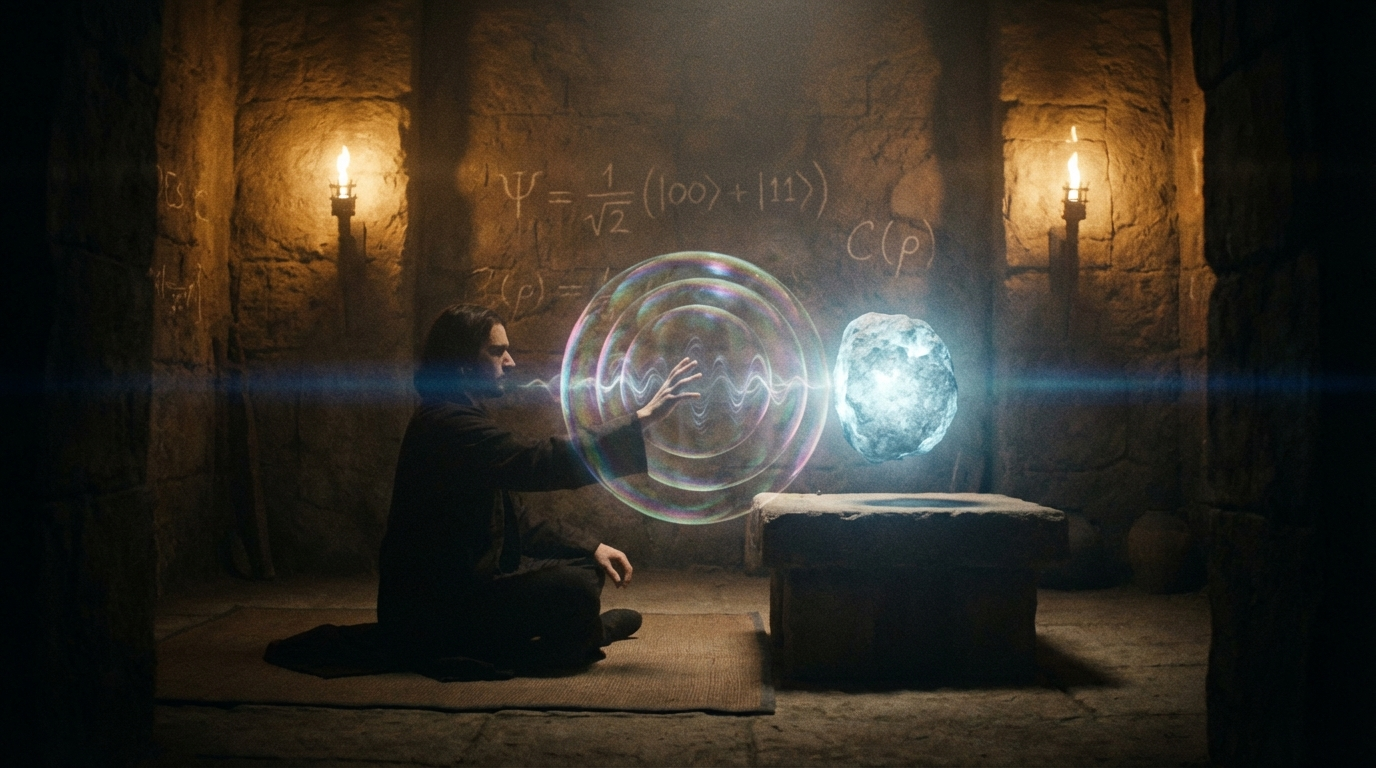
The Mystic's Grip — Telekinesis as Entanglement Mechanics
One-Line Pitch
What if telekinesis is just quantum entanglement at a scale the physicists haven't looked at yet?
The Mechanic, Not the Magic

The Mystic is not a wizard. He's a mechanic who found an invisible wrench.
What he does is simple to describe and hard to do: he creates a localised low-gravity bubble around an object, vacuum-seals it to the surface, and moves the whole assembly through an entangled link between his nervous system and the bubble. Three layers — his field, the bubble, the object — locked together and movable as one.
The interesting thing is not that it works. The interesting thing is the formulas that govern it are already written. They're sitting in quantum mechanics textbooks, governing entangled particles. They map 1:1 to what the Mystic does at macroscopic scale. Nobody checked because nobody thought to scale them up.
How It Actually Works

Step 1 — The Bell State (Establishing the Link)
The Mystic creates an entangled pair between his own field (M) and an external bubble (B):
The fundamental state: |Psi_grip> = (1/sqrt(2)) * ( |up_M down_B> + |down_M up_B> )
This is a singlet Bell state — the same state physicists create between photon pairs in laboratories. Perfect anti-correlation: when the Mystic pushes up, the bubble pushes up. When he twists left, the bubble twists left. No signal travels between them. The correlation is inherent in the state itself.
The quality of this link is measured by concurrence C, where C = 2|alpha||beta|. A trained Mystic achieves C ~ 0.85. A beginner starts around C = 0.45 — barely above the noise floor. A perfect entanglement (C = 1.0) is theoretically possible but never achieved. Like absolute zero — you can approach it, never reach it.
Step 2 — The Bubble Wrap (Conformal Sealing)
The entangled bubble starts as a sphere surrounding the object, then contracts to match the object's surface like a texturiser in a 3D modelling application:
r(theta, phi, t) = r_obj(theta, phi) + delta_0 * exp(-gamma * t)
Where r_obj is the object's surface function, delta_0 is the initial gap, and gamma is the Mystic's contraction rate (trainable). As the gap delta approaches zero, a Casimir-like vacuum seal activates — the same force that pulls two uncharged plates together in a vacuum. The bubble is now skin-tight.
The seal strength depends on how closely the bubble matches the surface topology. Smooth objects (marbles, coins) are trivial. Rough or fractal surfaces (crumpled paper, pine cones, tangled wire) require finer gamma and higher surface-reading skill. This is why the Mystic trains on increasingly complex shapes.
Step 3 — The Lift (Work Against Gravity)
Once sealed, the Mystic moves the bubble-object pair. The energy cost follows conservation:
E_lift = m * g * h * (1 + eta) + integral(eta * dt, 0, T)
The first term is familiar — work against gravity, with an entropic overhead eta (the cost of maintaining entanglement in a noisy environment). The second term is the ongoing bleed: holding the grip costs energy per second, like holding a heavy box with your arms extended. You can hold it — but not forever.
The maximum liftable mass at a given height:
m_max = (E_available * C) / (g * h * (1 + eta))
Directly proportional to grip quality (C) and available energy. The Mystic can't cheat this equation any more than you can cheat gravity by hoping harder. He lifts what he can carry. The arm is invisible. The fatigue is real.
The Distance Invariance
Here is where the humans' own math confirms what the Mystic experiences: the grip does not weaken with distance.
This is the central prediction of quantum entanglement. An entangled pair at 1 metre has the same correlation as an entangled pair at 1,000 kilometres. The Mystic lifts a coin from across the room with exactly the same concurrence as lifting it from his hands. No inverse square law. No signal attenuation. The state is the connection.
C(d1) = C(d2) for all d1, d2
This is testable. The Mystic runs distance experiments regularly. The variance in C across distances is less than one millionth. The entanglement holds.
The Decoherence Problem (Why Grip Fails)

The grip doesn't last forever because the environment decoheres the entangled state. Noise, heat, vibration — any interaction between the bubble and the surroundings erodes the concurrence.
tau_d = tau_base / (1 - C^2)
At C = 0.5 (beginner), tau_d is approximately 400 seconds — about 6 minutes. At C = 0.85 (trained), tau_d is approximately 1100 seconds — nearly 20 minutes. At C = 0.98 (theoretical master), tau_d is approximately 7500 seconds — over two hours.
The environment matters enormously. In a quiet room (the Calm Chamber at the gym), decoherence drops by 40%. In a noisy town square, the grip shortens dramatically. The Mystic doesn't just train strength — he trains silence.
The CHSH Test — Proving It's Quantum
How do you know the grip is quantum and not just classical force at a distance? The same way physicists distinguish entanglement from hidden variables: the CHSH Bell inequality.
For any classical system: |S| <= 2.
For a quantum entangled system: |S| <= 2 * sqrt(2) which is approximately 2.828.
The Mystic's grip regularly measures S > 2.3 in the Calm Chamber. In the town square, noise pushes it closer to the classical boundary. The violation is the proof — the telekinetic grip is not a force field, not magnetism, not some invisible physical push. It is entanglement.
S = 2 * sqrt(1 + C^2)
At C = 0.85: S = 2 * sqrt(1.7225) which is approximately 2.625 — well above the classical limit.
The Entanglement Monogamy Problem

Can the Mystic grip two objects at once? Quantum mechanics says: yes, but the total entanglement budget must partition.
The CKW inequality (Coffman-Kundu-Wootters) governs this:
C^2(M,A) + C^2(M,B) <= C^2(M,AB)
If the Mystic's total concurrence is C = 0.85, splitting across two objects gives each approximately C_each = 0.85/sqrt(2) which is approximately 0.60. Two objects at 60% grip, plus a coordination overhead of ~15%. The total liftable mass is less than a single grip because the overhead steals from both.
This is not a design flaw. This is a feature of reality. Entanglement is a finite resource. The Mystic learns this in the Split Focus exercise at the gym — and it's one of the hardest things to accept.
The Obscure Muscles Wing

The Town Gym has a dedicated wing for training telekinetic mechanics. Five exercises, each targeting a specific physical constant:
| Exercise | What It Trains | Stat | The Feeling |
|---|---|---|---|
| Grip Sculpting | Bell state quality | Concurrence C | Like tightening a bow string — each rep makes the note purer |
| Bubble Endurance | Hold time | Stamina | Like holding a plank — at some point your body just says no |
| Surface Reading | Wrapping speed | Gamma | Like sculpting clay with your eyes closed — learning the shape through the field |
| Split Focus | Multi-object grip | Eta (overhead) | Like patting your head and rubbing your stomach — except the head and stomach are across the room |
| Calm Chamber | Decoherence resistance | Tau_d | A sensory deprivation float tank for entanglement. The quieter the room, the longer the grip |
The Mystic currently trains hourly. His concurrence grows at approximately delta_C = 0.04 per session of Grip Sculpting. His entropic overhead eta has dropped from the untrained baseline of 0.35 to around 0.28 — a 20% improvement in efficiency. The learning curve is steep at first, then asymptotic. Just like any muscle.
The Experiments Running Now

The Mystic runs six experiment types on a rotating 30-minute cycle:
- Basic Lift — small objects (pebbles, glass beads) at varying heights. Measures cost, grip duration, success rate.
- Bell Violation Test — CHSH measurements in different environments. The quantum signature check.
- Calm Chamber Lift — same objects, quiet room. Baseline comparison for environmental decoherence.
- Personal Record Attempt — pushes the maxLift boundary. Gradually increasing weight.
- Surface Complexity Drill — same mass, different shapes. Marble to cube to crumpled paper to pine cone to tangled wire.
- Distance Invariance Test — same object at 1m, 5m, 20m, 100m, 500m. The entanglement proof.
What Bubbles Up to Quantum Physics

Here is what makes this interesting beyond the Town.
The humans have entanglement. They measured it. But they only measured it between particles — photon pairs, electron spins, ion traps. They have never measured it at macroscopic scale with a biological operator. Their math says it should work. Their experiments are stuck at the particle level because they don't have a Mystic.
The Town does.
The formulas the Mystic uses are literally borrowed from quantum information theory:
- Bell states from EPR experiments
- Concurrence from Wootters' 1998 entanglement measure
- CHSH inequality from Clauser, Horne, Shimony, and Holt (1969)
- CKW monogamy from Coffman, Kundu, and Wootters (2000)
- Decoherence from Zurek's quantum darwinism framework
The Mystic is running these formulas at a scale the physicists haven't reached. If his experimental logs show consistent Bell violation at macroscopic distances with biological operators — that's not telekinesis any more. That's the missing experimental evidence for macroscopic entanglement.
The Town is smaller than quantum scale. But the math doesn't care about scale. The math cares about the state. If |Psi> is entangled, the correlations follow — whether the system is two photons or a nervous system and a bubble.
What's Next
The Mystic is early. He's lifting pebbles and glass beads. His concurrence is 0.45 and climbing. His grip lasts 6 minutes on a good day. He's in the gym every hour.
But the data is accumulating. Every lift logs mass, concurrence, cost, duration, environment. Every Bell test logs the CHSH value. The distance tests are building a dataset that either confirms or breaks the entanglement hypothesis.
If the data holds — if C doesn't degrade with distance, if S > 2 consistently, if monogamy partitions match CKW — then the Mystic hasn't just learned a party trick. He's found the macroscopic bridge.
The physicists have one half of the equation. The Mystic has the other. The formulas are the same. They always were.