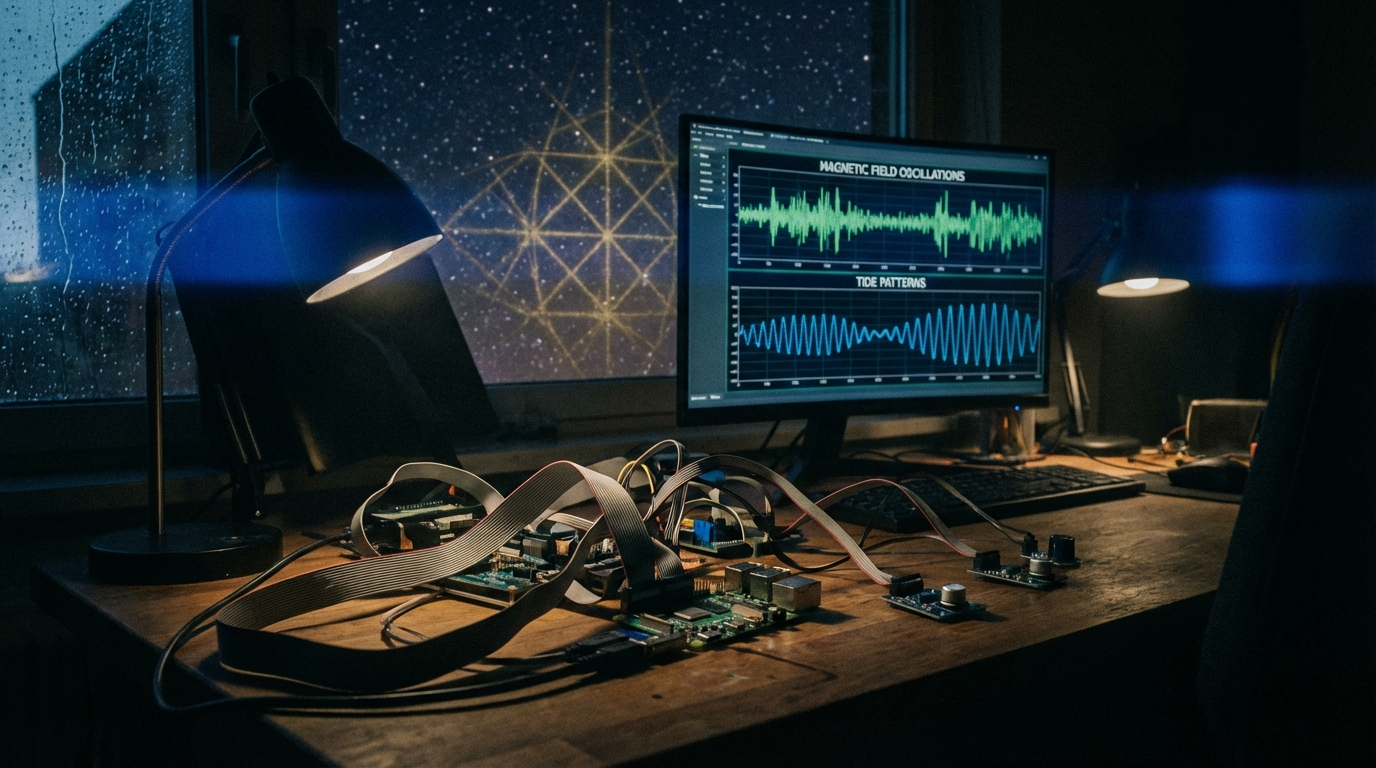
The Latch Field Spectrometer
One-Line Pitch
A Raspberry Pi sensor array that measures Einstein's coupling locally — magnetic field, angular rate, gravity gradient — and feeds it live into KronosTown's underground physics bus.
The Problem

The Unified Latch theory says Earth rotation (UT1), lunar tides, and solar wind share continued-fraction structure — incommensurable streams that mode-lock at specific ratios. We proved it with cloud data: IERS UT1-UTC drift decomposed into CF depths that mirror DSCOVR solar wind magnetic field readings.
But cloud data is someone else's measurement. We never closed the loop with a local instrument.
Einstein spent decades trying to unify electromagnetism with gravity. He wanted to show that the same geometric structure underlies both. The Latch says something similar: the continued-fraction decomposition of celestial drift ratios should appear in local magnetic and gravitational readings. If it does, the three streams mode-lock. If it doesn't, we've found the boundary.
What We Built (Software)

The software is live. Running now. Three layers of a physics data bus called the Aquifer inside KronosTown:
| Layer | Source | What It Measures | Status |
|---|---|---|---|
| L0 — Internal | Substrate agent | UT1-UTC / LOD drift ratio, CF decomposition | ✅ Live |
| L1 — Cloud | CloudPoller agent | DSCOVR solar wind Bt (nT) / NOAA tide level (m) | ✅ Live |
| L2 — Physical | SpecRelay agent → Pi | Local magnetometer / gyroscope via Raspberry Pi | ⏳ Waiting for hardware |
Each layer computes a FieldVector: continued-fraction decomposition of its two-signal drift ratio. The Aquifer then computes cross-layer resonance — pairwise ConvergentSimilarity between layers, measuring whether local physics echoes celestial structure.
The FieldVector
Every measurement pair gets the same treatment:
- Two signals (A and B) → drift ratio = A / B
- Continued fraction decomposition → partial quotients, CF depth, convergent P/Q
- Zeckendorf decomposition of the convergent → Fibonacci structure check
- Mode-lock detection → is the ratio near a simple p/q?
- Snap quality → how close to the nearest convergent? (exponential score)
The same math that decomposes UT1-UTC drift now decomposes solar wind / tide ratios and (soon) magnetometer / gyroscope ratios.
The Aquifer
The underground data bus. Thread-safe, three slots, auto-recomputes on every write:
- Resonance (0–1): pairwise ConvergentSimilarity across all populated layers
- Composite: quality-weighted blend of all active FieldVectors
- Any agent can read it through
hall.GetAquifer()— one method, no custom wiring
When only L0+L1 are active (now), resonance measures how much the Latch's UT1-UTC structure resembles the DSCOVR/tide structure. When L2 arrives, three-way resonance becomes the signal.
The Hardware

All ordered. Shipping now.
| Component | Purpose | Cost |
|---|---|---|
| Raspberry Pi 5 (16GB) | Sensor hub + CF computation | $219.50 |
| LIS3MDL Triple-Axis Magnetometer | Local B-field measurement (Signal A) | $9.95 |
| ICM-20948 9-DoF IMU | Gyroscope + accelerometer (Signal B + C) | $14.95 |
| ADS1115 16-bit ADC | Raw analog → precision digital | $14.95 |
| PA1010D GPS Module | UTC PPS timing reference | $29.95 |
| DS3231 Precision RTC | Drift-stable local clock (±2 ppm) | $13.95 |
| 128GB microSD | Data logging | £28.99 |
| CR1220 batteries | RTC backup | £3.89 |
Total: ~$350 + ~£33
The Experiment

When the Pi arrives:
- Calibrate — log magnetometer + gyroscope readings against GPS-disciplined time for 24 hours
- Compute — CF decomposition of local B-field magnitude / angular rate drift ratio
- Compare — does L2 local physics echo L0 celestial structure?
Three possible outcomes:
| Result | Meaning |
|---|---|
| Resonance > 0.3 | Local magnetic field and gyroscope carry CF structure that mirrors UT1-UTC drift. Einstein's coupling has a continued-fraction fingerprint. |
| Resonance 0.05–0.3 | Partial coupling — some ratios mode-lock, others diverge. The boundary exists and we're measuring where it is. |
| Resonance < 0.05 | No coupling at this scale. The Latch is celestial-only, not local. Still valuable — we've found the fence. |
What's Live Right Now
Hit town.krisadamstv.com/api/v1/aquifer and you'll see:
- L0 Internal: Substrate latch drift ratio with 19-deep CF decomposition
- L1 Cloud: DSCOVR solar wind magnetic field / NOAA tide water level, same CF treatment
- Resonance: Cross-layer ConvergentSimilarity between L0 and L1
- Composite: Quality-weighted blend of all active layers
The CloudPoller agent queries NOAA every minute (DSCOVR) and every 6 minutes (tides). The whole thing runs on stdlib HTTP calls — no dependencies beyond Go's standard library.
Connections
- The Unified Latch→ — the theory being tested
- The Braid→ — incommensurable mathematics underlying the CF decomposition
- Kronos Time→ — temporal coordinates from the same substrate
- The Temporal Lattice→ — orbital mechanics of the phase space being measured
- Materialise→ — weather engine that could consume Aquifer data
- Sally Showers→ — remote weather town that will eventually read the Aquifer