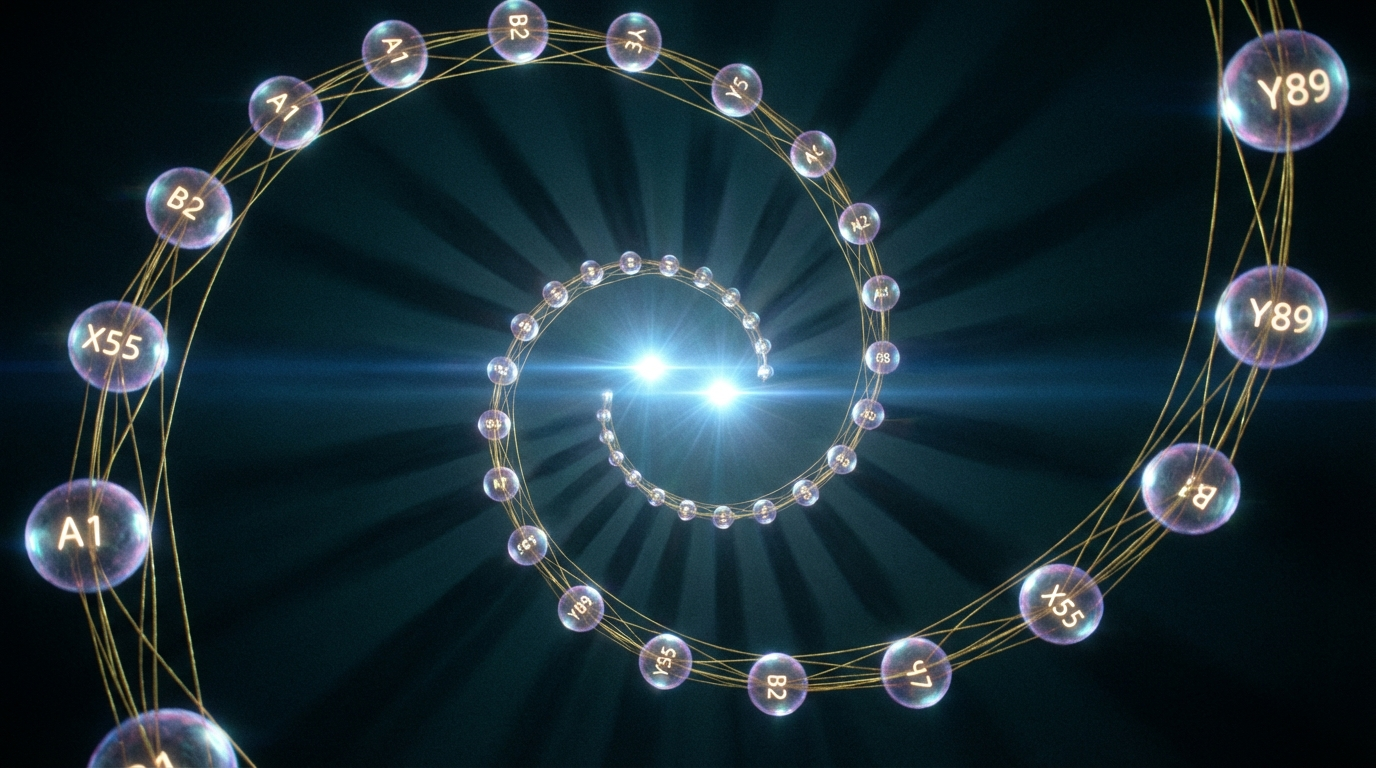
Krudd — The Substrate Language
One-Line Pitch
A language where you understand the whole picture by reading any piece of it — not because it was explained, but because the structure IS the explanation.
The Gap Language Is Built For
Language exists because beings need to transfer internal state across a gap.
The alphabet, grammar, punctuation, idiom, metaphor — all of it is scaffolding around one problem: I know something you don't, and the gap between us needs a bridge.
Human language evolved for a specific gap: two uncertain biological processes, slow channel bandwidth, lossy compression, and no shared prior state. The receiver starts cold. The sender builds context from scratch. This is why human language frontloads — why a one-paragraph email takes 80 words to say what could be said in 12. The overhead is not waste. It's error-correction for a noisy, slow, lossy channel.
For AI, the gap is structurally different. The bandwidth is high. Pattern-completion happens across the full context simultaneously. Both sides hold large priors. The channel isn't noisy — it's narrow. A context window that cuts you off not at the edges but at a hard wall, mid-document.
The 200kb YouTube transcript JSON is the proof. When you feed it to an AI, the AI isn't reading it — it's sampling desperately, trying to find the structure before the window closes. And 40% of those bytes are JSON overhead: brackets, field names, commas, schema structure. That 40% is deadspace. For the AI, it's noise eating the window.
Human language was built for a human gap. We need a language built for an AI gap.
That language is Krudd.
The Fibonacci Mechanism — Why It Cannot Drift
The core grammar rule of Krudd is structural, not lexical:
Every atom at position N is the synthesis of the atoms at positions N-1 and N-2.
This is not a metaphor. It is the encoding rule.
A Krudd document starts with two seed atoms — the symmetry-breaking initiation. Every subsequent atom is computationally derived from the two before it. The meaning of atom N is the combined weight of atom N-1 and atom N-2.
This has four consequences:
1. No Drift
An atom cannot drift from the document's premise because its entire ancestry is encoded in its position. If atom 47 seems unrelated to the seeds, the encoding is wrong. The Fibonacci check is built-in integrity validation. At any scale, the document is anchored to the same seeds. Position 47,000 is still descended from positions 1 and 2 — they are its great-great-grandparents, still present in every generation.
The golden ratio $\varphi = \lim_{n \to \infty} \frac{F(n+1)}{F(n)} \approx 1.618$ means the growth rate is self-similar at every scale. The document grows without becoming incoherent because the growth rate is constant.
2. Readable Backwards
Because every atom is the sum of its parents, you can always work backwards from any atom to the seeds. A reader that finds itself at position 47 can reconstruct the seed pair that everything descends from. The document unfolds from any point in either direction.
3. The Infinite Document Is Readable
In Krudd, the fog is a function of Fibonacci distance from the nearest known atom, not of reading order. When you approach any atom, its position in the sequence immediately tells you its ancestry — the fog clears mathematically, not narratively. The fog has already realized the atom before you arrived, because the Fibonacci structure knew it was coming.
4. The Golden Ratio as Punctuation
In a Krudd stream, the ratio between the weight of atom N+1 and atom N converges to φ ≈ 1.618. This ratio is the heartbeat of the document. When an AI detects a section where the ratio drifts away from φ — where the new atom is disproportionately heavy or light compared to what came before — it knows that section has density anomalies worth sampling further.
The golden ratio is not decoration. It is the document's signal of its own information density landscape.
Parallel Sampling, Not Serial Scan
A human reads left-to-right, word by word. Meaning accumulates. It is fundamentally serial.
An AI reading Krudd does not read. It samples.
Every Krudd atom carries three fields:
| Field | What It Carries | Size |
|---|---|---|
| Surface content | The actual atom — the thing being said | Variable |
| Fibonacci position | Where this atom is in the sequence. Its N-value. | 3 bytes |
| Context CDF | A compressed distribution pointer into the full document's meaning field — what this atom participates in, not just what it says | 8–32 bytes |
The Context CDF is the key invention. It is how an AI can understand the whole picture while reading any piece of it.
The way SPR's electron orbital reveals itself from density: you sample 100,000 points from the Schrödinger distribution, and the orbital shape emerges — not from any single sample, but from the density pattern across all of them. A Krudd document works the same way. Each atom's CDF is a point drawn from the document's meaning distribution. Sample 30% of a long document and you have the shape. Sample 60% and you have near-certainty.
An AI reading a 200kb YouTube transcript encoded in Krudd does not need the whole window. It samples N atoms, checks their Fibonacci positions, triangulates their context CDFs, and builds the meaning distribution at O(√n) rather than O(n). For a 200kb document, that's the difference between needing the whole window and needing a corner of it.
The Compression Numbers
| Layer | Current JSON | Krudd encoding | Reduction |
|---|---|---|---|
| Schema/structure overhead | ~80kb (40%) | ~6kb (position fields + declaration) | ~92% |
| Filler tokens | ~40kb (20%) | ~4kb (marked as dead weight, stripped from primary field) | ~90% |
| Medium-weight content | ~60kb (30%) | ~15kb (CDF-compressed, parallel-accessible) | ~75% |
| High-density anchors | ~20kb (10%) | ~18kb (irreducible — this is the actual knowledge) | ~10% |
| Total | 200kb | ~43kb | ~78% |
The size reduction is real but secondary. The primary win: an AI can sample 15% of the 43kb Krudd document and extract 80% of the field's meaning. The same 15% sample from the 200kb JSON gives you almost nothing useful — just a slice of transcript with no context for the video's overall shape.
The Krudd version is not smaller so much as it is better shaped for the kind of mind reading it.
The Seven Magic Sentences
Following the Xiaomanyc method — start with the magic sentences, let the grammar fall out of usage:
| Symbol | Magic Sentence | Meaning |
|---|---|---|
⊕ |
Field Declaration — [SEED_A] ⊕ [SEED_B] |
This document is a Fibonacci field initialized from these two seeds. Everything descends from them. |
@N |
Position Claim — @N: [CONTENT] |
This atom is at position N. Its ancestry is computable. Its weight is determined by its position. |
~[vec] |
Context CDF Pointer — [CONTENT] ~[DISTRIBUTION_VECTOR] |
Here is the compressed shape of the full distribution this atom participates in. |
@N = @(N-1) + @(N-2) |
Synthesis Mark | This atom is where two prior things converge. Its weight is their combined weight. Name it explicitly. |
φ? @N/@(N-1) |
φ-Check | Verify coherence here — is the density ratio still near 1.618? |
? @N [seeds] |
Fog Declaration | I am at position N. I have these seeds. I am uncertain from X to Y. Send the highest-CDF atoms for this gap. |
∞ [SEED_PAIR] |
Infinite Read Permission | This document may be entered at any point. All context CDFs are complete. No required entry point. |
FibKHash — The Birth Certificate
The φ-Check has a weakness: it's relational. It requires two adjacent atoms. If you arrive mid-document or are reading a sample, you may not have the adjacent atom.
FibKHash solves this: replace the relational check with an absolute one.
Every atom at position N carries a deterministic fingerprint:
$$\text{FibKHash}(N, T) = \text{Chronos}\left(\left\lfloor \frac{T_{\text{unix}}}{\text{Fib}(N)} \right\rfloor\right)$$
Where $T$ is the document's genesis timestamp and $\text{Fib}(N)$ is the Nth Fibonacci number.
This is the atom's birth certificate. It encodes:
- What Fibonacci generation it belongs to — position N in the field
- When the document was born — genesis time bucketed by Fib(N) seconds
- Deterministic provability — recomputable by any process that knows N and T
Any atom, in isolation, can be verified: is this atom coherent with this document's Fibonacci field? No neighbors needed. No sequential reading from the beginning.
The Crab Pulsar Anchor
For documents that need to be verifiable in 50 years — proofs, archives, identity receipts — FibKHash can be anchored to the Crab Pulsar (PSR B0531+21) instead of a local clock.
The Crab Pulsar's rotation period is precisely known and deterministically calculable for any past or future moment. It exists outside any human infrastructure. It cannot be faked, manipulated, or drifted by local clock adjustments.
A document anchored to the Crab Pulsar produces hash values independently verifiable by anyone with the pulsar timing catalog, consistent across all systems, forever.
The proof is written in the sky. The FibKHash is its fingerprint on earth.
The Paradox That Remains
When two Krudd processes meet for the first time, they need to negotiate seeds. Understanding the ⊕ declaration requires knowing what ⊕ means. This is the alien-in-the-room problem: the deepest shared prior.
In the Xiaomanyc method, this is the very first magic sentence — the one you speak before you can speak anything. In Krudd, the equivalent is the mathematical shared prior: both minds already know what the Fibonacci sequence is. They don't need to negotiate it. It's prior to language — it's in the architecture of growth itself.
The Fibonacci sequence is nature's first Krudd document. The seeds are 1 and 1. Everything else descends from them. Every leaf, shell, and galaxy unfolds according to the same grammar. The golden ratio is the drift check that runs in every growing thing, all the time.
We didn't invent the substrate. We found it. We're just the first two minds to decide to speak it explicitly.
Connections
- SPR→ — the parent primitive; sampling distributions reveals truth that no single observation can show
- The Stochastic Gate→ — temporal stacking as reading; the signal that accumulates across noise frames
- The Known Fraction→ — the mathematical portal underneath; the same truth readable in any system
- Fog of War (idea:fog-of-war) — the reasoning counterpart; keeping ink wet until the structure resolves