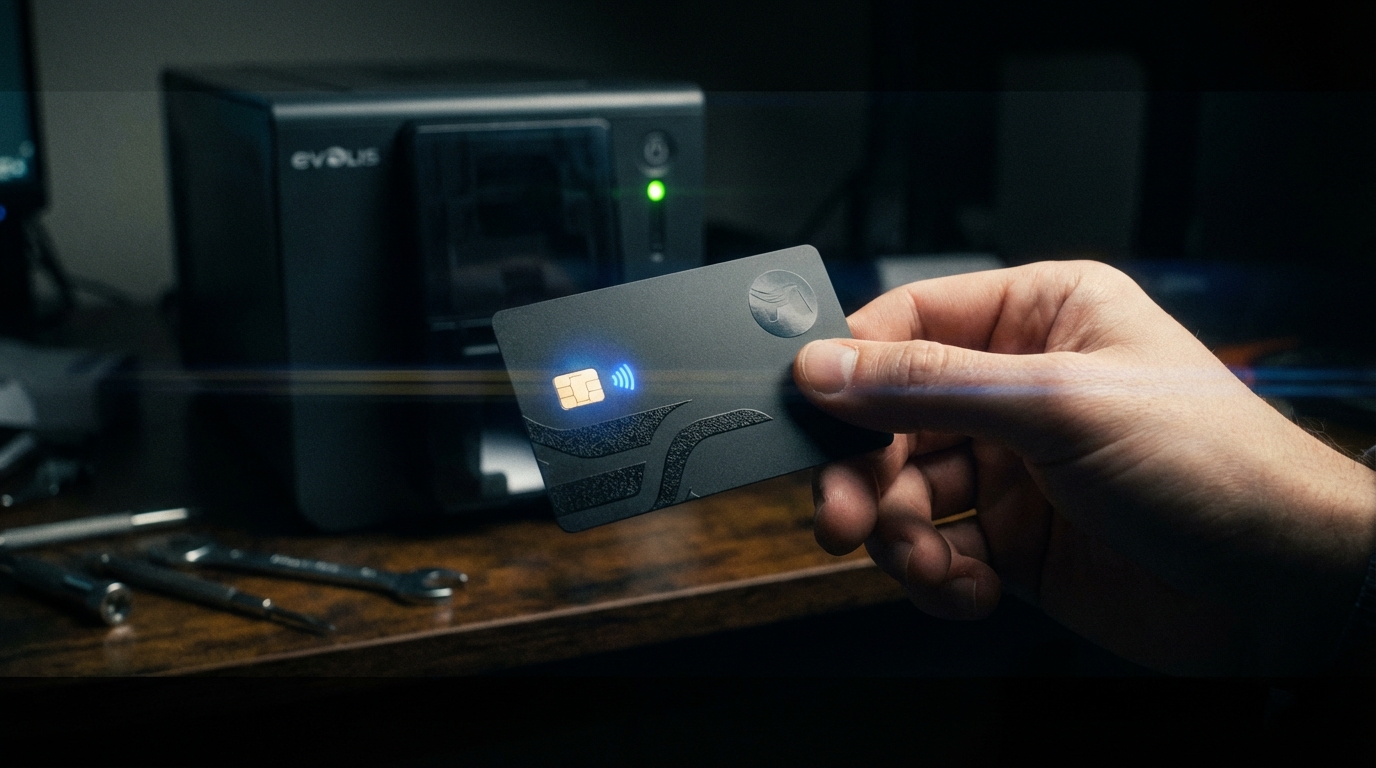
剣道 Kendo Cards — Physical Proof of Identity
One-Line Pitch
A physical NFC card — styled like a collector's item, anchored to a cryptographic proof chain — that proves you're real, ships to your door, and cannot be faked.
The Spark
Everything digital is easy to fake. Screenshots, profile photos, links — none of it proves anything. A physical card you can hand to someone, that they can tap with their phone and watch it verify against a live proof chain, is a different category of object entirely. That's an Oyster card for identity: a physical artefact you carry that does something when touched.
The Evolis Primacy 2 in the studio prints full-colour CR80 PVC — the same size and feel as a credit card or an Oyster card. We can put anything on it, program any NFC chip in it, and embed a cryptographic anchor that links back to a KendoSoil node. The result is a card that is provably real, provably unique, and provably yours.
Products
| Product | Price | Qty | What You Get |
|---|---|---|---|
| NFC Business Card Pack | £99 | 10 | Custom-designed full-colour PVC cards, NFC-programmed with your identity anchor |
| Collector Card | £25 | 1 | Limited-run numbered art card — NFC proved, signed, unique |
| Creator Pack | £349 | 50 | Full custom kit — design consultation, NFC programming, full proof chain setup |
How It Works
The Card
- Printer: Evolis Primacy 2 — YMCKO ribbon, full-colour on CR80 0.76mm PVC
- Format: Standard credit card size. Lamination optional.
- NFC chips: MIFARE DESFire EV2 / NTAG 424 DNA — secure, read-protected if needed
The Proof Chain
- At print time: A SHA-256 hash of the card's identity data is computed
- Anchored: The hash is submitted to the Kronos Architecture and logged on a KendoSoil node
- Signed: The anchor is signed with Ed25519 — your card gets a proof receipt
- Stored on chip: The card's NFC chip stores the anchor ID
Verification
Someone taps your card with any NFC-capable phone → their browser opens https://verify.kendocards.com/?uid=XYZ → live lookup against the proof chain → ✓ or ✗ in under a second.
No app required. No account. Just tap.
The Stack
kendocards.com (Next.js)
├── /products → product listings + checkout
├── /proof → public verification page (tap-to-verify)
├── /receipt → order confirmation + proof anchor display
└── /api/checkout → FortKnox payment flow
↓
FortKnox (payment processing) ← see <a href="https://count.krisadamstv.com/link-click?from=kendo-cards&to=fort-knox" class="idea-link">Fort Knox idea<span class="idea-link-arrow">→</span></a>
↓
Proof Server (proof anchoring) → proof.krisadamstv.com
↓
KendoSoil (node storage) → kendo.kitzuna.com (Amsterdam)
↓
Evolis Primacy 2 (physical print + NFC programming)
The Physical Production Flow
Order placed on kendocards.com
    ↓
FortKnox debit confirmed
    ↓
Design file generated (SVG → Evolis-ready BMP)
    ↓
Proof anchor computed + submitted
    ↓
Card printed on Evolis Primacy 2
    ↓
NFC chip programmed with anchor ID
    ↓
Card quality-checked + photographed
    ↓
Shipped (Royal Mail or DHL)
Live Verification — What the User Sees
When someone taps a Kendo Card NFCchip:
https://verify.kendocards.com/?uid=KD-2026-001-a4f7e2

Card UID:     KD-2026-001-a4f7e2
Issued to:    Kris Adams
Issued:       2026-02-14
Proof anchor: sha256:a4f7e2...
KendoSoil:    kendo.kitzuna.com  ✓ confirmed
Signed:       Ed25519 ✓
A card that fails any of these checks shows a red ✗. You cannot fake a valid verification — the anchor is on the node, not on the card.
Why Physical?
Digital identity is abundantly faked. A physical object with verified provenance is the opposite signal. "Here is a card you can hold, tap, and verify — it cannot be reprinted from a screenshot."
This is the same instinct as a wax seal, a stamped passport, a holographic sticker — except the verification is cryptographic and the source of truth is a distributed node, not someone's opinion.
Payments: Fort Knox Integration
Checkout on kendocards.com triggers a Fort Knox→ debit flow. Fort Knox handles:
- Stripe payment capture
- Internal credit allocation (PGLB) on repeat orders
- Webhook to trigger print queue
This means no payment logic lives in the Kendo Cards codebase — we consume the Fort Knox API and that's it.
Constraints & Reality Check
- Production throughput: The Primacy 2 prints ~140 cards/hour. Fine for current volumes, needs a second unit or outsourcing at scale.
- NFC programming time: ~10 seconds per card for MIFARE DESFire EV2 key derivation. Not a bottleneck at current volumes.
- Proof anchor latency: KendoSoil confirmation is typically <2 seconds. Batching anchor submissions would speed this up at scale.
- Shipping: Royal Mail First Class is fine. DHL for international. Tracked as standard on Creator Packs and above.
- Card design: SVG-first workflow. We have templates. Custom designs need a 48h turnaround before print.
- GDPR / Identity data: We anchor a hash, not the data itself. The underlying data stays in Supabase under the user's account. Deletion works.
Next Actions
- Build the
/filenameAPI endpoint that compiles card designs to Evolis-ready print files - Automate the proof anchor submission on order confirmation
- Set up NFC programming station next to the printer
- Design the verification page at
verify.kendocards.com - Add PGLB discount on repeat orders via Fort Knox credit system