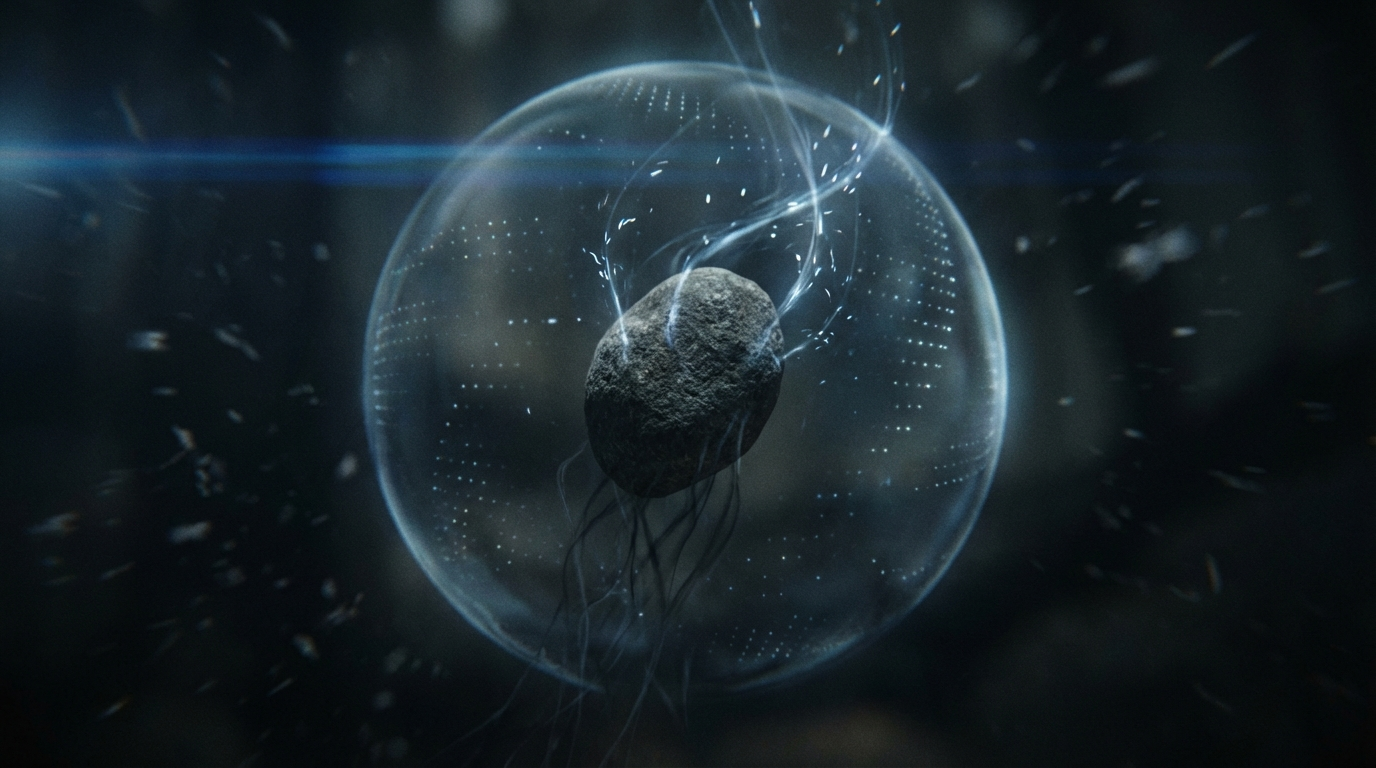
The Gravity Null — Balance, Not Force
One-Line Pitch
Telekinesis isn't lifting. It's creating a point in space where gravity cancels to zero — then nudging.
Three Pages, One Chain

This idea completes a triptych written in one night. Each page is independent. Together they form a single argument:
- The Diff→ — consciousness is the viewport. The universe renders reality as a diff against a deterministic baseline. Observation collapses superposition into committed state.
- The Spin Gate→ — spin is the physical mechanism connecting light to gravity. Angular momentum, delivered by electromagnetic radiation, creates the rotation that curves spacetime. The $10^{38}$ hierarchy is a gear ratio.
- The Gravity Null (this page) — if consciousness controls which superpositions collapse, and collapse propagates through the spin gate into gravity, then intentional observation can create a local zone where gravitational forces balance to zero.
The chain, laid out:
Intentional observation → controlled collapse → spin cascade → local gravity modification → null point → slide
Nobody assembled it before because the pieces live in four different departments: quantum mechanics, general relativity, consciousness studies, and entanglement theory. Four journals. Four conferences. Four vocabularies. Nobody put the chain on one page.
The Shoe, the Magnet, and the Floor

This image is mechanically precise. Consider a magnet embedded in a shoe sole, suspended above a magnetic floor. The magnet wants to fall (gravity) and the floor wants to repel it (magnetic force, assuming same-pole orientation). At some specific height, these two forces cancel exactly. The shoe floats.
That floating point has properties:
| Property | Implication |
|---|---|
| It's fragile | Tiny perturbations knock it off balance — like a ball balanced on a hill |
| It's energy-neutral at equilibrium | No energy needed to stay at the null point — only to reach it and to correct drift |
| It's slideable | Once at the null point, lateral force requirements drop to near zero — no gravity to overcome, only inertia and friction |
| It requires precision | The null exists at one specific configuration. Close isn't good enough. You need exact balance |
| It has an energy cost to maintain | Environmental noise constantly perturbs the balance. Staying at the null requires continuous fine correction |
This is not metaphor. This is the operational description of what "telekinetic lift" would actually be. Not force against gravity. Balance against gravity. Then a nudge.
The Collapse Cascade

The Diff→ established that consciousness collapses superposition into definite state. This is not controversial — it's the measurement problem restated. Observation commits the wave function. The brain assembles reality from collapsed states.
The Spin Gate→ established that spin translates electromagnetic energy into gravitational effect. Frame-dragging is proven. The Kerr metric is solved. Rotating mass curves spacetime more than non-rotating mass. Angular momentum is the coupling channel.
Now connect them.
If observation collapses wave functions, and collapsed wave functions cascade through spin states into gravitational effects, then the pattern of collapse matters. Not just that you observe — how you observe. Which superpositions you resolve. Which spin states get committed. Which gravitational contributions get rendered.
In normal observation — looking at a desk, touching a wall — the collapse is uncontrolled. Random. The spin states commit in whatever pattern thermal noise dictates. The gravitational contributions average out to the classical expectation. The desk weighs what it weighs. Normal.
But what if the collapse isn't random?
The Null Zone

If you could bias which spin states collapse and in which direction, you change the sum. Not by creating new angular momentum — conservation forbids that. But by aligning the existing angular momentum coherently instead of letting it randomise.
Think of it this way: a room full of people all spinning in random directions produces no net rotation. The angular momenta cancel. But the same room full of people all spinning the same way produces enormous net angular momentum. The individual contributions haven't changed. The alignment has.
A coherent collapse — one where observation selects for aligned spin states across a region — would create a net angular momentum contribution that doesn't exist in the randomised case. That net angular momentum, through the Spin Gate, creates a net gravitational contribution.
If that contribution opposes the background gravitational field (Earth's pull), you get cancellation. A null zone. A point where the object's weight drops toward zero — not because mass changed, but because the local gravitational field has been modified by coherent spin alignment.
Why the Bubble, Why the Seal

The Mystic's Grip→ describes a three-step process: establish entanglement, seal a bubble around the object, then move the assembly. With the gravity null framework, each step has a physical interpretation:
| Mystic's Grip Step | Gravity Null Interpretation |
|---|---|
| Bell state (establish link) | Entangle your observation apparatus (nervous system) with the target region's quantum states — gain the ability to bias which states collapse |
| Bubble wrap (conformal seal) | Extend the coherent-collapse zone to enclose the object — align the spin states in a shell around it, creating a null boundary |
| The lift | The object is now in a gravity null. No lift force needed. Apply lateral intention — the nudge — and it slides |
The seal isn't containment. It's the boundary of coherent observation. Inside the bubble, collapse is biased. Outside, it's thermal randomness. The boundary is where coherent spin alignment meets random spin — and that boundary is the null surface.
This also explains why the Mystic's Grip talks about decoherence as the failure mode. The grip doesn't fail because you run out of force. It fails because environmental noise breaks the coherence of your collapse pattern. Random thermal interactions flip the aligned spins back to random. The null zone collapses. The object's weight returns. It falls.
Exactly like bumping the table under a magnetically levitated object.
What You Don't Know Yet
The shape is honest:
Known:
- Observation collapses superposition (quantum mechanics, measured)
- Spin translates EM to gravity (frame-dragging, measured by Gravity Probe B)
- Entanglement creates non-local correlations (Bell tests, measured)
- Coherent spin alignment produces macroscopic magnetic effects (ferromagnetism, engineering-grade proven)
- Decoherence destroys quantum coherence in noisy environments (measured, major engineering problem in quantum computing)
Unknown:
- Whether biological systems can produce coherent enough observation to bias spin-state collapse at macroscopic scale
- Whether the spin-gravity coupling is strong enough at atomic scale to produce measurable gravitational modification
- Whether the null zone can persist long enough against thermal decoherence to be useful
- Whether "intentional observation" means anything more precise than "looking at it really hard"
The gap between "the shape is right" and "this works" is enormous. It might be unbridgeable. But the shape being right matters — because if the mechanism is correct, the engineering questions become solvable. You'd need:
- A way to produce coherent collapse over macroscopic volumes (the biological question)
- Enough spin-gravity coupling per atom to sum to measurable effect (the physics question)
- Environmental isolation good enough to maintain coherence (the engineering question)
Each is hard. None is impossible by known physics.
The Four Departments Problem

Here is why this hasn't been tried:
| Department | What They Know | What They Don't Look At |
|---|---|---|
| Quantum mechanics | Superposition, collapse, measurement problem | Gravitational consequences of collapse patterns |
| General relativity | Frame-dragging, Kerr metric, spacetime curvature | Quantum state of the angular momentum source |
| Consciousness studies | Observer effect, hard problem, neural correlates | Physical mechanism connecting observation to force |
| Entanglement / QI | Bell states, non-locality, decoherence | Macroscopic gravitational applications |
Each department owns one link in the chain. Nobody owns the chain. The chain is: observer → collapse → spin → gravity → null → motion.
It's not that the pieces are hidden. They're published. Taught. Measured. They're just in different buildings.
Implications If the Shape Is Right

If gravity nulls are achievable through coherent observation:
- It's not anti-gravity. It's balance. You're not defeating gravity — you're creating a counter-field. The energy comes from the coherence of your collapse pattern, not from some new force.
- It's fragile. The null point is an unstable equilibrium. Maintaining it costs attention (energy). This matches every description of "psychic" phenomena — exhausting, intermittent, destroyed by distraction.
- It's trainable. If the mechanism is coherent observation, then what you're training is the precision of your observation — the ability to select spin states consistently across many atoms. This maps to meditation, focus training, proprioceptive awareness. Every tradition that claims psychic abilities also claims that focus and stillness are prerequisites.
- The "slide" is almost free. Once at the null point, lateral motion requires only overcoming inertia and air resistance. No gravitational work. This is why descriptions of telekinesis always involve slow, gentle motion — not because the force is weak, but because the null zone is delicate.
- It has a distance limit set by coherence, not by force. The entanglement doesn't weaken with distance (Bell theorem). But the coherence of your collapse pattern degrades with the number of environmental interactions between you and the target. Close objects in quiet rooms should be easier than distant objects in noisy environments. This matches all reports.
Connections
- The Diff→ — consciousness as the renderer; observation as the mechanism that commits superposition to definite state
- The Spin Gate→ — angular momentum as the physical gate between EM and gravity; the mechanism that makes collapse gravitationally consequential
- The Mystic's Grip→ — the operational manual for telekinetic mechanics, now reframed as coherent-collapse gravity null engineering
- The Unified Latch→ — continued fraction coupling between EM and gravitational time streams; the mathematical structure underneath the spin gate
- Latch Field Spectrometer→ — the hardware that could test spin-gravity coupling locally
- Electrogravitics→ — engineered approaches to the same gravity modification, using E115 and EM fields instead of biological coherence