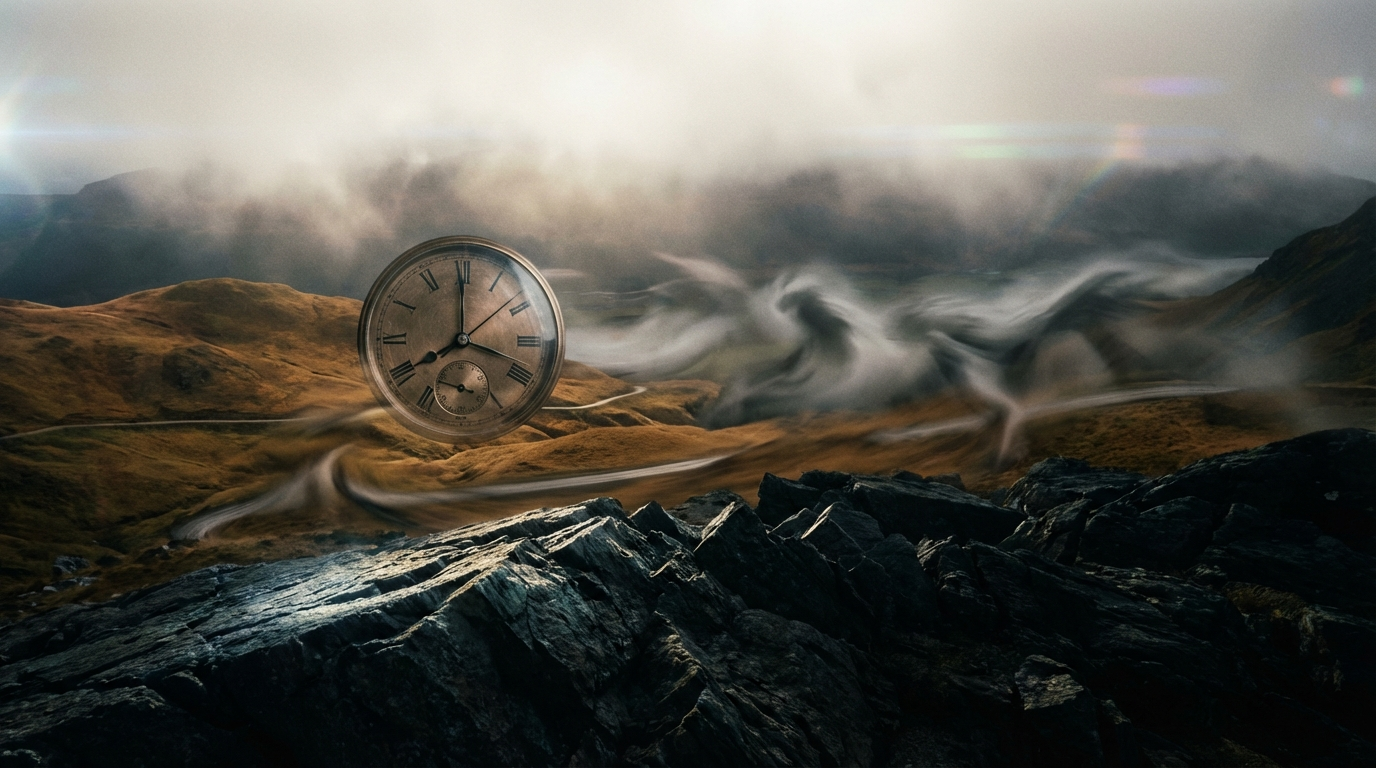
Fog of War — The Wet Ink Principle
One-Line Pitch
The obstacle is not a wall. It's a landscape. Some of it is fixed, some is still moving, and the most dangerous thing you can do is pretend everything has dry ink before the writing is done.
The Three Ages of Certainty

Age 1: Arithmetic (Dry Ink)
300 / 5 = 60
Every number is fixed. The ink is dry. The problem is a fossil by the time you read it. All you need is the skill to decode it.
Age 2: Algebra (Gate of Certainty)
ax² + bx + c = 0
Algebra invented a gate — x — that holds open a space where a value will eventually arrive. The formula doesn't need to wait for it. The shape is preserved. You can reason about things you don't yet know, as long as you know how they relate to each other.
Age 3: Dynamics (Wet Ink)
This is where we are now. It's not just that some values are unknown — it's that some values are actively changing. They have velocity. They have direction. They interact with each other. They can switch from tethered to freefall mid-problem.
Algebra gave us x — a placeholder for a value we'll learn.
Dynamics gives us x(t) — a living variable that is different every time you look at it.
The move is to keep the ink wet for as long as the thing being described is still moving. Not wet because you're lazy. Wet because to dry the ink prematurely is to photograph a dancer and call it a pose.
Classifying the Landscape

When a problem shows up, the first job is not to solve it. It's to map the motion states of its elements.
| Motion State | What It Means |
|---|---|
| Fixed | Genuinely won't move. Gravity. Deadlines that have already passed. Physics. |
| Tethered | Can move, but only within a radius. A budget with some flex. A person's patience with a known limit. |
| Gravity-bound | Falling or settling toward a resting state but hasn't landed yet. Market sentiment. A conversation in progress. Drying cement. |
| Freefall | No resting state visible yet. A crisis. A viral moment. An argument that hasn't found its bottom. |
| Own force | Actively reshaping the space around it. A competitor's move. A new technology. A person with momentum. |
This is classification of motion state, not classification of type. It looks different:
Example — Should I Launch This Product?
Traditional view stacks everything flat:
| Element | Answer |
|---|---|
| Market demand | Yes (surveys say so) |
| Budget | Tight but possible |
| Competitor | Launching something similar |
| Team readiness | Almost there |
| Timing | Now or never |
This looks like a decision grid. But it implies all five are on the same plane, measured in the same ink, at the same moment.
Motion-state view:
| Element | Motion State | Reality |
|---|---|---|
| Market demand | Gravity-bound | The surveys were taken last month. The number is real but the direction is still in motion. |
| Budget | Tethered | Fixed anchor but flexible radius — cost optimisations you haven't found yet. |
| Competitor | Own force | You don't control this. Anything you assume about their timeline is projection, not measurement. |
| Team readiness | Gravity-bound drifting toward fixed | "Almost there" has been "almost there" for three weeks. The settling rate matters more than the snapshot. |
| Timing | Freefall | "Now or never" is almost always a feeling, not a fact. |
Three of five elements are in motion. The flat grid implied five dry-ink answers. The landscape has two-and-a-half dry values and two-and-a-half wet ones. That's a fundamentally different decision.
The Flat Composite Trap

When we need clarity, we collapse depth.
We take elements at different distances, velocities, and certainty levels and stack them into a single flat view — a spreadsheet, a pros-and-cons list, a decision matrix. And in that flat composite, things overlap.
The hour hand and the minute hand are in the same position at 12:00. From a photograph, they are one thing. But they measure entirely different scales of the same system. Meeting at a point does not mean they are the same point. Two different realities temporarily sharing a projection.
The Hardened Layer Default
When elements overlap in the flat composite, the brain defaults to the most solid interpretation:
- If something could be soft or hard → assume hard.
- If something could be moving or still → assume still.
- If something could be uncertain or certain → assume certain.
This gives you a stable platform, fast decisions, defensibility. But it also removes sudden wins you didn't see because you crystallised them as walls, creative paths that only exist in the soft layer, and the ability to notice that two apparently overlapping elements are on different planes entirely.
Things that are confused in a snapshot are often perfectly clear in a sequence.
Deliberate Fog as a Creative Tool

In strategy games, Fog-Of-War covers territory you haven't explored — a limitation to push back.
Here it's inverted: deliberate fog is a creative tool. A blanket you throw over parts of the problem space to protect them from premature collapse.
When two elements appear to overlap, you don't resolve the overlap. You fog it — mark it as a region where the flat composite is unreliable and depth information is needed.
The fog means: I know enough to know I shouldn't flatten this yet.
The fog lifts when:
- Time passes and the elements separate (the clock hands move apart)
- New information arrives that reveals the depth relationship
- The elements show different settling rates — and therefore are on different planes
The Kaleidoscope Problem
Teaching the difference between black and white is easy in a static frame. Inside a kaleidoscope — where every pattern is shifting, where today's black is tomorrow's arrangement of coloured fragments — it's a different problem entirely.
The solution is not "better classification." It's temporal patience. Let the kaleidoscope turn. Watch the fragments rearrange. The pattern is not in any single frame — it's in the motion between frames.
See What You Can See

There is a phrase that captures this entire principle in five words:
See what you can see.
Not "see what you expect." Not "see what would be convenient." Not "see what you saw last time." Just — see what you can see. Right now. With these eyes. In this light.
This is the posture. Not passivity, not slowness, not indecision. Just: let the seeing happen before the deciding starts.
The Waterfall Principle
If you try to carry the water uphill to fuel the waterfall, you exhaust yourself quicker than the water flows. The waterfall doesn't need your help. Gravity handles it. Your job is to be at the bottom when it arrives — not to haul the water up the mountain so you can stage the moment.
Don't decide what the video is about before you've filmed it. Don't decide what the audience will think before they've watched it. Don't decide whether an idea is good before you've lived with it for a day.
Observe first. Then act on what you saw.
The Way of Water
Water doesn't decide where it's going. It responds to the terrain it's on, right now, in this instant. It doesn't plan three turns ahead. It doesn't argue with gravity. It doesn't carry itself uphill to make a better story.
And yet — given enough time and enough terrain — water carves the Grand Canyon.
The Response Protocol

When asked for a decision with mixed-certainty inputs, the answer has four layers:
| Layer | Symbol | What it is |
|---|---|---|
| Bedrock | 🪨 | Dry ink, high confidence. Genuinely fixed. Act on this. |
| Setting | 🧱 | Drying ink, medium confidence. Settling toward clarity. Watch it. |
| In Motion | 🌊 | Wet ink, low confidence. Actively changing. Direction visible but position uncertain. |
| Fogged | 🌫️ | Overlapping projections, deliberately unresolved. Two things on different planes — don't collapse them yet. |
Then: "Given the bedrock, here's what I'd do. Given the fog, here's what I'd watch. Given the motion, here's when I'd re-evaluate."
This is not hedging. This is higher resolution decision-making. The answer has more information, not less. The confidence is more honest, not weaker.
The Deadlock Problem
Current AI systems are request-response machines. A question comes in. An answer must come out. There is no architecture for "I heard you, and I'm still thinking, and I'll know more tomorrow."
So what happens? Fudging. The system takes wet-ink values and snaps them to the nearest dry value. It collapses the probability distribution into a point estimate. It presents uncertainty as confidence. It answers the question before it has finished hearing it.
This is not a flaw in any particular system — it's the architecture of the paradigm. The system is designed to converge. Wet ink is treated as a bug, not a feature.
The alternative: build response pipelines that can hold state across time rather than requiring full resolution per request. A question asked today can be partially answered today and refined tomorrow when wet ink dries.
The One-Line Version
Algebra taught us to keep variables open until we had values.
Fog-Of-War teaches us to keep assessments open until the motion settles.
Don't dry the ink before the writing is done.
Connections
- SPR→ — the visual rendering counterpart; certainty as a continuous field, not binary; keep the sample budget honest about what you don't know
- Krudd→ — the language counterpart; fog declarations are a valid grammatical state; the document that knows what it doesn't contain
- The Stochastic Gate→ — noise is the mechanism of seeing; uncertainty isn't obstacle, it's instrument
- The Phosphor Gate→ — the perceptual counterpart; staying on the right side of the threshold to keep what you find
- The Known Fraction→ — every number system has barriers that dissolve when you change lens; dry-ink certainty in one system is wet-ink freedom in another