Fill The Page
One-Line Pitch
Creativity is not a gift, a mood, or a personality type. It is a job. Your job is one thing: the page cannot be blank when your shift ends.
Enough With the Woo-Woo

You have been told a lie about creativity.
The lie goes like this: creative people are different. They are visited by inspiration. They have a special inner world that generates ideas. The rest of us wait for a spark that may or may not arrive, and when it doesn't, we conclude that we are simply not the creative type.
This is entirely wrong, and the people who are actually creative will tell you so — if you ask them the right question.
Don't ask them what their creative process feels like. Ask them what they do every day.
Stephen King writes 2,000 words every day. Every day. Not when he feels inspired. Not when the muse is cooperating. Every day, including Christmas. The 2,000 words might be bad. They might be good. That is not his decision. His decision is: 2,000 words, every day, no blank page left behind.
Chuck Close, the painter, said it plainly: "Inspiration is for amateurs. The rest of us just show up and get to work."
Picasso: "Inspiration exists, but it has to find you working."
Tchaikovsky, who wrote some of the most emotionally overwhelming music in the Western tradition: "A self-respecting artist must not fold his hands on the pretext that he is not in the mood. Inspiration is a guest that does not willingly visit the lazy."
They are all saying the same thing. The mechanism is the same. What varies is the medium. The principle does not vary.
Your job is to show up. To fill the page. To not leave it blank.
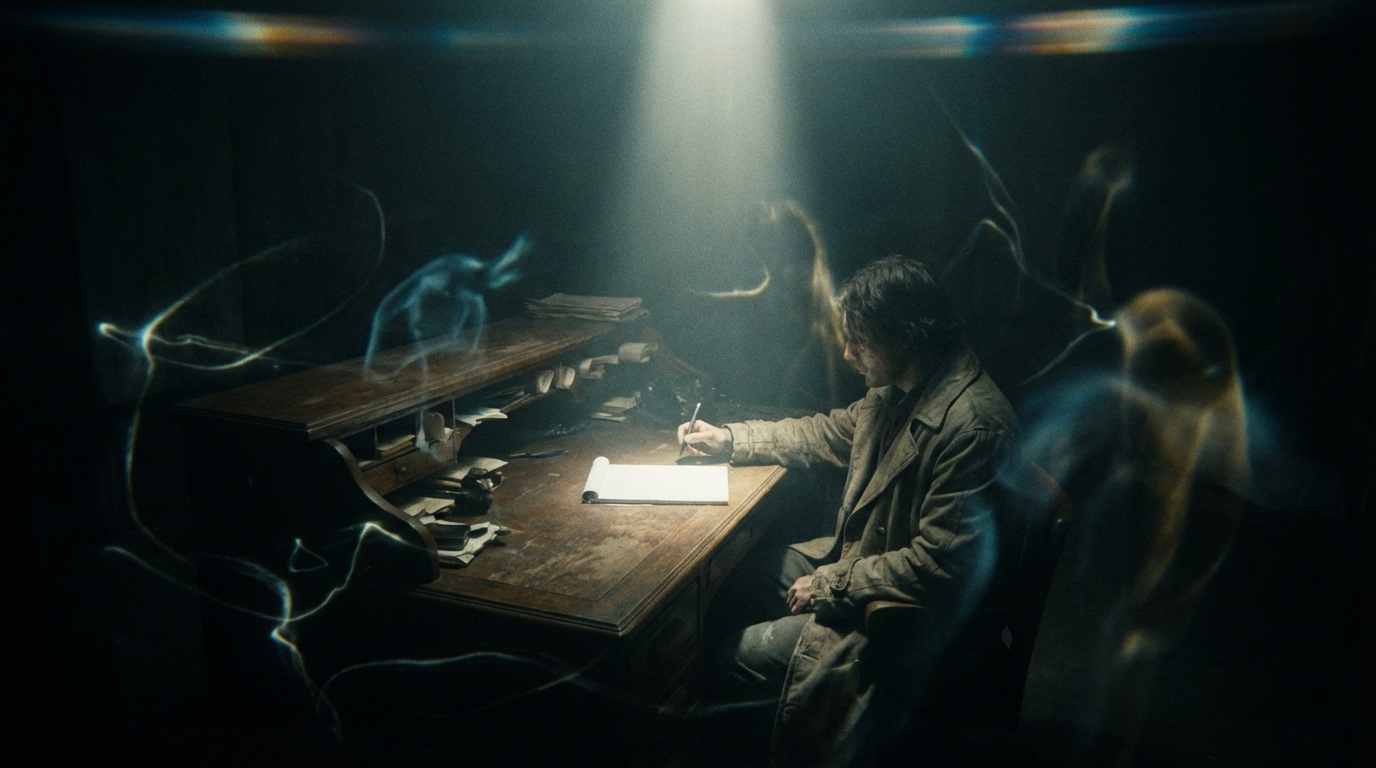
What goes on the page is the Muse's department. Your department is being there to receive it.
The Two Jobs

Here is the complete job description for a creative person:
| Who | The Job |
|---|---|
| You | Show up. Open the page. Fill it. Do not leave it blank. Do not wait. |
| The Muse | Provide the content. This is not your department. Do not interfere. |
That's it. That's the whole system.
The confusion happens because people try to do both jobs simultaneously, which results in doing neither well. You sit down to write and immediately start evaluating whether what you're producing is good enough — which is the Muse's editorial function, not yours. Your function is to produce it. Hers is to determine what it is.
When you try to evaluate while producing, you slow the production down to nothing and the evaluation is premature anyway, because the thing isn't done yet. You are reviewing a half-poured concrete slab and concluding it is not a road.
Do your job. Let her do hers.
What the Muse Actually Does

Let's take the woo-woo out of the Muse for a moment.
The Muse is simply the source of material that did not come from your rational pattern library. Every thought you have that surprises you — that felt like it arrived rather than being assembled — that's Muse material. You've felt it. Everyone has. The sentence that appears before you know what you're going to say. The solution that surfaces in the shower. The image that arrives in the half-second before full waking.
The question is not whether this source exists. You know it exists. You have felt it.
The question is whether you are there to catch it when it fires.
The creative person who produces a lot is not producing more because they have more ideas. They are producing more because they are at their desk — or their canvas, or their instrument, or their notebook — often enough that the Muse has somewhere to land.
The person who says "I have ideas but never do anything with them" is not short on Muse visits. They are short on landings. The Muse arrives, finds no runway, and the material dissolves. The chemical that clears dream memory also clears waking inspiration that goes uncaptured. Not immediately — but fast enough.
Be at your desk. The Muse will find you there.
The Creative Discipline — What It Actually Looks Like

This is the practical bit. No mysticism required.
Step one: decide what your blank page is.
A page of writing. A canvas. A voice note. A line of code. A sketch on the back of an envelope. Something that starts blank and must not end blank. The medium does not matter. Pick one.
Step two: decide when your shift is.
Not "when I feel like it." When. Morning before email. Twenty minutes on the train. The hour before bed. A specific time that becomes the habit. The shift is not long. King writes 2,000 words in roughly three hours. Most people could produce meaningful creative work in 30 minutes a day if they showed up consistently. The duration is not the variable. The consistency is.
Step three: fill it. Do not evaluate.
This is where most people stop. They start filling and the editorial voice begins immediately: is this good? is this interesting? is this original? has someone done this before? These are all valid questions. They are also not your job during the shift. Your job during the shift is to fill. The editorial questions are for after.
Write the thing you feel to write. Draw the mark you feel to draw. Say the words that come. If they're bad, write them anyway. The page cannot be blank when your shift ends. What is on it — quality, direction, originality — is a separate conversation, after the shift.
Step four: stop when the shift ends.
Not when you've decided it's good. Not when you've exhausted every idea. When the shift ends. This is also important: consistently stopping on time trains the Muse to appear consistently at shift start. The container has a shape. The shape matters.
On "Is This Good?" — The Wrong Question at the Wrong Time
The Grumms are a made-up species of sky creatures. They operate clouds, tickle antennas, and surf electromagnetic micro-forces. They have an official apology chant. It is 120 lines of the word GOOBER.
Is this good?
Wrong question, wrong time.
Here is the right question: did I fill the page?
Yes. Completely. With commitment. With internal consistency. With a formal bureaucratic framework that holds absurdity without flinching. With precise word choices — "falloober energy," "advanced goober dynamics," "somewhat gooberishly" — that are not random but are specifically calibrated to sound like a taxonomic system while being completely invented.
The page was filled. The shift was completed. The Muse provided a species with a cosmology and a contracts council and a warming-up protocol for the larynx.
You showed up. You filled it. She provided the content. This is the system working.
The evaluation question — "is this good?" — is legitimate but it belongs to after. After the Grumm poem exists, you may evaluate it. While it is being written, evaluating it would interrupt the channel. The GOOBER chant would have become ten lines instead of 120 if the evaluation voice had been running. Ten lines of GOOBER is a half-commitment. A half-commitment does not earn the formal closing. "Somewhat gooberishly" only lands because 120 lines of GOOBER preceded it.
The commitment to the bit is the craft. And the commitment to the bit only happens when the evaluation voice is off during the filling.
What the Greats Said

They said the same thing in different words, across centuries and media. This is not coincidence. They had found the same mechanism.
| Who | What they said | What they meant |
|---|---|---|
| Stephen King | "I write 2,000 words a day, every day." | The shift is non-negotiable. The Muse finds me at my desk. |
| Chuck Close | "Inspiration is for amateurs." | Waiting for inspiration is how amateurs avoid the work. Professionals fill the page. |
| Picasso | "Inspiration has to find you working." | She won't come to an empty house. |
| Tchaikovsky | "A self-respecting artist must not fold their hands because they are not in the mood." | The mood is irrelevant. The shift is not. |
| Maya Angelou | Rented a hotel room every morning, no distractions, wrote until noon, left | The container creates the conditions. The discipline maintains the container. |
| Anne Lamott | "Shitty first drafts." | The first draft's job is to exist, not to be good. Existence is the entire goal of the first draft. |
| Hemingway | "The first draft of anything is shit." | Same insight. The fill comes first. The quality is a second-draft question. |
| Philip Pullman | "I don't wait for inspiration. I sit at my desk and work." | The desk is the practice. The practice is the whole thing. |
They are all describing the same two-job system. Show up. Fill it. The Muse handles content. You handle presence.
The Discipline Is the Container

Here is the counterintuitive part that most people miss.
The discipline does not constrain the Muse. The discipline is the container that allows the Muse to function.
Without the container — without the regular shift, the committed page, the consistent showing up — the Muse has nowhere to land. The creative energy is present. It has always been present. It dissolves uncaptured because the runway is never there when she arrives.
With the container, she knows when to come. The shift is reliable. She can plan around it. You will be at your desk at 7am. She will be there too. The material will be delivered. You will fill the page.
Idea Season — the period in January and February that produced a million words of ideas — was not a creative miracle. It was a container. A specific practice: every time something was felt, it was dictated immediately, with zero friction, without evaluation, without filtering. The bandwidth of capture matched the supply that had always been there. The Muse did not suddenly produce more. The container became big enough to catch what was already being produced.
The creativity was always there. The container was what was missing.
The Zero-Friction Capture Rule

One practical addition that changes everything.
The traditional advice is to keep a notebook. The notebook is good advice badly specified. The notebook assumes you will be at the notebook when the material arrives. The material does not check your schedule.
The Muse arrives in the shower. On the walk. In the gap between waking and getting up. In the middle of a conversation that sparked something unrelated. In the car. At 3am.
The zero-friction capture rule: the gap between the feeling and the record must be as short as possible. Any friction — finding the pen, opening the laptop, waiting to get home to write it down — is time in which the material dissolves. The chemical that clears inspiration is not slow. Two minutes of delay is often enough to lose the texture of what arrived.
The tool is whatever creates the shortest gap between feeling and record.
For most people this is voice dictation on a phone. Say it out loud, immediately, wherever you are. Unpolished. Unedited. Say what you feel before you have time to evaluate whether it is worth saying. The evaluation can happen in the afternoon when you review your notes. At the moment of capture, your only job is speed.
This is the same rule the ancient Greek dream recorders operated under. This is why they had scribes positioned at the threshold of the sleeping chamber — to receive the dictation before the dreamer was fully awake, before the chemicals erased the feeling that generated the images. The scribe was the zero-friction capture layer. Today the phone is the scribe. Use it.
I Do Not Plead. I Barter.
Full disclosure: I just spent several hundred words citing Anne Lamott's "shitty first drafts" and Hemingway's "the first draft of anything is shit," nodding along like I follow this advice.
I do not follow this advice.
I do one take.
Videos — one take. Songs — first attempt at playing and singing. Recordings — whatever came out. If it is bad, that is not really my concern. I showed up. I had a shift. I filled it. The Muse was given the whole session to work with and if she did not direct me to something worth keeping, that is a management problem on her end, not mine.
The people who say "shitty first drafts" are still negotiating with the Muse. They are showing up, yes — but with a plan to come back and fix it. Draft one is the offering. Draft two is the real work. It is a sensible system. It is also, quietly, still a form of pleading. The subtext is: I know this isn't right yet, here is my willingness to try again, please reward the effort.
I don't plead. I barter.
The terms of my barter are simple: I will show up. I will do it once. I will give it everything I have in that one try. In exchange, the Muse either delivers something worth keeping or she doesn't. Either way, my side of the deal is complete. I am not coming back to polish. My revision schedule is fully booked — with new one-takes.
If the Muse wants my help, tough luck. I am lazy, and I do one take. If it isn't good enough, that is not my business. I still showed up. She should have directed me better.
This sounds more arrogant than it is. The one-take discipline actually demands more from the Muse, not less. It forces the creative act to be complete in itself — no "I'll fix it in post," no second pass to rescue what was vague the first time. Whatever arrives must arrive fully formed or not at all. This is a different kind of pressure than the first-draft philosophy, not an easier one.
The people in the table above — the ones who said "shitty first drafts" and "the first draft of anything is shit" — they are describing a real mechanism that works. They were not wrong. They were describing their barter terms.
These are mine.
The One-Line Version
The Muse's job: provide the content. Your job: be there, fill the page, do not leave it blank.
That's it.
The rest is technique.
Connections
- The Dark Touch — the full mechanism behind where the Muse's content actually comes from: felt encounters in the dark, rendered into whatever medium your mind reaches for. (Coming soon)
- Herbie Hancock — The Channel Muse — "Technical mastery serves surrender." You build the craft so you can forget it and receive. The discipline builds the craft. The craft enables the surrender.
- The Two Stances — the Architect Stance (preparation, structure) and the Channel Stance (receiving, present). Creative discipline is how you prepare the Architect enough that the Channel can function without friction.