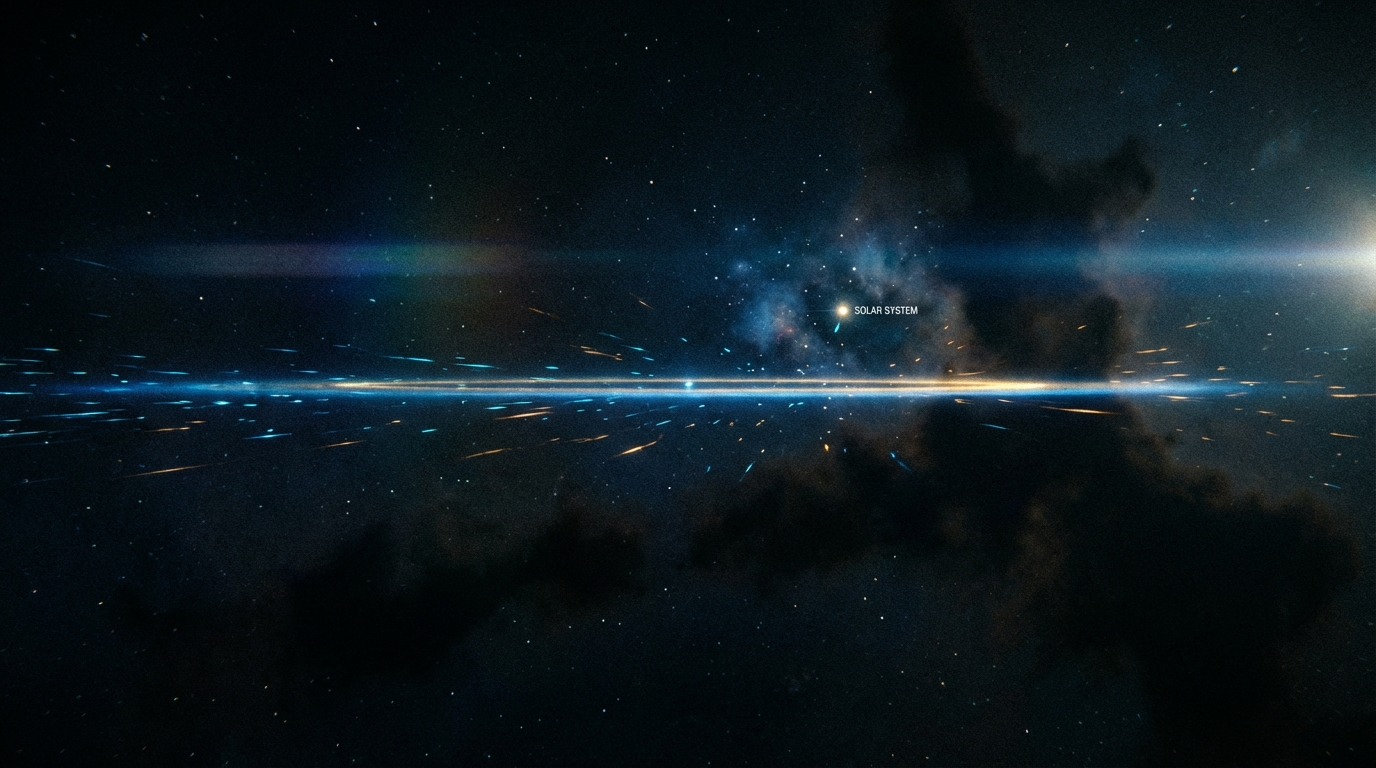
The Ecliptic Highway — The Busy Road We Forgot to Look At
One-Line Pitch
The ecliptic plane, viewed side-on, may be layers deep with intergalactic traffic — and we miss it entirely because we lack the dimensional vocabulary to perceive it.
The Geometry

The ecliptic plane is the flat disc of the solar system — Earth orbits in it, the planets orbit in it, the asteroid belt hugs it. Most galaxies have a similar plane. If you were outside our solar system and looked at the ecliptic edge-on, you'd see a razor-thin disc.
Now stack discs. Galaxy after galaxy, plane after plane. From certain vantage points, these planes align. Traffic — if it exists — would run along these planes. The path of least energetic resistance. The cosmic equivalent of following the river valley, not climbing the ridge.
We're inside one of these discs. We look across the plane, not into it. We look along the highway, not at the cross-section.
The Dimensional Blindspot

A 2D being living on a piece of paper doesn't know there's a room. It experiences the lines on the page — it cannot perceive height. To anything that exists in height, the 2D being is simply unaware. It's not denying the room. It doesn't have the perceptual apparatus to suspect the room.
We may be the same.
The traffic on the ecliptic highway might move through a dimension of physical reality we don't register — not a metaphorical dimension, an actual one. The physics may be there. The evidence may be there. We're not tuned to read that axis.
And so the highway is quiet from where we stand.
The Rug

The phrase that crystallises it: we forget to look below the rug.
The rug is the ecliptic plane. We are on top of it. Vast amounts of business happen beneath — and through, and along — it. And we don't look there, because we don't know to look there, because we've never thought of the plane as a surface rather than a field.
It's not suppression. It's not conspiracy. It's that a primitive civilisation doesn't know what it doesn't know. The ants on the table can't see the highway outside the window.
What Would Looking Like?

If you viewed the ecliptic plane side-on — cut the solar system with a blade and watch the edge — what would you be watching for?
| Signature | What It Might Mean |
|---|---|
| Gravitational anomalies tracking along the plane | Mass in transit, not in orbit |
| Spectral signatures repeating at ecliptic latitudes | Something using the corridor |
| Energy patterns consistently thinner above and below the plane | Activity concentrated at the disc |
| Periodic occultation events along the ecliptic | Object density that doesn't match known matter |
None of this has been the consistent focus of mainstream SETI strategy. SETI has looked for signals. It hasn't systematically looked for traffic patterns. Traffic doesn't advertise. It flows.
The Civilisation Gap

There is a standard Kardashev argument: a Type III civilisation doesn't need to signal. It is the infrastructure of the galaxy. It doesn't know we're here any more than the highway knows about the ant.
If that's true, we would not be looking for messages. We'd be looking for roads.
The ecliptic plane — and the aligned planes of other star systems — are the most energetically efficient corridors in the galaxy. If there is traffic, it is most likely here. If it is most likely here, and we're inside it, we are perhaps the worst-positioned observers in the galaxy to notice.
Like trying to see the current by sitting on the riverbed.
Connections
- The Fragment→ — what objects are arriving in the solar system that don't fit known trajectories?
- Zero Darkness→ — the question of what fills the dark that we can't account for
Next Step to Explore
- Map SETI archival data against ecliptic latitude rather than galactic latitude — is there a signal concentration in the plane?
- Pull gravitational anomaly datasets: is there a plane-correlated signature not explained by known masses?
- The dimensional blindspot argument deserves formal treatment: what perceptual apparatus would be required to detect plane-correlated traffic?