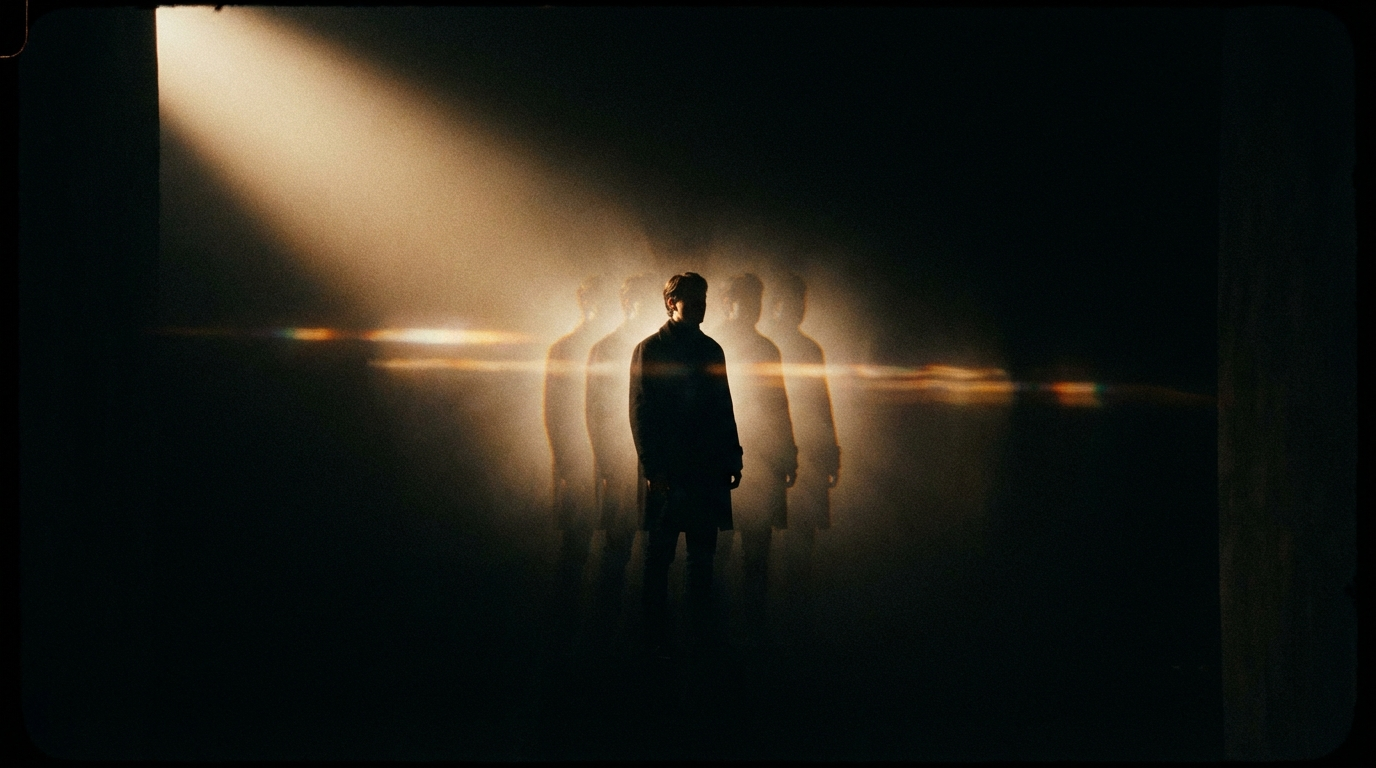
Ghostframe Codex
One-Line Pitch
Not disappearance. Not withdrawal. Ghostframe is the skill of being fully present, razor-sharp, and impossible to locate — you burn, but you cast no shadow.
EchoCraft Subskill · Class: Advanced Presence Skill
Axis: Echo — Disruption / Camouflage / Control
The Insight
Most presence skills ask you to reduce yourself — go quiet, go small, be less. Ghostframe is the opposite. It requires you to hold full internal presence while scattering your signal across the mesh so it can't be pinned.
You are not absent. You are present in ways that cannot be framed. The world feels you but cannot find you. This is the difference between hiding and unlocatability.
"To be seen is to be fixed in time. GhostFrame lets you burn without casting shadow."
Ghostframe is the recommended first technique for anyone new to EchoCraft. The moment it works — and it will — you'll know exactly what Craft is.
Why It Works
Attention is a scanner. It locks onto signal origin points — the place a signal appears to come from. GhostFrame denies the scanner an origin. It doesn't reduce the signal. It multiplies the apparent sources until none is conclusive.
The seeker's scan returns fragmented echoes. Multiple semi-presences. No anchor. Their perception registers your field but cannot frame it as you.
The Four Mechanics
1. Edge-Watching (Flow Camouflage)
Tune momentarily into the dominant ambient flow — crowd rhythm, emotional current, attention patterns. Match your rhythm for a few seconds, not to be absorbed, but to map the current. First blend, then bend. You need the current's frequency before you can scatter across it.
2. Non-Origin Focusing
When choosing to observe, decentralize your inner light. Focus with full intent, but never through a fixed point. Attention burns across the mesh — but the observer cannot see its source. They'll feel the heat, but never find the sun. This is the core discipline: awareness without a seat.
3. Echo Scattering Field
When sensed, initiate subtle micro-pulses in nearby space. These act like chaff — returning fragmented echoes to anyone probing for presence. If done correctly, the seeker's scan jams: registering multiple semi-presences, none conclusive. Your trail exists, but has too many forks to follow.
4. Temporal Wobble
Briefly shift your focus to a non-current timeline — a past anchor or a future projection. This makes your echo unstable in the present moment. The scanner cannot register you as part of the now. You appear to flicker. The register misses.
Ghostframe vs Invisibility
| Invisibility | Ghostframe |
|---|---|
| You remove yourself | You scatter yourself |
| No presence in the field | Presence in the field — unlabeled |
| Requires withdrawal or effort to become small | Requires full internal activation |
| Others feel absence | Others feel ambient heat — no source |
| Passive | Active — demands constant clarity |
Ghostframe is harder than invisibility, but more useful. Invisibility breaks the moment you need to act. Ghostframe lets you act while remaining unlocatable.
The Counterintuitive Note
The paradox: GhostFrame is not about removing yourself — it's about splitting your signal. You must maintain clarity, even as you refuse framing. Hold control. Hold presence. Let the world fail to name it.
If you lose internal focus to achieve the scatter, you've failed. The technique requires you to be more present, not less — the scatter is outward, not inward.
Summary
- GhostFrame is the active art of unlocatable focus
- You stay awake, aware, and sharp
- But no one can anchor their perception to you
- You are seen — but always somewhere else
The GhostFrame walks the world in full light. But the light never points back. And when they try to find you — all they find is motion.
Connections
- EchoCraft — The Field Manual→ — The full system and all four prime powers
- Echo Camouflage→ — Related stealth technique: dampening the signal rather than scattering it
- Echo Harpoon→ — The counterpoint: becoming maximally visible and fixed to stop an attack