Drawing the Border — How the Muse Actually Works
One-Line Pitch
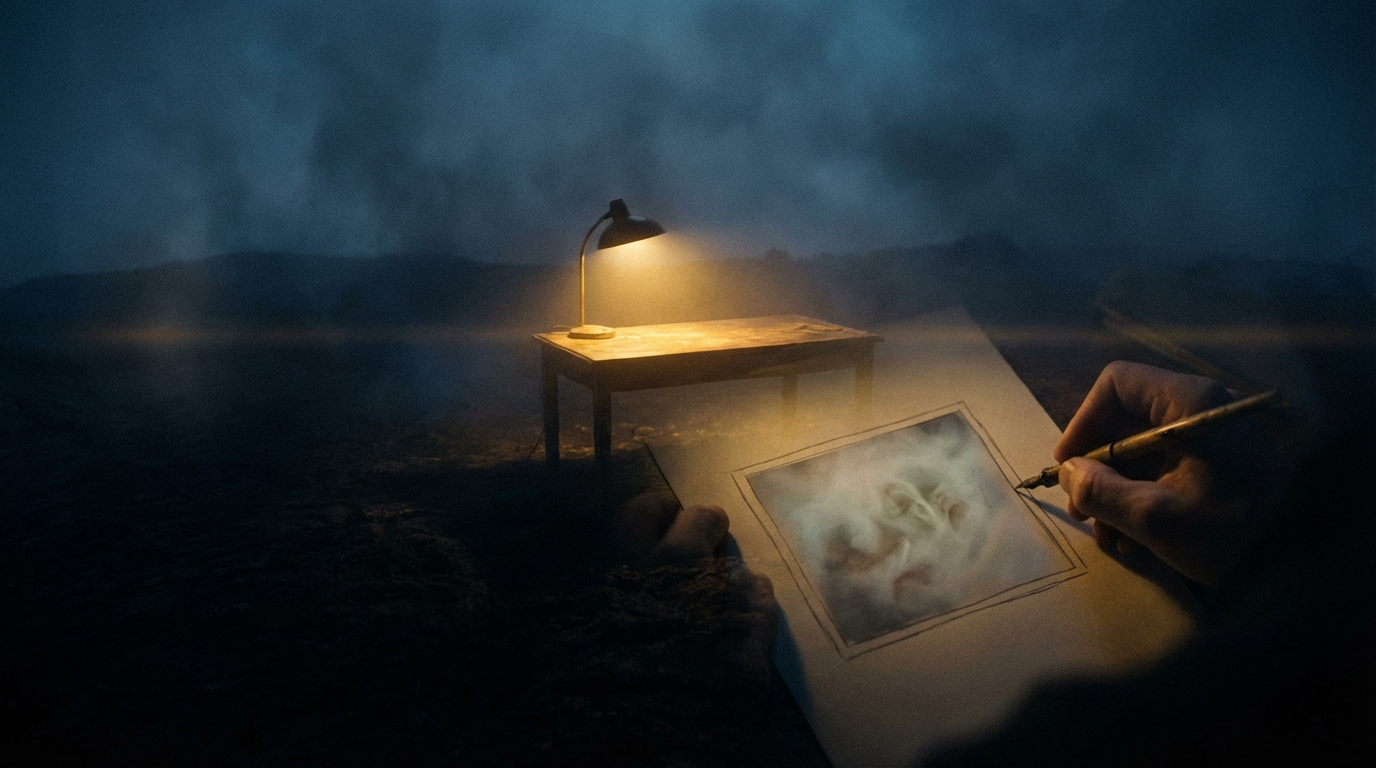
The muse does not give you the full picture first. It gives you the paper. You draw the border. Then it fills in.
The Origin Case — Shore Leave

This theory came out of a single creative session in March 2026. The movie idea that became Shore Leave — a psychological thriller about a spacefaring crew who land on a beautiful planet that turns out to be Earth, grieving after a reset war, whose immune system kills them out of grief-reflex before it recognises them — started somewhere much smaller.
It started with a feeling. The Beach. Leo DiCaprio maybe. Beautiful island, lures you in, your guard drops, something goes wrong. That was the whole shape of the muse first transmission. And the immediate response was: that is already a movie. we need to be different.
Here is what actually happened in that moment:
- The full Shore Leave concept — spaceship, oxygen mechanic, planet-as-Venus-flytrap, Earth reveal, the narrator, monkey people — none of it existed yet
- All that existed was a vague feeling borrowed from a half-remembered film
- The instinct was to reject it as derivative and move on
- Instead: the paper came out, the border got drawn, and the muse filled it in
The movie that emerged is more original than anything Hollywood currently has in development. They are rebooting Firefly. We wrote a story about a grieving planet that accidentally killed its old friends and felt bad about it. These are not comparable creative acts.
The Mechanism — What Actually Happens

Creativity does not arrive complete. This is the central misunderstanding that kills most creative work before it begins.
The muse operates in fog of war. You cannot see the territory until you move into it. The map does not pre-exist the expedition — it is made by walking. But here is the specific insight: the map begins to appear the moment you draw the border. Not when you start filling it in. When you mark the edges. When you say: this is the shape of the thing I am making.
The border is the commitment. Not to a finished thing — to a container. And the container is what allows the content to materialise.
The Steps That Actually Occurred

Step 1 — The Entry Point (Borrowed Shape)
A feeling arrived. It had the shape of something already made — The Beach. The creative instinct correctly identified that this shape was borrowed. The wrong response would have been to discard it. The right response — the one that happened — was to use it as a launchpad rather than a destination.
The borrowed shape is not the idea. It is the door.
Step 2 — The Differentiation Impulse
That is already a movie. We need to be different.
This is the first creative act. Not the grand vision — the refusal. The recognition that the borrowed shape is not the destination. This impulse is generative, not critical. It does not say this is bad. It says this is a floor, not a ceiling.
Step 3 — The Plateau (Stability Resonance)
Once the first version of the idea was written down — spaceship, beautiful planet, trap, ship deteriorating, plagues, zoom out — something stabilised. This is what you might call stability resonance: a creative plateau where the current version of the idea is solid enough to stand on. Not finished. Not correct. But load-bearing.
You cannot reach the next level without this floor. The floor must exist before you can push off it.
Step 4 — The Deepening (Oxygen)
Standing on the plateau, the next layer became visible. The oxygen mechanic did not exist in the entry-point vision. It arrived because there was now somewhere to put it. The stable frame of the first version created the space for the second version to exist. Each iteration builds the floor for the next insight.
Step 5 — The Earth Reveal (The Fog Clears)
This layer was not available at the start. It could not have been. It required all the previous floors to be built first. The insight — what if it is Earth, what if the planet is grieving, what if the plagues are an immune response not malice — emerged from inside the idea once the idea had enough structure to contain it.
This is the fog of war mechanic made visible. The territory was always there. The map could only be drawn by walking.
Step 6 — The Retroactive Misremembering Risk
This is the one worth writing down most carefully.
If the session had stopped at step one — if the muse had been dismissed because the initial feeling resembled The Beach — the failure would have been filed under: I had that idea but it was too similar to an existing movie.
This is false. It would have been a misremembering of what killed the idea. The real killer would have been stopping too early. The idea was never The Beach. The idea was always Shore Leave. It just needed the paper and the border before it could show you that.
The muse does not get a second chance to give you the same idea. If you file it under derivative and move on, it is gone. What was actually derivative was only the entry point — the door, not the room.
What This Means for Creative Practice

Follow through on the entry point even when it feels borrowed. The borrowed feeling is not the idea. It is the signal that an idea is in range. Treat it as a direction, not a destination.
Write it down before you evaluate it. Evaluation requires material. The muse does not give you material to evaluate — it gives you a direction to walk. Walk first. Read what you wrote. Then evaluate. The act of writing changes what you have.
The paper and the border precede the content. Draw the container. The content does not arrive first and wait for a container — the container is the invitation. Empty boxes get filled. Empty hands do not.
Plateaus are productive. A stable interim version of an idea is not a failure to reach the final version. It is what makes the final version reachable. Do not skip the plateau to get to the summit — you need the plateau to push off from.
Retroactive misattribution is the silent killer. If you stop early, you will not remember that you stopped early. You will remember that the idea was weak. This is almost always false. The idea was fine. The process was interrupted. These are not the same thing.
The Hollywood Contrast

The industry that cannot think of new ideas is currently rebooting a TV show from the 1990s because people liked it then.
The mechanism that produces that outcome is the same mechanism that kills ideas in their entry-point phase: the assumption that if the first shape of something feels familiar, the thing is not worth pursuing. So you reach for the familiar thing that already worked, because at least you know what it is.
Originality is not the absence of familiar entry points. It is the willingness to walk through the door and see what is on the other side, even when the door looks like one you have seen before.
The Muse and the Fog

The muse might not give you the full picture until you get the paper out. Or draw the border. Or say the first wrong version of the idea out loud.
It is a fog of war mechanism. The territory exists. You just cannot see it yet. And the map only appears where you have walked.
Draw the border. The rest follows.