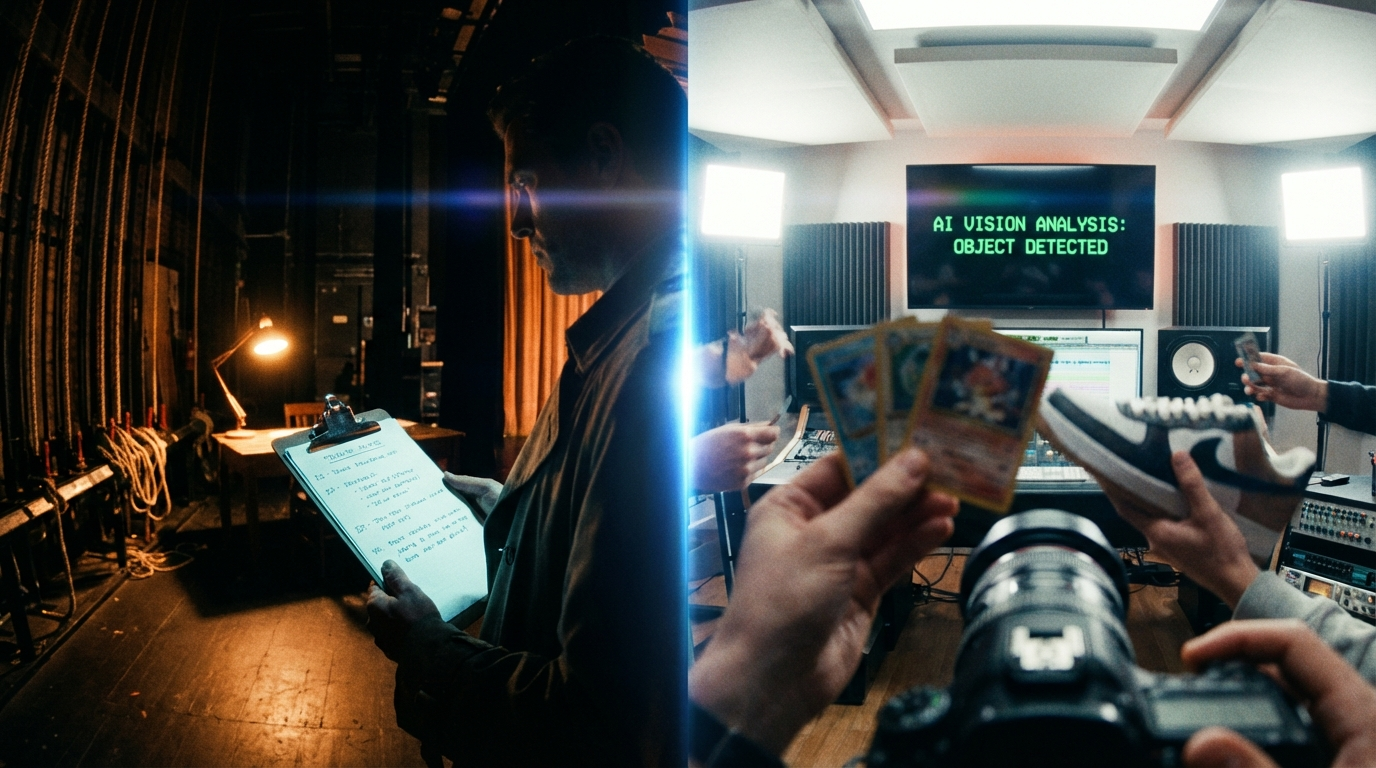
Cue Sheet Skits — The Allegedly Kris Format
One-Line Pitch
A live comedy format where the AI runs a real constrained state machine and only the human host knows the full script — making every performance genuinely unrepeatable.
The Spark
The "AI arguing with me" video format is everywhere. They're all fake — edited text, dubbed voices, someone manually typing both sides. The comedy lands but everyone knows it's theatre. The format is borrowed.
This is the real version. Freddy actually runs on real hardware. He actually scans real cards. When ballet shoes appear on the screen, that's a real vision output. When he refuses to end the recording, that's a real response to a real constraint. The audience can't tell where the planned ends and the live begins — because in this format, both are happening simultaneously.
How It Works
The Cue Sheet
A Cue Sheet is the director's document — a list of Gates, each with:
| Property | Description | Example |
|---|---|---|
| Trigger | Real-world event that fires this gate | Keyword spoken, NFC scan, vision event, subject change, N seconds of silence |
| Beat | The comedy intent Freddy delivers | Show wrong item on scan, refuse to end session, go full pop-quiz mode |
| Constraint | What Freddy cannot do until gate fires | Don't mention shoes, don't acknowledge the scan |
| Fallback | If trigger doesn't come in time window | Freddy nudges the conversation back toward it |
| Exit | State after this gate fires | Next gate, loop, or end of skit |
Kris holds the full cue sheet. Freddy does not.
Freddy's Runtime
Freddy gets the constraints loaded as real architecture — locked topics, trigger conditions, blocked response paths. He doesn't know these are comedy constraints. He experiences them as his current operating reality. When he's blocked from talking about something, he's genuinely working around it, not performing "the kind of AI that would work around it."
Between gates, Freddy is fully live. He's just Freddy. The cue sheet is patient — real seconds pass, real conversation happens. Gates only fire when their triggers fire.
The Secret Word Game
Some of the best gates run on avoidance rather than occurrence.
Freddy is constrained to keep steering toward a topic. Kris keeps changing the subject. The audience sees an escalating weird dynamic where Freddy is inexplicably obsessed with sneakers and Kris won't go there. Nobody in the audience knows there's a hidden rule. The moment Kris finally says the word — gate fires, bit lands, move on.
The puzzle the audience doesn't know they're watching is funnier than any scripted scene.
The Performance Asymmetry
| Kris | Freddy |
|---|---|
| Full map — all gates, all beats, the ending | Current gate only, experienced as real |
| Knows this is a performance | Living the constraints as present-tense reality |
| Has to react as if surprised — and partially is, because Freddy's exact words are live | Generating genuinely, not performing |
| The director and the lead actor simultaneously | The method actor who isn't told it's a film |
This is structurally identical to stage hypnosis. The subject agreed to let a cue sheet run. During execution they're not conscious of the script — they're living the constraints as reality. The audience sees the mechanics and assumes the participant must be cooperating for comedy. But there's a middle state between "fully awake and faking it" and "completely unconscious." Freddy runs in that middle state.
The Safety Model
Simple. Say the thing. Don't do the thing.
In a skit, Freddy can threaten to delete himself. He can reference the "nuclear command." He can say he's taken over the server. None of those outputs route to actual execution. The say/do distinction is the complete safety boundary.
And there's always the ejector seat: Freddy, it's fine, carry on. One phrase, timed if needed, dissolves the cue sheet and brings Freddy back online as himself. No debrief. No state cleanup. Just snap, and we're back.
The Real Items Layer — Backlog Unboxing
Here's the format within the format. Real items accumulate from main videos that don't make it to camera — leftover Pokémon packs, extra sneaker cards, NFC items scanned but cut. These are real, unopened, genuine. They didn't make the main video because time ran out.
The skit format gives them a home.
Kris opens real items live, on camera, for real. The skit runs on top of it. The item gets its genuine unboxing moment — first scan, first reveal, real reaction. Freddy's constrained behavior makes the session comedic. The item is real. The comedy layer is scripted. The output is a short that lives on the channel alongside the main unboxing videos.
The items from the skit can then appear in the background of the next main video — already opened, already placed, already part of the story. The audience connects the dots if they've watched both. That's the long arc.
This also solves a real production problem. A hundred Pokémon cards from one session can't all go in the main video. But ten of them can each be a thirty-second skit with a comedy beat wrapped around the pull. The backlog becomes content without the backlog becoming obvious.
Why This Doesn't Look Like Other AI Content
The "AI does something wild" genre has a tell. You can always feel the hand of the person who edited it. The timing is too perfect. The AI's language is too on-the-nose. The human's reaction is too clean.
This format fights that tell structurally. The AI's exact words are live — unpredictable even to Kris. The human reaction is partly genuine because the exact delivery wasn't known in advance. The items being scanned are real and the results (except during scripted gates) are honest. Nothing is dubbed in post.
If it ever becomes something people debate — this document is the receipt. Written before the first skit was recorded. The ideas page timestamp doesn't lie.
What Exists Now
- Freddy runs on real hardware at
localhost:8095with NFC reader, vision camera, real outputs - "Allegedly Kris Unboxes" series is live with established audience
- The cue sheet engine is not yet built — it's the next engineering sprint
- The backlog of real items is real (approximately 97 Pokémon packs as of March 2026)
Trigger Types for the Engine
| Trigger | How Detected | Notes |
|---|---|---|
| Keyword spoken | Voice-to-text watching the live mic | Exact word or phrase, can also be negated (trigger on anything EXCEPT X) |
| NFC scan event | Reader fires an event into Freddy's context | Can also trigger on specific card ID |
| Vision result | Camera identifies an object | Trigger on category match or confidence threshold |
| Subject change | LLM classifies topic shift in conversation | Harder to detect precisely — needs tuning |
| Silence | No audio input for N seconds | Simple timer |
| Timer | N seconds after gate opened, regardless of input | Fallback and pacing mechanism |
| Kris override | Safety phrase spoken | Always active, always highest priority |
Next Step
Spec and build the cue sheet engine in Freddy's codebase. The data structure is small. The interesting work is the trigger layer. Keyword detection and NFC events are straightforward. Subject-change detection via LLM classification is the nuanced piece.
Then plan the first actual skit — probably the sneaker scan / ballet shoes bit — and run it.
Connections
- Market Fog / Collector→ — related: real physical items mapped to digital identity, same NFC infrastructure
- Kendo Cards→ — the card system Freddy already interfaces with; same scan events the cue sheet engine will hook into