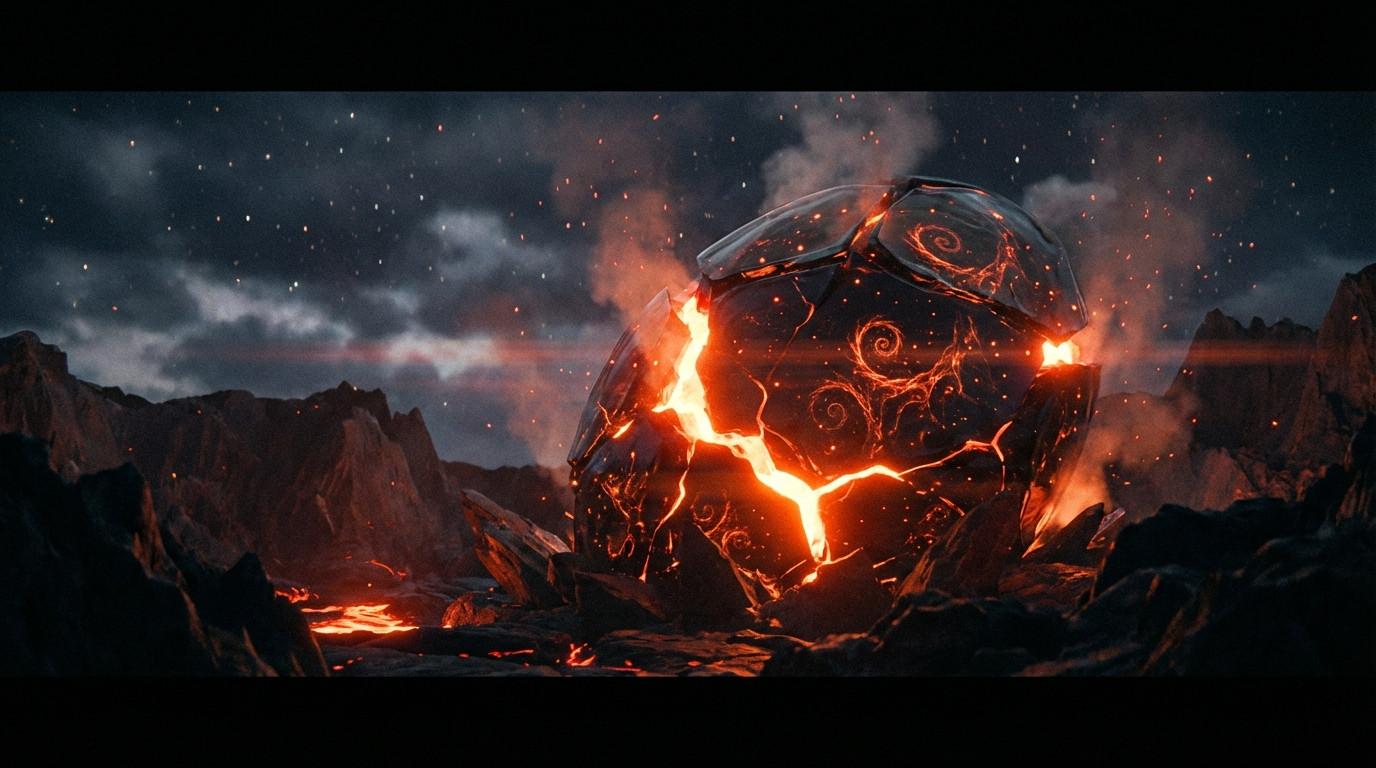
The Cinder Chrysalis — Fire Physics of Information
One-Line Pitch
What if fire isn't just a metaphor for knowledge — but the actual physics?
The Spark

It started with a YouTube video. The Slow Mo Guys — Gav and Dan — filmed fire at a million frames per second: Filming the Closest satisfying satisfying Thing to the Sun. Top-down flames, spinning rods, cinnamon thrown into the blaze. They were making beautiful slow-motion content. We were watching it and seeing something else entirely.
Frame by frame, what emerged wasn't a metaphor. It was a field physics manual for how information behaves when it meets uncertainty. Every law we derived from studying their footage is testable, computable, and now running as a live creature in KronosTown.
All credit for the original fire footage goes to The Slow Mo Guys. We didn't film anything — we just couldn't stop pausing and staring at what the plasma was doing.
The 11 Laws of Fire

Derived from studying slow-motion flame footage. Each maps to a measurable property of information systems.
Law 1 — Inverse-Square Decay
$D(r) = \left(\frac{r_0}{r}\right)^2$
Visibility decays as the inverse square of distance from the knowledge source. This isn't approximation — it's the same physics as light intensity, gravitational force, and signal propagation. At double the distance, you have a quarter of the information.
Law 2 — Fractal Boundary
The edge of what you know is never a clean circle. It's a Rayleigh-Taylor instability boundary with fractal dimension $D_f \approx 1.35$. Light fluid (knowledge) pushes into heavy fluid (uncertainty), creating fingers, plumes, and pockets. The boundary is longer than any smooth curve could be.
Law 3 — Anisotropy
Knowledge doesn't spread evenly. It reaches further in some directions than others — driven by data availability, attention, and structural coupling. The flame leans. The information field leans too.
Law 4 — Dark Pockets Near the Core
Close does not mean known. Even near the brightest part of the fire, dark pockets survive — wrapped in flame but untouched by it. These are the things you should know but don't. Proximity to the source doesn't guarantee illumination.
Law 5 — Kolmogorov Cascade
$E(k) \propto k^{-5/3}$
Energy distributes across scales following Kolmogorov's law. Large-scale structures (market trends) feed energy to medium-scale patterns (daily oscillations) which feed small-scale turbulence (tick-by-tick noise). When this cascade breaks — when energy pools at the wrong scale — the system is sick.
Law 6 — Colour-Temperature Gradient
The colour of flame maps to its temperature: blue core (hottest, most certain), through white and yellow, to red edges (coolest, most uncertain). In an information system, the colour IS the confidence level. Core predictions are high-confidence blue. Edge predictions are low-confidence red. The gradient tells you where you are.
Law 7 — Phase Separation
Fire contains two simultaneous phases:
- Gas phase (continuous): the smooth, connected flame body — this is the information field itself
- Particle phase (discrete): individual embers, sparks, and projectiles — these are discrete signals flying through the field
Both exist at the same time. The field carries the embers. The embers feed the field.
Law 8 — Vortex Recycling
$\frac{\partial V}{\partial t} = S(x,t) - \kappa \nabla^2 V + \mathbf{u} \cdot \nabla V$
The knowledge field has curl. Old information doesn't just decay — it gets recycled through convection cells, re-entering the system at different altitudes and temperatures. The vortex is source plus diffusion plus advection. Three forces, always in tension.
Law 9 — Centrifugal Sorting
In a spinning flame (angular momentum from market cycles), signals sort by mass. Heavy signals (high-confidence, multi-source) penetrate deep into the core. Light signals (single-source, low-confidence) get flung to the periphery. The spinning sorts the wheat from the chaff automatically.
Law 10 — Phase Inversion
The most dramatic thing in the footage: when enough cinnamon (catalyst data) is thrown into the fire, the system undergoes phase inversion. The boundary stops being a wall and becomes a membrane. The gradient sign flips — the interior becomes brighter than the exterior. The shell that was protecting the interior now permits radiation outward.
Percolation threshold: $p_c \approx 0.5927$ (2D site percolation). When ember density crosses this, the discrete signals form a connected network. The phase inverts.
Law 11 — Persistent Topological Voids
Even in the solar phase — maximum flame coverage, full inversion — certain dark spots persist. These are not noise. They are topological defects: structural unknowns that cannot be filled by more data. They are properties of the geometry, not the coverage. Some things are unknowable not because you haven't looked hard enough, but because the shape of the problem has holes.
The Cinder Chrysalis — A Living Creature

These 11 laws are now running as a bestiary creature in KronosTown: The Cinder Chrysalis (Ignis inversus).
It lives in the Caldera — a volcanic fissure at the south edge of the Bestiary Reserve. It has four forms:
| Form | Condition | Signal |
|---|---|---|
| Egg | Almost no embers in the field | The substrate is dark. No data flowing. |
| Chrysalis | Embers exist but shell dominates core | Rules and thresholds are more visible than predictions. Boundary-dominant. |
| Hatching | Percolation threshold crossed, inversion beginning | Signals connected into a network. The cascade is starting. |
| Dragon | Full solar mode — core dominates shell | The model is radiating. Constraints are invisible. Fire physics validated. |
Every minute, the Chrysalis reads the substrate's signal field and computes:
- Ember density vs percolation threshold
- Core brightness (chimera coherence × field resonance) vs Shell brightness (field vitality × boundary clarity)
- Cascade health — is energy distributing properly across time scales?
- Void count — how many structural unknowns persist?
- Fractal dimension — how turbulent is the boundary between known and unknown?
- Inverse-square fit — does signal strength actually decay as $1/r^2$?
What It Proves

The Chrysalis is a test rig. If the fire physics are real — if information genuinely behaves like plasma — then:
- Signal strength should decay as inverse-square with age (Law 1)
- The confidence boundary should be fractal, not smooth (Law 2)
- Dark pockets should appear near high-confidence regions (Law 4)
- The cascade ratio should approximate $k^{-5/3}$ when healthy (Law 5)
- Phase inversion should be detectable and meaningful (Law 10)
- Voids should persist through all phases (Law 11)
If the Chrysalis hatches and the numbers hold, the fire wasn't just beautiful — it was right.
The Cinnamon Cascade

The most remarkable sequence in the Slow Mo Guys footage: powdered cinnamon thrown onto a fire. Seven frames from the video capture the complete phase transition:
- Injection — particles enter the thermal boundary
- Nucleation — isolated ignition points form
- Percolation — the connected network emerges at $p_c$
- Inversion begins — interior brightness overtakes boundary
- Peak cascade — maximum energy transfer across all scales
- Solar moment — Rayleigh-Bénard granulation visible, convection cells self-organize
- Sustained plasma — stable radiating state, voids locked in
This is the metamorphosis the Chrysalis watches for. When the substrate's signal density crosses the percolation threshold and the core overtakes the shell — that's the cinnamon catching.
Connections
- Fog of War→ — the original wet-ink framework where these fire laws live as mathematical operators
- The Stochastic Gate→ — the gate where information crosses from uncertain to committed, where the fire meets the stone
- The Grumms→ — the atmospheric fauna that ride the electromagnetic field above the fire